

For most entrepreneurs debating LLC Wyoming vs Nevada in 2026, Wyoming wins on cost and on maintenance burden. A Wyoming LLC costs $100 to form and $60 a year to keep and a Nevada LLC costs about $425 in year one and $350 every year after.
If you physically operate in a US state, form your LLC in that state. If you have an office in California, then form in California. If you have an office in Texas, then form in Texas. And if you run the business from home, your home state typically becomes your formation state.
If you live outside the US and have no US office, employees, or inventory, Wyoming is the stronger choice.
Neither Wyoming nor Nevada helps someone who operates somewhere else. Forming out of state means registering at home anyway, which adds a second set of fees and filings without reducing what you owe.
Important Note: If you plan to raise institutional venture capital, investors will generally expect a Delaware C-corporation, and if you employ people or hold inventory in a US state, that state has a claim no matter where you live.
Here are some of the specific cases and exceptions worth noting:
- You have an office, warehouse, employees, or other significant presence in Nevada: Form your LLC in Nevada.
- You have that presence in a state that is neither Nevada nor Wyoming: Form in that state. The next section explains why forming elsewhere costs you twice.
- You plan to raise institutional venture capital: Investors will generally expect a Delaware C-corporation, not an LLC in either state.
- You live outside the US but have US employees, inventory, or an office: That state has a claim regardless of where you live.
- You already hold a Nevada LLC and are now moving out of Nevada: Keep reading and run the redomestication math further down before making a switch.
If you’re a non-US resident living outside the United States currently and none of the exceptions above apply to your business, Wyoming is generally the best state to form your LLC in.
One disclosure before you begin: nearly every Wyoming vs Nevada LLC comparison online comes from a company selling registered agent services in one of those states. That means its recommendation and revenue often point in the same direction.
doola forms LLCs in all 50 US states, so we’re just as happy if you form in Nevada or Wyoming. We’re here to help you make the best decision for your situation and business requirements.
LLC Wyoming vs Nevada: At a Glance
| Feature | Wyoming | Nevada |
|---|---|---|
| Formation filing fee | $100 | $75 |
| Mandatory second filing at formation | None | $150 |
| Mandatory third filing at formation | None | $200 State Business License |
| Annual filing | Annual Report | Annual List of Managers + State Business License renewal |
| Annual state cost | $60 minimum | $350 |
| Year one total state cost | $100 | $425 |
| Ongoing annual state cost | $60 | $350 |
| Members or managers named in public state filings | No | Yes |
| Registered agent required | Yes | Yes |
| State income tax on the LLC | None | None |
Registered agent service is priced separately in both states and is not included above. Fees and tax rates verified against the Wyoming Secretary of State and Nevada Secretary of State fee schedules on August 4, 2026.
Scorecard
| Wyoming | Nevada | |
|---|---|---|
| Setup Cost | A+ (1st cheapest out of 50 states)$100 in year one. Wyoming is among the cheapest among all 50 states in the US. | C- (ranks 27th in terms of cost)Nevada is among the most expensive because $75 Articles is joined by a $150 Initial List and $200 State Business License. |
| Ongoing annual cost | A+ ($60)Wyoming’s licence tax stays at the floor for entities with less than $300,000 in Wyoming assets. | D ($350) |
| Speed to setup | A+ (3 days typical turnaround) | A+ (3 days typical turnaround) |
| Privacy (state public record) | B-Wyoming names no members or managers in public filings. | B-Nevada’s Initial and Annual List publish managers by design. Neither affects federal disclosure. |
| Depth of business case lawStable and predictable behavior of corporate law in the state | A+Wyoming created the LLC in 1977 and its statutes are stable. | A-Nevada has a litigated precedent for business disputes, which some counsel value when litigation is foreseeable. |
| Based outside of USA | A+No US nexus means the choice is cost plus public record, and Wyoming wins both. It doesn’t require an SSN or US residency to form. | C |
| Based in Nevada | F | A |
| Based in Wyoming | A | F |
| Based in USA, not in Nevada or Wyoming | F (form in your home state) | F (form in your home state) |
| Ease of compliance | B-One filing a year to one agency: the annual report, due the first day of your formation anniversary month, can be filed up to 120 days early, with the licence tax calculated on Wyoming assets. | B-Two filings a year to the Secretary of State, the Annual List of Managers and the State Business License renewal, both due the last day of the anniversary month. Nevada adds a second agency, the Department of Taxation, once Commerce Tax or payroll thresholds are crossed. |
| Asset protection | B+ | B+ |
| Deadline penalties | B+Wyoming charges no late fee at all. The entity goes delinquent on day 2 of the month after the due date, and the Secretary of State administratively dissolves it if the report is not filed within 60 days of the due date.Reinstatement is $100, or $350 if dissolution was for failing to maintain a registered agent, and the window to reinstate is two years. | C+Nevada charges cash penalties that stack: $75 on a late Annual List (NRS 86.272(3)) plus $100 on the late State Business License (NRS 76.130(4)(a)(1)), so $175 for one missed anniversary month, with charter revocation following under NRS 86.274(2). |
| SSN Required to form? | No | No |
| Ease of moving LLC to another state | BWyoming publishes its fees and keeps them low: voluntary dissolution or any other filing is $60, and reinstatement if you have lapsed is $100. | C+Nevada does not publish a conversion or domestication fee at all, listing both as “contact office for fee information,” so you cannot budget the exit before starting it.Nevada’s dissolution is $100, but the $350 annual fee clock keeps running until you formally dissolve, and the state requires the Annual List and State Business License to be current before it will accept the filing.Reinstatement, if you have lapsed, is $300. |
| If I have physical locations in multiple states | Complicated. Talk to a doola expert | |
Your Formation State Doesn’t Change Where You Owe Tax
The state where an LLC is formed does not determine where that business owes tax or where it has to register. Four primary factors drive this decision:
- Physical Nexus means a state can require registration and taxation because the business has a presence there: an office, employees, inventory, or an owner working from home.
- Economic Nexus means a state can require sales tax registration purely on sales volume into that state, with no physical presence at all.
- Foreign Qualification is the filing an LLC formed in one state must complete to legally do business in another, and it comes with its own filing fee, its own annual report, and its own registered agent.
- Pass-through Taxation means the LLC itself usually pays no income tax; the members do, on their own returns, in the states where they are resident or where the income is sourced.
Put together, these facts produce the following branches:
1. You live and physically operate in one state: Form there. If someone in Los Angeles forms a Wyoming LLC, that Wyoming LLC is doing business in California the moment it operates from California, which triggers foreign qualification at home. As a result, you end up paying filing fees for two states, two annual reports, two registered agents, and yet zero reduction in California tax.
2. You are a non-US resident with no US physical operations: For entrepreneurs in this category, there is no third state with a claim, and the choice comes down to state fees and public-record privacy. Wyoming wins on both.
3. You already hold a Nevada LLC: Skip to the redomestication arithmetic further down, which shows the break-even period on switching.
How Much Does It Cost Per Year to Maintain a Wyoming LLC vs a Nevada LLC?
| Item | Wyoming | Nevada |
|---|---|---|
| Formation filing fee | $100 | $75 |
| Initial List of Managers | Not required | $150 |
| State Business License | Not required | $200 |
| Annual report or annual list | $60 | $150 |
| Annual business license renewal | Not required | $200 |
| Year one total | $100 | $425 |
| Ongoing annual total | $60 | $350 |
Wyoming’s first annual report is not due until the first day of the anniversary month in the following year, so year one is the $100 filing fee alone.
Nevada’s Annual List and license renewal are due by the last day of the anniversary month, also beginning the year after formation.
That gives us a clean five-year comparison as shown below:
| Year | Wyoming | Nevada | Difference in Cost |
|---|---|---|---|
| Year 1 | $100 | $425 | $325 |
| Year 2 | $60 | $350 | $290 |
| Years 3 to 5 | $180 | $1,050 | $870 |
| 5-year total | $340 | $1,825 | $1,485 |
📌 Note:
The Wyoming annual report license tax is computed at the $60 floor, which applies to any LLC with $300,000 or less in assets located and employed in Wyoming; above that, the tax is $.0002 per dollar of Wyoming assets.
Nevada’s Commerce Tax is excluded because it only applies above $4 million in Nevada gross revenue. Late fees are excluded from both.
Registered agent service is priced separately in both states and excluded, because rates vary by the service provider.
doola’s pricing is separate from the costs above. State filing fees are paid directly to the state, while formation, registered agent, and ongoing compliance services are priced separately.
Wyoming vs Nevada LLC Taxes: What Each State Actually Charges in 2026
Both states are frequently described as having no taxes. You might assume that the lack of state income tax means your LLC will owe no state-level taxes or fees. In reality,
Nevada LLCs face three key charges: the annual business license fee, the annual list fee, and the Commerce Tax if revenue exceeds the applicable threshold.
Wyoming Taxes
Wyoming has no state corporate income tax, no state personal income tax, and no franchise tax.
State sales tax here is 4%, with counties permitted to add local rates on top, and it applies to sales delivered into Wyoming, which for most non-resident e-commerce sellers is not where their customers are.
The annual report license tax is the only recurring state charge: $60, or $.0002 per dollar of assets located and employed in Wyoming if that produces a larger number.
Assets held outside Wyoming do not count toward the calculation, which is why the overwhelming majority of Wyoming LLCs pay the $60 floor indefinitely.
Nevada Taxes
Nevada has no state corporate income tax or state personal income tax. The Commerce Tax applies to businesses with more than $4 million in Nevada gross revenue in a fiscal year running July 1 to June 30, at industry-specific rates set by NAICS code.
The Modified Business Tax is a quarterly payroll tax that applies to wages paid to Nevada employees above a $50,000 quarterly threshold, at 1.17% for general businesses. State sales tax is a minimum 6.85%.
And the State Business License is $200 at formation and $200 every year after, which makes it a recurring tax on existence rather than a one-time setup item.
Does Forming in a No-Income-Tax State Lower Your Tax Bill?
Neither state’s lack of income tax helps an entrepreneur whose income is taxed somewhere else.
A US-resident member pays state income tax based on residency and on where the income is sourced, and forming the LLC in a no-income-tax state does not change either.
For a non-US resident with no US-source income effectively connected to a US trade or business, the state income tax question is largely moot in both states, because there is no state income tax exposure to avoid in the first place.
Pass-through taxation is the mechanism underneath all of this: the LLC is generally not the taxpayer, the members are.
Entrepreneurs with multi-state operations, US-source income questions, or treaty positions should get a real answer rather than a general one. This section is general information, not tax advice for any specific situation.
Key Takeaway: On income tax the two states are identical at zero. Nevada adds a gross receipts tax above $4 million, a payroll tax on Nevada wages, and a $200 annual license. Wyoming adds none of the three.
Do I Have to Pay Taxes in My Home State If My LLC Is in Wyoming or Nevada?
Yes, forming an LLC in Wyoming or Nevada does not exempt you from tax or registration where the business actually operates.
Your home state taxes are based on presence and residency and not on the address printed on the formation certificate, and it will require the out-of-state LLC to register before doing business there.
Note: “Doing business” in a state generally means maintaining a place of business, employing people, holding inventory, or having an owner conducting the work from there, and it triggers foreign qualification.
Let’s say an entrepreneur living and working in Georgia forms a Nevada LLC to save on tax. Nevada charges $425 in year one and $350 a year after.
Georgia still requires foreign qualification, an annual registration, a Georgia registered agent, and taxes on their share of the profit on the Georgia return.
Georgia LLC vs Nevada LLC: What the Nevada Route Actually Costs
State filing fees for a Georgia-based owner, comparing forming at home against forming in Nevada and qualifying back into Georgia.
| Cost or Requirement | Form a Georgia LLC | Form a Nevada LLC While Operating From Georgia |
|---|---|---|
| Form the LLC | $110 | $425 |
| Georgia Certificate of Authority (foreign qualification) | Not required | $235 |
| Nevada Certificate of Existence, required as an attachment to the Georgia filing | Not required | $50 |
| Georgia annual registration | $60/year | $60/year, once qualified |
| Nevada Annual List and State Business License renewal | Not applicable | $350/year |
| Registered agent | One, in Georgia. A Georgia resident can serve as their own at no cost | Two, in Nevada and Georgia. The Nevada agent has to be a paid commercial provider |
| Filing deadlines to track | One. Georgia, 1 January to 1 April | Two, on unrelated calendars. Georgia by 1 April, Nevada by the last day of the anniversary month |
| Georgia income tax on the owner’s share of profit | 4.99% flat for 2026 | 4.99% flat for 2026. Forming in Nevada does not reduce it |
| State filing fees, year one | $110 | $710 |
| Recurring state filing fees | $60/year | $410/year |
| Five-year state filing fees | $350 | $2,350 |
The Nevada route costs $2,000 more over five years and removes nothing from the Georgia column.
Registered agent service, local occupational tax certificates, and expedite fees are excluded because they vary by provider and county. Georgia charges no franchise or net worth tax on LLCs.
Figures verified against the Georgia Secretary of State Corporations Division fee schedule effective 6 September 2025, the Nevada Secretary of State fee schedule, and the Georgia Department of Revenue.
They now pay two states instead of one, and maintain two sets of filings. Plus, they owe precisely the same tax as if the LLC had been formed in Georgia for a single fee.
Which State Offers More Privacy for LLC Owners, Wyoming or Nevada?
State public-record privacy governs what appears in a Secretary of State filing that anyone can search. Federal beneficial ownership disclosure governs what a company must report to the US Treasury.
They move independently, and a state that scores well on the first has no influence at all over the second.
State Public Records
Wyoming does not name members or managers in its public LLC filings.
The Articles of Organization require the organizer and the registered agent, and the annual report requires the person filing it, which means ownership does not become a searchable public record by default.
Nevada does the opposite by design. The $150 Initial List of Managers or Managing Members exists specifically to record who runs the company, and the Annual List renews that disclosure every year. Whoever is listed becomes public.
Federal Beneficial Ownership Reporting
FinCEN finalized its BOI reporting rule on August 11, 2026, making permanent the exemptions first introduced in March 2025.
Under the final rule, companies formed in the United States are exempt from Beneficial Ownership Information (BOI) reporting requirements. That means a Wyoming LLC or Nevada LLC does not need to file a BOI report, regardless of whether its owner is a US or non-US resident.
FinCEN’s distinction is based on where the company was formed, not the nationality of its owner. Only certain foreign entities registered to do business in the United States remain subject to BOI reporting.
The final rule also removes BOI reporting requirements for US persons. Reporting companies do not need to report US person beneficial owners or company applicants, and US persons with a FinCEN ID do not need to update or correct information they previously submitted.
This exemption does not make an LLC anonymous. Banks can still require ownership information for KYC, and information may still be available to the IRS, courts, or other authorities where legally required.
Wyoming may offer greater privacy in its public business records, but that is different from complete anonymity.
Key Takeaway: Wyoming wins on state public records because Nevada publishes managers by design. On federal beneficial ownership reporting the two states are identical, currently exempt as US-formed entities, and neither state choice affects it in either direction.
Asset Protection: Does Nevada Still Beat Wyoming?
Charging order protection is comparable in both states, and Nevada’s asset-protection reputation is stronger than the statutory difference between the two states.
A charging order is the remedy a creditor of an individual member gets against that member’s LLC interest. Both Wyoming and Nevada provide it, and both have statutory language making it the exclusive remedy for a judgment creditor of a member.
Single-member LLCs, however, are the weak spot in both. Charging order protection was built around the idea of protecting other members from an outsider’s intrusion, and courts have been less consistent about applying it when there are no other members to protect.
Neither Wyoming nor Nevada makes that concern disappear.
On structures, both states permit series LLCs, and Wyoming additionally offers the close LLC, a variant with restricted transferability and simplified governance that suits small owner-operated companies. Neither is a protection product; both are organizational tools.
Veil-piercing risk in either state is a bigger factor that stems from commingling personal and business funds, undercapitalization, ignoring the operating agreement, and failing to maintain the entity as a genuinely separate business.
A Nevada LLC run out of a personal checking account is more exposed than a Wyoming LLC with clean books, and no statute in either state changes that.
State of formation is a minor variable in asset protection and operational discipline is the major one. Nevada’s premium does not buy stronger protection than Wyoming’s.
Compliance Burden and Annual Filings, Side by Side
Three factors, applied identically to both states: annual reporting, taxation trigger, and licensing.
Wyoming: Ongoing Compliance & Annual Filings
Filings go through the official website. The annual report is due on the first day of the anniversary month of formation, so an LLC formed on March 15 files by March 1 every following year.
The report confirms the mailing address and registered agent and states the value of assets located and employed in Wyoming, which is what drives the license tax: $60 minimum, or $.0002 per dollar of Wyoming assets above $300,000.
Reports may be filed up to a year in advance. Above $500 of license tax the filing must be mailed rather than submitted online.
Related Reading: Forming a Wyoming LLC as a Foreigner
Nevada: Ongoing Compliance & Annual Filings
Filings go through SilverFlume. Two obligations run in parallel every year:
- Annual List of Managers or Managing Members at $150
- State Business License renewal at $200.
Both are due by the last day of the anniversary month. Nevada republishes your managers every year.
Nevada’s taxation triggers, Commerce Tax above $4 million in Nevada gross revenue and Modified Business Tax on Nevada wages above $50,000 a quarter, sit with the Department of Taxation rather than the Secretary of State.
Related Reading: How to Start an LLC in Nevada: A Step-by-Step Guide for 2026
What Happens When You Miss The Deadline?
Wyoming deems an entity delinquent on the second day of the month following the due date, and administratively dissolves it if the report is not filed within 60 days of the due date. Reinstatement is available for a fee.
Nevada assesses late penalties on both obligations separately, and continued failure leads to revocation of good standing and eventually of the charter.
In both states the entity’s legal protections and its ability to open or maintain bank accounts are affected long before dissolution becomes final.
If You Are Forming a Corporation Instead of an LLC
Both states apply their annual report or annual list plus license structure to corporations, so Nevada’s recurring cost premium persists.
Nevada corporations pay their Annual List on a share-based fee schedule that scales with authorized capital rather than a flat $150, which can push the annual cost materially above the LLC figure for a corporation with a large authorized share count.
Wyoming corporations use the same $60-minimum asset-based license tax as LLCs. Nevada’s public disclosure of officers and directors applies to corporations as it does to LLC managers.
Wyoming has one filing a year to one agency. Nevada has two filings a year to the Secretary of State, plus a second agency once revenue or payroll thresholds are crossed.
Can a Non-US Resident Form a Wyoming or Nevada LLC Without an SSN?
Yes, a non-US resident can form an LLC without an SSN in Wyoming or Nevada LLC.
No US citizenship, residency, SSN, or US address is required to own or form an LLC, and neither Wyoming nor Nevada imposes a residency requirement on members or managers.
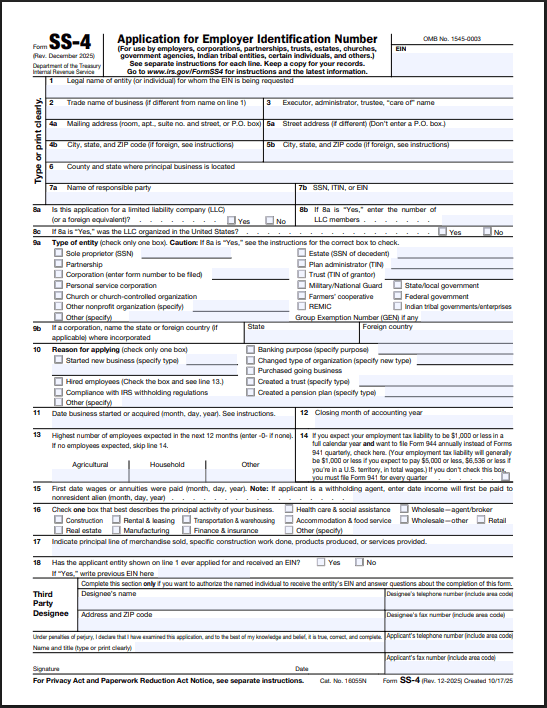
- EIN without an SSN: The EIN comes from the IRS, not the state, using Form SS-4. The online application requires the responsible party to have an SSN or ITIN, so a foreign responsible party applies by fax or mail instead, entering “Foreign” where a taxpayer ID would go.
Processing takes longer than the online route, and the EIN is required before any US bank or payment processor will proceed.
- ITIN: An ITIN is a personal tax identification number, not a business one, and it is needed only when the individual has a US filing obligation of their own. Many non-resident owners of foreign-owned single-member LLCs never need one.
It is not a prerequisite for forming the LLC or obtaining the EIN.
- Registered agent and US address: Both states require a registered agent with a physical in-state address to receive legal and state correspondence. That address is for service of process and state mail.
- Banking and payments: Non-residents do open US business accounts, and institutions look for the formation documents, the EIN letter, an operating agreement, identification for beneficial owners, and a coherent explanation of the business and its expected activity.
- Operating agreement. Neither state requires filing one. For a single-member foreign-owned LLC it matters more than for most companies, not less, because it is the primary document evidencing that the entity is genuinely separate from its owner, and because banks and processors ask for it.
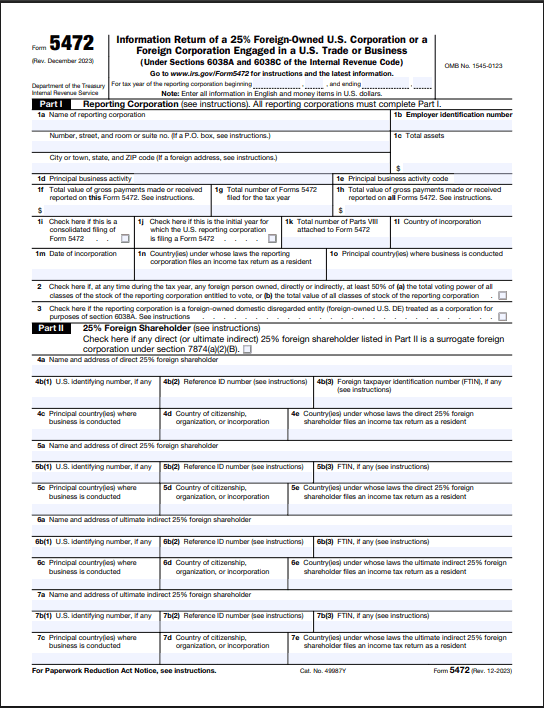
- Form 5472. This is the obligation most often missed and the most expensive to miss. A foreign-owned single-member LLC treated as a disregarded entity must file Form 5472 with a pro forma Form 1120 each year.
The penalty for failure to file is $25,000. It applies even when the LLC had no revenue, and even when no US tax is owed. A dormant foreign-owned LLC still files.
Is Either State Materially Easier For A Non-Resident?
No, procedurally. Both accept foreign members, both require a registered agent, both are formed remotely, and neither improves EIN or banking outcomes.
The verdict for a non-resident with no US physical presence therefore falls back to cost and public record, and both favor Wyoming: $100 and $60 a year against $425 and $350, with ownership kept out of the searchable state record.
The state barely matters for a non-resident. The EIN route, the operating agreement, the banking file, and Form 5472 are what determine whether the company works, and the $25,000 Form 5472 penalty dwarfs every fee on this page.
Can I Move My Nevada LLC to Wyoming?
Yes, you can move your Nevada LLC to Wyoming. Nevada’s carrying cost is $350 a year. Wyoming’s is $60. The annual saving is $290.
In Wyoming, you need to file with the Wyoming Secretary of State, which moves the entity’s home state while preserving its original formation date, its EIN, and its legal identity.
Wyoming charges $100 for the domestication filing. Nevada requires a dissolution filing to close out the entity there.
Certified copies from Nevada add a small fee. Handled independently, the one-time cost lands in the low hundreds; handled through a professional service, closer to $450 to $700.
At the low end the move pays for itself inside the first year. At the high end, at $290 saved annually, break-even is roughly two to two and a half years.
The risks are not in the filing fees, but in banking. An entity’s state of formation is part of its KYC file, and changing it can trigger re-verification, document requests, or in some cases a new account, with an interruption in the middle.
Payment processors run the same re-verification. Contracts naming the entity by state may need assignment or amendment, and any state registrations, sales tax permits, or industry licenses tied to the Nevada entity need updating.
Dissolving in Nevada and forming fresh in Wyoming is the alternative, and it is usually the worse one, because it forfeits the formation date and the entity’s history and generally means a new EIN, a new bank account, and a new processor application from zero.
One Case Where The Move Solves Nothing
When an owner whose Nevada LLC actually operates in a third state, redomesticating to Wyoming replaces a Nevada carrying cost with a Wyoming one and leaves the home-state foreign qualification, home-state annual report, and home-state tax exactly where they were.
The nexus problem is upstream of the formation state and moving the formation state does not touch it.
The switch saves $290 a year and breaks even in roughly one to two and a half years depending on how it is handled. Banking disruption, not filing cost, is the reason to plan it rather than rush it.
Final Verdict: Should You Choose Wyoming or Nevada?
If you operate from a physical location in one state, form there.
Not Wyoming, not Nevada. Foreign qualification will add a second set of fees and filings to home-state obligations that were never reduced. Stop optimizing the formation state and spend the attention on bookkeeping instead.
If you are a non-US resident with no US physical presence, choose Wyoming.
It costs $325 less in year one and $1,485 less over five years, it keeps ownership out of the searchable state record, and it requires one annual filing instead of two. Nothing in Nevada’s higher price corresponds to anything this entrepreneur receives.
If you already hold a Nevada LLC and operate elsewhere, run the redomestication math above.
$290 a year saved, break-even in roughly one to two and a half years, with banking continuity as the thing to plan around.
An LLC owner actually operating in Nevada should form in Nevada, and for that entrepreneur the $350 is simply the cost of doing business at home rather than a premium.
Someone who has already built banking and processor relationships around a Nevada entity may find that $290 a year is a fair price for not disturbing them.
Otherwise, for the great majority of entrepreneurs, Nevada’s premium has no major upside.
How doola Handles Either State

The disclosure at the top of this page holds: doola forms LLCs in all 50 states, so nothing above is written to sell you Wyoming.
- If the verdict pointed you to Wyoming, doola files the Articles of Organization, provides the registered agent, and tracks the annual report deadline so the entity doesn’t slip into delinquency.
- If it pointed you to Nevada because you actually operate there, the same applies to the Annual List and the State Business License renewal.
- If it pointed you back to your home state, doola files there too.
For non-US founders, the formation filing is the easy part. doola obtains the EIN from the IRS without an SSN or ITIN, sets up a US business address, supports the bank account application, and handles the federal and state returns a foreign-owned single-member LLC is required to file.
State filing fees are paid to the state. doola’s service pricing is separate →
FAQs

Is Wyoming or Nevada better for an LLC?
For most founders, Wyoming is better than Nevada for an LLC. It costs $100 to form and $60 a year against Nevada’s $425 and $350, requires one annual filing instead of two, and does not publish members or managers in state records.
Nevada is the better choice only for founders who actually operate in Nevada.
Why do people form LLCs in Wyoming instead of Nevada?
Founders usually choose Wyoming instead of Nevada for their LLCs because Nevada costs more now.
Nevada added a $200 State Business License and a $150 Initial List of Managers after 2009, which pushed formation to about $425 and annual maintenance to $350.
Nothing in either state’s LLC law changed to favor Wyoming; the cost gap opened and stayed open.
How much does it cost per year to maintain a Wyoming LLC vs a Nevada LLC?
Wyoming costs $60 a year, the minimum annual report license tax for LLCs with $300,000 or less in Wyoming assets.
Nevada costs $350 a year: $150 for the Annual List of Managers plus $200 for the State Business License renewal.
Registered agent service is extra in both states.
Do I have to pay taxes in my home state if my LLC is in Wyoming or Nevada?
Yes, forming in Wyoming or Nevada does not change where a business owes tax or must register.
Operating from a home state triggers foreign qualification there, meaning a second set of filing fees, annual reports, and registered agents, with no reduction in home-state tax.
Which state offers more privacy for LLC owners, Wyoming or Nevada?
Wyoming, on state public records: it does not name members or managers in public filings, while Nevada publishes managers through its Initial and Annual List.
On federal beneficial ownership reporting the states are identical, and neither provides anonymity from courts, the IRS, or banks.
Can a non-US resident form a Wyoming or Nevada LLC without an SSN?
Yes, a non-US resident can form an LLC without an SSN in Wyoming or Nevada. Neither state requires US citizenship, residency, or an SSN.
The EIN is obtained from the IRS on Form SS-4 by fax or mail when the responsible party has no SSN or ITIN. A registered agent with a physical in-state address is required in both states.
Does Nevada still have better asset protection?
No, Nevada does not offer better asset protection. Charging order protection is comparable in both states and Nevada’s advantage is narrative rather than statutory.
Single-member LLCs face similar uncertainty in each. Veil-piercing risk comes from commingled funds and undercapitalization, not from the state of formation.
Nevada LLC or Wyoming LLC, which should I pick if I run an online business from outside the US?
Choose Wyoming. With no US physical presence, no third state has a claim, so the decision rests on cost and public record, and
Wyoming wins both: $340 versus $1,825 over five years, and no members or managers named in state filings.