

Someone in your founder group chat probably already told you: “Just go with Delaware.” It was likely the guy who just raised a $2M seed round or a formation site that assumes every business is three months away from a YC demo day.
Because this “always Delaware” advice carries so much weight in tech circles, you end up digging through forum threads at midnight, trying to figure out if the Wyoming vs. Delaware LLC debate actually applies to your situation.
The reality? It almost certainly doesn’t.
That “go with Delaware” playbook was written strictly for venture-backed startups chasing institutional capital, hiring specialized legal teams, and relying on Delaware’s Court of Chancery. When applied to a bootstrapped operation, picking Delaware over Wyoming just means signing up for a $400 annual franchise tax bill and heavy corporate governance tools you’ll never use.
Once you look past the hype, the decision boils down to one direct question:
Are you taking institutional money, or running a lean, cash-flowing business?
If your business leans toward outside funding, Delaware remains the default choice for three specific reasons:
- VCs and angel investors often require a Delaware entity as a condition for signing a check.
- It makes converting to a C-Corp much simpler down the road when issuing institutional equity.
- It gives you access to centuries of well-established corporate case law for complex investor structures.
On the other hand, if you’re building without outside investors, the dynamic changes entirely in Wyoming’s favor. We’ll get to that in the next section.
Here is what this guide will cover to help you pick the right state:
- The VC Exception: Why Delaware dominates institutional fundraising (and when it matters to you).
- The Bootstrapper Advantage: How Wyoming slashes overhead, fees, and privacy risks.
- The Direct Comparison: A feature-by-feature breakdown of costs, taxes, and protection.
- The Founder Rule: How to decide right now, and why you can always change your mind later.
Wyoming vs Delaware LLC: At a Glance
Delaware vs Wyoming: Best LLC State for Non-Residents?
What Do You Actually Get With a Wyoming LLC?
Wyoming’s pitch to founders is simple: low costs, minimal administrative headaches, and zero state income tax. Once filed, it demands very little beyond keeping your annual report current.
Here are the key low-friction benefits:
- Low Filing Fee: A flat $100 fee paid directly to the Wyoming Secretary of State.
- Zero State Income Tax: No corporate or personal state income taxes to worry about.
- Minimal Formalities: No state requirement to publicly file operating agreements or member lists.
- Simple Maintenance: Just one $62 Annual Report required each year to stay in good standing.
Is Wyoming LLC Privacy Actually Anonymous?
Short answer: No, not completely.
While Wyoming is famous for owner privacy, it’s critical to understand where those protections actually end.
Wyoming doesn’t require member or manager names on the official Articles of Organization, keeping your personal details out of searchable state databases. However, this isn’t total untraceable anonymity:
- Federal Mandates: Banks, tax authorities, and federal registries still require full beneficial ownership disclosures.
- Public Record Shielding: Neither Wyoming nor Delaware requires member names on standard formation documents (Articles of Organization or Certificate of Formation).
- The Agent Paper Trail: In both states, your registered agent must keep identifying details and contact info on file, which can be legally subpoenaed by courts or law enforcement.
As highlighted by business advisors in the Forbes Business Council, Wyoming appeals to non-US founders primarily because it keeps personal details off public search engines. However, this is a public privacy shield, not complete anonymity from government oversight or tax reporting.
The Federal Baseline: CTA & FinCEN Update
Privacy claims were further equalized at the federal level:
On March 26, 2025, FinCEN removed Beneficial Ownership Information reporting for US-formed companies under the Corporate Transparency Act on an interim basis, and on August 11, 2026, made that exemption permanent.
What this means for founders: A new Wyoming or Delaware LLC no longer has to file beneficial ownership information with FinCEN, removing one federal compliance requirement from both options.
But this does not make either state fully anonymous or eliminate their state-level privacy differences. Banks, registered agents, tax authorities, and other institutions may still require owner information, while what appears in public state records continues to depend on the state.
Crypto or DAO Business: Wyoming Has a Real Head Start
While Delaware dominates traditional corporate law, Wyoming has established itself as the premier U.S. jurisdiction for digital asset companies, Web3 protocols, and crypto-adjacent businesses.
In 2021, it enacted the Decentralized Autonomous Organization Supplement, the first state to let DAOs organize formally as LLCs.
What this means for you as a founder:
- Digital Asset Classification: Wyoming explicitly recognizes virtual currencies as intangible personal property under commercial law, giving crypto businesses and holding LLCs clear statutory rights regarding asset ownership and custody.
- DAO & DUNA Legal Wrappers: Wyoming passed groundbreaking legislation allowing Decentralized Autonomous Organizations to form as official DAO LLCs or Decentralized Unincorporated Nonprofit Associations (DUNAs). This grants on-chain communities real corporate liability shields without sacrificing decentralized governance.
- State-Backed Crypto Infrastructure: From special banking charters (SPDIs) to launching its own state-backed stablecoin (WYST), Wyoming actively builds public-private rails for digital asset operations rather than imposing regulatory friction.
What Are You Really Paying For With a Delaware LLC?
Delaware isn’t trying to win on price, it’s selling predictability, prestige, and institutional trust. And, VCs don’t insist on Delaware because it’s cheap; they insist on it because it eliminates legal surprises.
So, here is what that extra money is actually buying instead:
- The Court of Chancery: Business disputes aren’t decided by a general jury that might get confused by complex equity structures. They’re handled solely by specialized judges who are experts in corporate law, leveraging a massive body of legal precedent so lawyers can easily predict outcomes.
- Contractual Flexibility: Delaware gives founders and members extensive freedom to structure internal management, governance, and economic rights however they see fit.
- Investor Familiarity: Angel syndicates and VC firms have standard legal templates built specifically for Delaware entities, which drastically cuts down legal overhead during a fundraise.
- Seamless Growth: If you need to convert your LLC into a Delaware C-Corp to issue stock options or close a priced round, the process is streamlined and routine.
The Price of That Protection
That institutional clout comes with recurring costs you can’t skip, even if your business makes zero revenue:
- Annual Franchise Tax: Effective under House Bill 400, Delaware’s annual tax is $400, due every year by June 1st (no separate annual report required).
- Registered Agent Fees: Delaware mandates an in-state registered agent with a physical local address, adding another $50 to $150 annually.
- State Business License: If your company conducts actual business operations inside Delaware, the Delaware Division of Revenue requires a state business license (generally starting at $75/year for a first location), which isn’t automatically granted just by forming an LLC.
- Out-of-State Foreign Qualification: If you operate in another state (like California or New York), you’ll still have to register and pay taxes there as a “foreign entity,” effectively doubling your compliance paperwork.
Did You Know? Big Companies Are Leaving Delaware. Here’s Why!
Delaware’s reputation took a real hit over the last two years, and it’s worth knowing the story before treating Delaware as a safe choice.
Since 2024, a trend nicknamed “DExit” has picked up real momentum. Tesla and SpaceX reincorporated from Delaware to Texas in 2024; Coinbase followed to Texas in 2025, while Dropbox and TripAdvisor moved to Nevada.
Roughly 60 public companies have changed incorporation since January 2024 per tracked reincorporation data, but the names are prominent enough to shift the conversation.
The “DExit” Phenomenon: What It Actually Means for Founders?
1. For Bootstrapped & Small Businesses: It Changes Zero
“DExit” is strictly a high-stakes litigation story for massive public corporations and mega-fund managers dealing with shareholder governance battles.
If you are running a bootstrapped SaaS, agency, or digital business, large-scale boardroom disputes do not impact your daily operations. Your decision still comes down strictly to maintenance costs and state taxes.
2. For VC-Track & Venture Startups: Delaware Remains the Default
Despite the headlines, institutional venture capital firms and angel syndicates still heavily prefer Delaware for early-stage investments. Its corporate framework is deeply baked into standard legal templates and investor workflows.
Unless your board specifically directs you otherwise, Delaware remains the default choice for venture fundraising.
Is Delaware Overkill If You’re Not Raising VC Money?
If you aren’t raising venture capital, Wyoming wins on low friction and cost. Here is why:
- Minimal Overhead: Wyoming charges a $62 annual report fee versus Delaware’s $400 flat annual franchise tax plus registered agent fees.
- Strict Privacy: Wyoming keeps member and manager names off public record databases.
- Asset Protection: You get top-tier charging-order protections without Delaware’s premium ongoing price tag.
Wyoming vs Delaware LLC: Decision Framework
Here is the filter that settles the debate for most founders upfront:
Wyoming LLC vs. Delaware LLC: The Myths Around Both States
Here are some of the most common myths around Wyoming LLCs and Delaware LLCs, along with what they actually mean for a non-resident founder.
The Stripe & PayPal Myth: Will a Wyoming LLC Get You Shadowbanned?
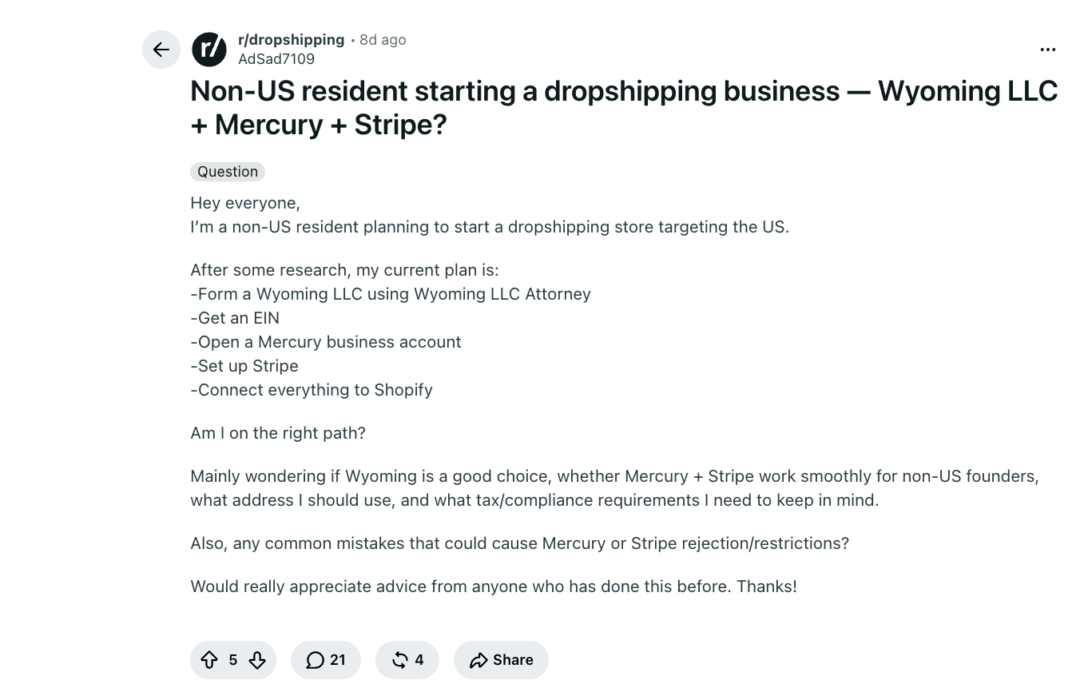
There is a persistent rumor among international founders that payment processors somehow distrust Wyoming LLCs, while a Delaware address gives a business a cleaner path to Stripe or PayPal.
There is no published Stripe or PayPal rule supporting that idea.
Stripe’s verification requirements focus on whether the business and the people behind it can be verified. For a US business, the legal name and tax ID entered with Stripe need to match IRS records exactly.
If Stripe cannot verify that information automatically, it may ask for IRS documentation such as the EIN confirmation letter or Letter 147C, along with documents that verify the business, its address, and the people connected to it.
PayPal follows a similar pattern.
Its US verification process can require government-issued identification, proof of residential address, proof of the business address, business registration documents, and proof of the company’s EIN or TIN. PayPal also collects information about beneficial owners and controlling individuals for legal-entity accounts.
So, a Wyoming LLC is not automatically “shadowbanned” because of the state printed on its formation documents. Problems are more likely to arise when information cannot be verified or does not match across records.
For example, founders can run into trouble when:
- The legal business name entered with Stripe does not exactly match IRS records.
- The EIN cannot be verified with acceptable IRS documentation.
- The business or residential address cannot be verified.
- Beneficial-owner information is incomplete or inconsistent.
- The business model falls into a restricted or higher-risk category.
- The processor asks for additional documents and the business cannot provide them.
The same warning applies to the idea that forming in Delaware will unlock Stripe. Stripe Atlas happens to form companies in Delaware, but that should not be confused with a general Stripe approval advantage for every Delaware LLC.
The Delaware Banking Myth: Will Banks Trust You More Just Because You Formed in Delaware?
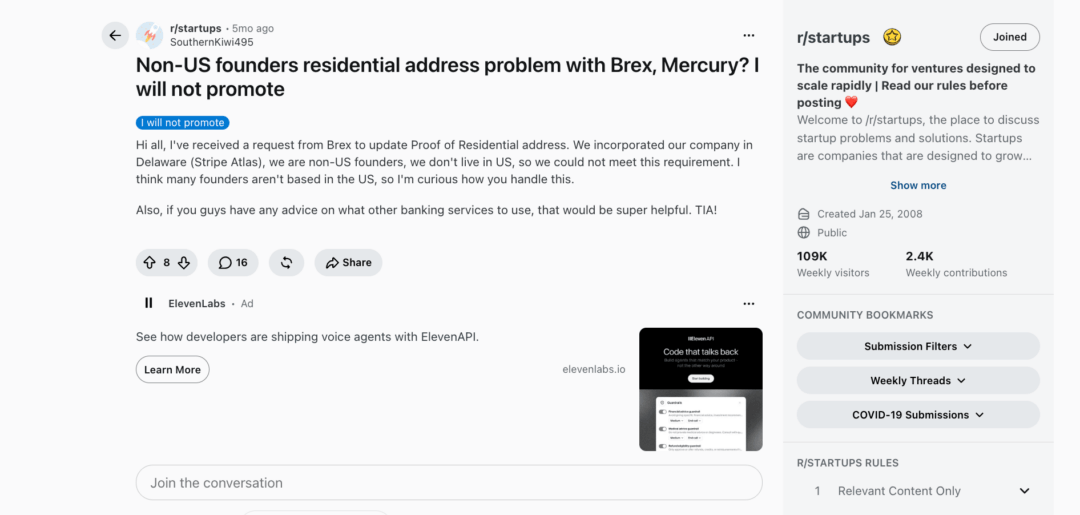
Delaware has one of the strongest business-law reputations in the United States. That reputation does not mean a Delaware LLC automatically jumps to the front of the line when applying for a US business bank account.
Mercury supports US-registered companies founded by people living outside the United States. Its published eligibility requirements focus on the company’s legal registration, business activity, existing or planned US operations, ownership, founder location, and address.
It does not state anywhere that a Delaware entity receives preferential approval over a Wyoming entity.
For documentation, Mercury asks US businesses for state-filed formation documents and IRS-issued EIN evidence. Accepted EIN documents include CP 575, Letter 147C, or the IRS-returned version of Form SS-4. International founders can use a passport for identity verification.
Address quality matters too. Mercury says a company’s principal place of business can be in the US or abroad, but it does not accept a registered agent address, PO box, or UPS Store address as the principal operating address. It may also ask for documents proving where the company or its owner actually operates.
A bank or fintech can still want to know:
- Who actually owns and controls the company
- Where that person lives
- Where the business operates
- What the company sells
- Where its money comes from
- Whether it has legitimate US operations or plans
- Whether its formation and IRS records match the application
When banking is the concern, the better question is whether the founder can satisfy the bank’s actual eligibility, KYC, documentation, address, and business-activity requirements.
Wyoming vs Delaware LLC: What’s the Real Cost Over 5 Years?
All figures reflect official state filing fees and standard third-party registered agent costs verified as of September 2026. Fees are subject to change by state legislatures. Total 5-year calculations assume standard maintenance without optional expedited fees, localized home-state foreign qualification, or industry-specific licensing.
Registered agent pricing is a third-party estimate, not a state fee. This assumes Wyoming’s $60 minimum, which applies to LLCs with $300,000 or less in Wyoming-based assets per the Wyoming SOS fee schedule, and excludes optional add-ons on either side.
Delaware becomes materially more expensive for one simple reason: its $400 annual tax runs roughly six-and-a-half times Wyoming’s $60 minimum, compounding every year regardless of revenue or activity.
doola’s Verdict
For a bootstrapped or single-state business, Wyoming’s lower maintenance costs win clearly. Delaware’s higher price tag can still make sense, but only when its specialized court system or investor familiarity directly serve your strategy, not when chosen by default.
The Hidden Cost: Ongoing Compliance
State filing fees are only half the equation. Most founders severely underestimate the time and operational cost required to keep an entity compliant year after year:
- Setup Overhead: Getting a physical registered agent address, filing Articles of Organization, and securing an EIN.
- Banking & Operations: Tying your EIN and corporate documentation to a functional US business bank account.
- Deadline Tracking: Keeping up with annual report filings, franchise tax deadlines, and state notices to avoid losing good standing.
This ongoing burden is precisely where a formation service like doola can help. By bundling your registered agent, EIN retrieval, and compliance calendar into one automated dashboard, you can eliminate the friction of juggling multiple third-party vendors with doola.
Why It Matters Even More for Non-US Founders
If you’re operating from abroad, the operational friction multiplies fast:
- No US SSN: Applying for an IRS EIN without a Social Security Number requires specific manual processing.
- Remote Banking: Setting up US business banking and payment processors (like Stripe or PayPal) from another country requires precise corporate verification.
- Cross-Border Compliance: Managing annual filings across time zones and foreign tax reporting regulations creates risk if left unmanaged.
Ultimately, the real friction of running a US LLC isn’t the initial state fee, it’s staying compliant post formation.
The Foreign Qualification Trap: Will You Owe Fees in Two States?
Neither state exempts you. Whether you form a Wyoming LLC or a Delaware LLC, forming out-of-state does not give you a pass on registering where your business actually operates day-to-day.
If your LLC is “transacting business” in your home state, meaning you have a physical office, local employees, or regular local operations, your home state legally requires you to file for a Foreign Qualification.
A Common (and Expensive) Founder Mistake
Suppose you live and run your business in California, but form a Wyoming LLC to save money. Because your daily physical operations happen in California, you are required to register your Wyoming LLC as a foreign entity in California.
Instead of saving cash, you just doubled your compliance stack. For example:
- Two Filing Fees: Initial state formation in Wyoming + Foreign LLC Certificate of Authority in California.
- Two Registered Agents: A local registered agent required in Wyoming and another in California.
- Two Annual Tax Bills: Wyoming’s $62 annual report + California’s $800 minimum annual franchise tax.
The Takeaway for Wyoming vs. Delaware LLC Compliance
While exact definitions of “doing business” vary by state law, the core lesson remains constant: a cheap state on paper becomes expensive the moment you add a second state’s compliance layer.
How to Choose in 30 Seconds: Wyoming LLC vs Delaware LLC
Here is the direct bottom line, broken down by the actual type of business you’re running:
- Choose Wyoming if you are bootstrapped, a solo founder, or self-funded. If you don’t need venture capital or specialized business courts, Wyoming cuts out hundreds of dollars in unnecessary fees every year.
- Choose Wyoming if you run an e-commerce store, agency, or digital product where low ongoing maintenance ($62/year) and owner privacy are your top priorities, as long as your local setup doesn’t trigger foreign qualification in your home state.
- If you are a non-US founder: Non-US founders building cash-flowing online businesses lean toward Wyoming for low-friction compliance; those actively building for US venture funds pick Delaware.
- Choose Delaware if institutional fundraising or angel syndicates are in your near-term roadmap. Keep in mind, however, that institutional investors ultimately expect a Delaware C-Corp rather than a standard LLC.
- Choose Wyoming if you are building a DAO, token project, Web3 protocol, or crypto-adjacent company where state-backed digital asset statutes directly support your daily operations.
In the Wyoming vs Delaware LLC comparison, Wyoming wins for founders who prioritize lower overhead, straightforward compliance, and privacy. Delaware earns its higher price tag and spot only if you are actively raising venture capital or managing complex multi-founder equity.
Do Not Choose Either State Based Only On
- A promise of “zero US taxes.”
Wyoming has no state individual or corporate income tax, but that does not automatically make a foreign-owned LLC tax-free. Federal tax and reporting requirements depend on how the LLC is taxed, where its income comes from, and what transactions take place. Certain foreign-owned single-member LLCs may also need to file Form 5472, even when little or no US income tax is due. - Claims of complete anonymity.
A Wyoming LLC can offer useful public-record privacy, but “anonymous” does not mean the owner is invisible. The IRS requires the LLC’s responsible party to be identified when applying for an EIN, and banks and payment processors can require beneficial-owner and identity information as part of their verification process. - An unusually low formation price.
The number advertised at checkout is only one piece of the cost. Check what renews after the first year, including registered agent service, compliance packages, mail services, tax support, and filing assistance. Also separate the provider’s charges from fees actually required by the state. - The assumption that Delaware improves Stripe approval.
Forming in Delaware does not guarantee a Stripe account. Stripe verifies information such as the legal entity, EIN or other tax identification information, business address, owners or controllers, business activity, and overall risk before approving and maintaining an account. - The assumption that forming the LLC finishes the compliance work.
Getting the Articles of Organization and an EIN is the beginning, not the end of the filing calendar. Depending on the LLC’s ownership and activity, federal filings such as Form 5472 may still apply, alongside state annual obligations. Under the current FinCEN rules, US-created LLCs are exempt from BOI reporting, but that exemption does not eliminate other IRS or state requirements.
What About Nevada? The High-Roller Alternative
Nevada also comes up constantly in these founder searches for a simple reason: it aggressively markets itself as the ultimate tax-free, privacy-first sanctuary. It’s frequently pitched right alongside Wyoming and Delaware, and lately, it’s been scoring headlines as a prime “DExit” destination.
Other Considerations to Keep In Mind
- Business Size and Growth Plans: Smaller businesses benefit from Wyoming’s simplicity and low costs. Larger corporations may prefer Delaware for its legal and financial advantages.
- Industry Requirements: Delaware is ideal for industries like tech startups seeking venture capital. On the other hand, Wyoming’s tax benefits and privacy laws may better suit other industries.
- Long-Term Goals: Consider your long-term business goals, including potential expansions, investments, and exit strategies, to determine which state’s LLC formation aligns best with your vision.
In conclusion, both Wyoming LLC vs. Delaware LLC offer compelling benefits, but the better choice depends on your specific business needs, financial considerations, and strategic objectives.
Wyoming vs Delaware LLC: Common Questions, Answered by doola
- Is Delaware or Wyoming better for an LLC?
It depends entirely on your capital strategy. Wyoming suits bootstrapped founders, small businesses, and holding entities prioritizing low annual costs and owner privacy. Delaware fits venture-track startups planning to raise institutional capital or expecting complex multi-investor transactions.
- What is the main disadvantage of a Wyoming LLC?
Its legal framework is less familiar to institutional venture capitalists. If raising outside equity from Silicon Valley VCs is part of your near-term roadmap, a Wyoming entity may create unnecessary friction during investor due diligence.
- What are the disadvantages of a Delaware LLC?
Higher recurring overhead. Delaware charges a flat $400 annual franchise tax (compared to Wyoming’s $62 report fee), mandates an in-state registered agent, and requires a separate state business license if you conduct physical operations inside Delaware.
For a small business that never touches Delaware courts, you’re paying for legal machinery you’ll never use.
- Do I need to live in Wyoming or Delaware to form an LLC there?
No. Neither state requires owners or managers to reside locally, or even in the United States. However, both states legally require you to maintain a local registered agent with a physical state address.
- Does Wyoming actually protect my privacy as a business owner?
It protects your personal details from casual public search engines because member and manager names aren’t published on the state’s Articles of Organization.
However, your registered agent must still keep your beneficial ownership information on file, which remains accessible via formal legal subpoenas.
- Which state has lower long-term maintenance fees?
Wyoming, by a wide margin. Over five years, maintaining a Delaware LLC costs at least $2,000 in state franchise taxes alone, compared to just $310 total in Wyoming.
- Is it easier to raise capital with a Delaware LLC?
Not automatically. Venture capital investors overwhelmingly prefer a Delaware C-Corp over an LLC formed in any state.
Choosing Delaware as an LLC gives you a cleaner conversion path to a C-Corp later, but the LLC structure itself won’t make you more fundable on day one.
- Which state offers better asset protection for LLC owners?
Wyoming is renowned for its strong charging-order protections, which shield single-member LLC owners from personal creditors. Delaware relies on its deep, centuries-old Court of Chancery precedents to resolve internal owner and shareholder disputes.
- Do I still need to register in my home state if I form in Wyoming or Delaware?
Usually, yes. If your business has a physical location, employees, or regular local operations in your home state, that state requires you to register as a “foreign entity.” This adds a second layer of state filing fees, annual reports, and registered agent costs on top of what you already pay in Wyoming or Delaware.
- Are companies actually leaving Delaware?
A prominent but specific group is. Since 2024, roughly 60 major public corporations (including Tesla, SpaceX, and Coinbase) have reincorporated to states like Texas or Nevada following controversial Chancery Court rulings.
However, this is strictly a high-stakes corporate governance story, it does not alter the cost or operational math for a standard small-to-midsize LLC.
Launch Your LLC With doola

When weighing a Wyoming LLC vs. Delaware LLC, settling the debate is only the first step. Turning that choice into an operational business requires far more than a single filing.
From securing an in-state registered agent to acquiring an IRS EIN and keeping up with annual state deadlines, managing these moving parts on your own can quickly derail your focus.
doola brings everything into one seamless dashboard:
- End-to-End Formation: We handle your state filings in Wyoming, Delaware, or your home state.
- Complete Compliance: Registered agent service, EIN retrieval, and automated annual report tracking are built directly into your workflow.
- Global Access: Built specifically for both US and international founders who need a hassle-free way to run a bankable US business from anywhere in the world.