
![How to Pay International Contractors in [year]: Currency, Accounts, Taxes & Best Practices](https://doolastaging2.wpenginepowered.com/wp-content/uploads/2025/11/banner-cta-new.png "How to Pay International Contractors in [year]: Currency, Accounts, Taxes & Best Practices")
The Easiest Way to Start and Scale Your U.S. Business.



The modern entrepreneur doesn’t build locally. They build globally by default.
That said, hiring global talent has never been easier. A designer in Toronto, a developer in Warsaw, a marketer in Mumbai…all just a Zoom call away.
But while hiring itself is frictionless, paying international contractors correctly is not.
Cross-border payments introduce complexities most business owners don’t anticipate:
- Should I pay in USD or their local currency?
- What’s the best way to pay international contractors without burning cash on fees?
- Do I need tax forms? W-8BEN vs. W-8BEN-E: which one should I collect?
- Can I just send money from my personal account and sort it out later?
What business owners often miss is: one wrong move can result in unnecessary FX costs, messy bookkeeping, or tax compliance issues that surface during tax season or investor due diligence.
This doola guide breaks down how to pay international contractors the right way, covering currency decisions, payment platforms, tax documentation, and best practices that protect your business as you scale beyond borders.
And if you’re building a US entity while managing a global contractor network, doola handles the infrastructure: from entity formation and EIN to clean bookkeeping and compliance, so global payments power your growth instead of complicating it.
Why Currency Choice Matters When Paying International Contractors
When entrepreneurs think about international contractor payments, they often focus on how to send money. But just as important is what currency you’re sending it in.
That choice determines who carries exchange rate risk, how much you lose in hidden fees, how quickly payments settle, and how clean your books look at month-end.
Let’s break this down properly.
Paying in USD vs. Local Currency
Before sending your first cross-border payment, you need clarity on the currency framework. This isn’t something to “figure out later.” It should be part of your contractor onboarding process.
Let’s say you’re a US company paying:
- A Canadian contractor (operating a local Canadian business account), invoicing in CAD
- A European contractor billing in EUR and managing VAT obligations locally
- An Indian freelancer invoicing in INR and withdrawing into a domestic Indian bank
In each case, you essentially have two structured options:
| ✔️ Pay in USD, keeping your accounting denominated in your home currency and shifting conversion to the contractor’s bank
✔️ Pay in the contractor’s local currency, using a payment platform that converts funds before delivery |
That single decision affects multiple layers of your business operations, here’s how:
1. Contractor Satisfaction & Relationship Stability
Many international contractors prefer being paid in their local currency because it protects them from unpredictable exchange rate fluctuations.
If you pay in USD and the dollar weakens before conversion, they effectively earn less than expected. That creates uncertainty in income planning, especially for contractors working on tight margins.
Paying in USD shifts currency risk entirely onto the contractor. Paying in local currency signals operational maturity and consideration for global working norms.
2. FX Fees & Hidden Conversion Costs
These typically include conversion spreads (the markup between the real exchange rate and the rate you’re offered), transfer or platform fees charged for sending funds internationally, and receiving bank fees that may be deducted before the contractor gets paid.
Every cross-border transaction carries layered costs, even when they’re not obvious.
If you send USD directly via a traditional bank wire, the contractor’s bank usually handles the conversion at retail FX rates, which are often less favorable. The difference may look small (1–3%), but over recurring payments, it compounds significantly.
If you instead pay in local currency using a fintech platform with transparent exchange rates, you may reduce total conversion costs and control the FX markup on your side.
3. Settlement Delays That Disrupt Cash Flow & Trust
Traditional USD wire transfers often take 2–5 business days to settle.
In some cases, intermediary correspondent banks introduce additional delays, especially across certain regions. These delays can disrupt contractor cash flow and create friction around payment timelines.
Modern fintech platforms that process local currency payments frequently settle faster, sometimes within 24-48 hours, improving predictability and operational smoothness.
Who Should Bear FX Costs?
This is a very important yet overlooked aspect and should be clarified in detail in your contractor agreement.
Your contracts should clearly specify how currency conversion costs are handled.
Typically, there are 3 models:
- The company absorbs all FX and transfer fees, ensuring the contractor receives the full invoiced amount.
- The contractor absorbs conversion costs, meaning they receive the net amount after currency conversion.
- Both parties agree to split the impact, often by setting a slightly adjusted rate to account for average spreads.
Any ambiguity in this area creates unnecessary confusion, delayed payments, and strained contractor relationships.
When to Pay in USD
If your company maintains accounting records in USD and wants simplified reconciliation, paying contractors in USD can reduce bookkeeping complexity.
USD payments may also make sense when payments are irregular or project-based, where short-term FX swings are less likely to materially impact the contractor’s income.
It can also provide pricing stability in long-term contracts denominated in USD, particularly if both parties agree upfront to lock rates in dollars.
When to Pay in Local Currency
Paying in local currency often makes more sense when contractors explicitly request it or when you’re making large recurring monthly payments.
If you’re paying a contractor $5,000 USD monthly and exchange rates fluctuate by 3–4%, that could mean a meaningful income difference month to month. Converting upfront into the contractor’s home currency can eliminate uncertainty and strengthen retention.
Local currency payments also reduce friction in contractor budgeting and can prevent uncomfortable renegotiations if exchange rates shift dramatically.
Example: USD vs CAD in Practice
Let’s say a US LLC hires a Canadian contractor at a rate equivalent to 6,500 CAD per month.
At an exchange rate of 1 USD = 1.30 CAD, that equals approximately $5,000 USD.
But if the USD weakens and the rate moves to 1 USD = 1.25 CAD, your $5,000 USD payment now converts to only 6,250 CAD.
That’s a 250 CAD shortfall in the contractor’s expected monthly income; purely due to currency fluctuation.
Over 12 months, that’s 3,000 CAD in lost income from the contractor’s perspective.
To prevent this, the US company may choose to pay a fixed 6,500 CAD monthly instead. In that case, if the exchange rate shifts, the company absorbs the fluctuation. However, the contractor receives predictable income.
That predictability often outweighs minor FX differences, especially in long-term working relationships.
Best Ways to Pay International Contractors: Tools & Methods
There’s no universal “best” way to handle international contractor payments.
The right solution depends on your monthly payment volume, the countries you operate in, your tolerance for FX fees, and how much operational complexity you’re willing to manage.
Here’s a breakdown of the tools entrepreneurs use and where each option fits:
1. Wise: Early / Growth-Stage Entrepreneurs Managing Multiple Currencies

Wise is one of the most founder-friendly platforms for cross-border payments. It offers real exchange rates (mid-market rates) with a clearly displayed fee before you send money. Businesses can hold and convert funds in multiple currencies within one account.
Pros
✔️ Transparent FX rates: Wise shows the real exchange rate and its exact fee upfront, helping you avoid hidden spreads.
✔️ Lower conversion costs: Fees are typically lower than traditional banks, which makes a meaningful difference on recurring monthly payments.
✔️ Multi-currency accounts: You can hold USD, EUR, GBP, and more in one place, useful if you collect revenue globally and pay contractors in different regions.
✔️ Automation-friendly: Ideal for recurring contractor payments, reducing manual processing each month.
Cons
❌ Not available in every country: Some regions have restrictions, which may limit contractor coverage.
❌ Transfer limits in certain corridors: Large transfers may trigger additional verification.
For business owners managing global teams, Wise often strikes the best balance between cost efficiency and operational simplicity.
2. PayPal: For Small, Occasional Contractor Payments

PayPal is widely recognized and easy to use, which makes it appealing for quick contractor payments. Many freelancers already have PayPal accounts, so onboarding is simple.
Pros
✔️ Widely accepted globally: Most freelancers already use it, reducing onboarding friction.
✔️ Easy setup: You can start sending payments quickly without complex documentation.
✔️ Integrated invoicing features: Contractors can send PayPal invoices directly through the platform.
Cons
❌ Higher FX spreads: Currency conversion margins can be significantly higher than fintech competitors.
❌ Additional receiving fees: Contractors may receive less than expected due to platform deductions.
❌ Risk of account holds: In certain cases, PayPal may freeze accounts pending review, which can disrupt payment continuity.
Overall, PayPal is convenient, but not always cost-efficient at scale.
📌 Looking to set up PayPal Payments? PayPal Payments Set-up for US and Non-US Founders
3. Payoneer: For Companies Working With Freelancers
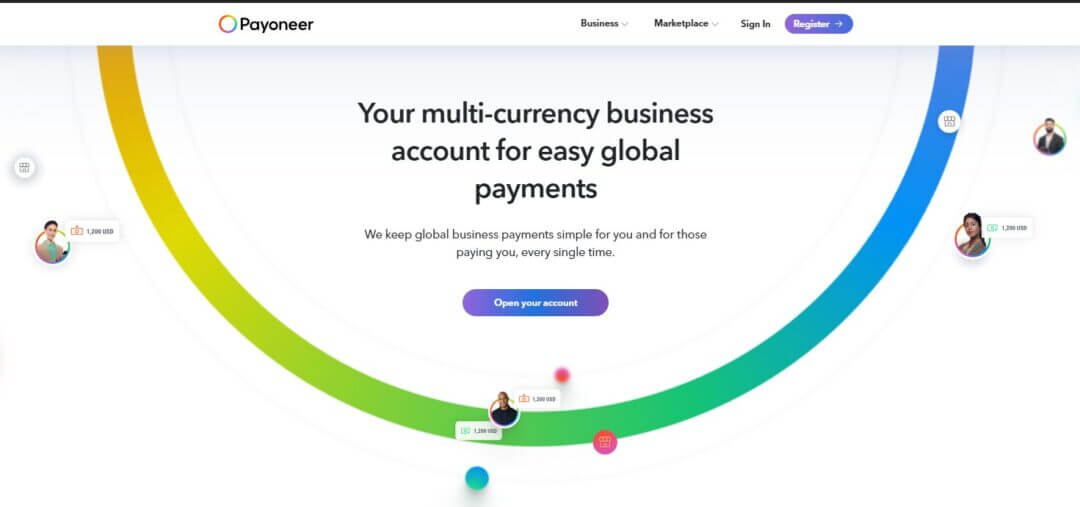
Payoneer focuses heavily on global contractor ecosystems and marketplaces. It’s commonly used in emerging markets where traditional banking infrastructure may be less seamless.
It is ideal for companies working with freelancers across Asia, Africa, Latin America, and Eastern Europe.
Pros
✔️ Contractor-friendly infrastructure: Many international freelancers already use Payoneer for global clients.
✔️ Strong emerging market coverage: Useful for regions where other fintech platforms have limitations.
✔️ Multiple withdrawal options: Contractors can withdraw to local bank accounts or prepaid cards in some countries.
Cons
❌ Fee variability by region: Costs can differ significantly depending on geography and withdrawal type.
❌ Less transparent FX spreads compared to Wise: Rates may not always reflect mid-market exchange rates.
For geographically diverse contractor bases, Payoneer can improve accessibility, but business owners should monitor fee impact carefully.
4. Direct Wire Transfers: Large, Infrequent Payments

Wire transfers move funds directly from your bank to the contractor’s bank via the SWIFT network. They are secure but often expensive and slower compared to fintech alternatives.
Traditional bank wire fees typically range from $25–$75+ per transfer, plus intermediary bank charges.
Note: Fee details vary by institution; for example, many major US banks list international wire fees on their public fee schedules.
Pros
✔️ Direct bank-to-bank settlement: High perceived security and institutional reliability.
✔️ Suitable for large transfers: Often preferred for six-figure or high-value transactions.
Below is an example of how a single customer credit deposition looks via direct SWIFT transfer.
![How to Pay International Contractors in [year]: Currency, Accounts, Taxes & Best Practices](https://www.doola.com/wp-content/uploads/2026/03/image-1.png "How to Pay International Contractors in [year]: Currency, Accounts, Taxes & Best Practices")
Cons
❌ High flat fees: $25–$75+ per transfer quickly adds up for recurring monthly payments.
❌ Intermediary bank deductions: Contractors may receive less than expected due to correspondent bank charges.
❌ Slower processing times: Settlement can take several business days, especially across multiple banking systems.
For recurring monthly contractor payments, wires are often inefficient.
Key Takeaway for Entrepreneurs
Selecting the best way to pay international contractors requires evaluating your operational realities. So, make your decision based on:
Monthly payment volume: Higher volume justifies investing in lower FX spreads and automation.
Number of countries involved: The more regions you operate in, the more valuable multi-currency support becomes.
Sensitivity to FX costs: Even a 1–2% difference compounds significantly over time.
Contractor preference & accessibility: The best system is the one both sides can reliably use.
As your company scales, fragmented payment methods create accounting complexity. What works for three contractors breaks at thirty.
Wondering what doola can help you out with. Explore our services and get started today.
Business Account vs. Personal Account: What Business Owners Must Know
One of the most damaging mistakes business owners make when paying international contractors is using their personal bank account “just for now.” It may feel harmless in the early days, especially when cash flow is tight or systems aren’t fully set up.
But when it comes to business payments, especially cross-border contractor payments, one thing is non-negotiable:
Never pay international contractors from your personal account.
This isn’t about preference. It’s about legal protection, tax compliance, and long-term scalability.
Why a Business Account Is Critical
A dedicated business bank account is the strongest financial infrastructure your company can have. It establishes financial discipline, reinforces legal separation, and creates compliance clarity from the beginning.
Here’s why it matters for entrepreneurs:
✔️ Clean bookkeeping: When all contractor payments flow through your business account, expense tracking becomes straightforward. Reconciliation is faster, and your accounting software can accurately categorize and match transactions without manual guesswork.
✔️ Clear separation for liability protection: If you operate a US LLC or C-Corp, maintaining separation between personal and business finances helps preserve limited liability protection.
Commingling funds can weaken that protection and expose personal assets in legal disputes.
- Easier audits and due diligence: Whether it’s a tax audit or investor review, organized financial records signal operational discipline. Separate accounts make it easier to prove that expenses are legitimate business costs.
- Simpler tax filing: During tax season, your accountant shouldn’t have to sift through personal grocery purchases to find contractor payments. A business account streamlines reporting and reduces the risk of misclassification.
- Professional credibility: Paying contractors from a branded business account enhances trust. It indicates that they’re working with a structured company, not an informal side project.
When this structure is missing, the risks compound quickly, and that’s exactly what happens when business owners rely on personal accounts.
Risks of Using Personal Accounts
Using a personal account for business payments may seem convenient in the short term, but it creates compounding risks.
Here’s what entrepreneurs often underestimate:
❌ Messy expense tracking: Personal and business transactions become intertwined, making accurate reporting time-consuming and error-prone.
❌ Commingling funds (legal risk): Mixing personal and business money can jeopardize the legal separation of your entity, particularly for LLCs and corporations.
❌ Disallowed deductions: If you can’t clearly demonstrate that payments were business-related and properly documented, deductions may be challenged.
❌ Scrutiny during audits or banking reviews: Inconsistent transaction patterns between personal and business accounts can raise compliance concerns with banks, investors, or regulators.
If you’re operating a US business, keeping finances separate is integral to protecting your entity and preserving limited liability.
Otherwise, scaling becomes chaotic when your Stripe revenue lands in your business account, but contractor payments leave from your personal savings.
Reconciliation, in such cases, turns into a spreadsheet nightmare. And your tax reporting becomes “reactive” instead of “structured”.
Invoices, Expenses & Record-Keeping for Global Payments
International transactions introduce currency conversions, multi-jurisdiction considerations, and additional documentation requirements. And remember:
If you can’t prove it, you can’t deduct it.
Without proper records, what should be a straightforward business expense can quickly turn into a compliance headache during tax season, or worse yet, during an audit or investor review.
So, clean documentation isn’t just about staying organized. It protects your deductions, strengthens financial reporting, and ensures your global payments hold up under scrutiny.
Let’s now start with the foundation: the invoice.
What Every Contractor Invoice Should Include
Before you send payment, make sure the invoice itself meets basic documentation standards. A compliant invoice, for that matter, is the paper trail that supports your deduction.
Every contractor invoice should clearly include:
- Contractor name & address: The full legal name and business or residential address of the contractor, matching your agreement and tax documentation.
- Description of services: A clear explanation of what work was performed, not vague labels like “consulting,” but specific services tied to your business activity.
- Invoice date: The date the invoice was issued, which helps determine reporting periods and reconciliation timing.
- Payment amount: The exact amount due, including whether it reflects gross compensation before fees.
- Currency: The currency in which the invoice is denominated (USD, CAD, EUR, INR, etc.), which is critical for accurate accounting.
- Payment terms: Due date, late payment terms (if any), and agreed method of payment.
A structured invoice protects both you and the contractor. It creates clarity, alignment, and an audit-ready trail from day one.
Recording International Payments
Once the invoice is in order, the next step is proper bookkeeping, especially when foreign currency is involved.
When paying in foreign currency, make sure to:
- Record the expense in USD (for US entities): Even if the invoice is issued in another currency, US companies must report expenses in USD for tax purposes.
- Use the exchange rate on the payment date: The conversion rate applied on the actual payment date determines the deductible amount.
- Track FX gains or losses if material: If exchange rates fluctuate between invoice issuance and payment, the difference may create a small foreign exchange gain or loss that should be properly categorized.
Manual tracking may work at the beginning, but as payments increase, you’ll need automation tools. Accounting platforms help maintain consistent, up-to-date bookkeeping year-round to prevent the last-minute scramble that many business owners experience during tax season.
With doola’s bookkeeping and accounting support, your records stay organized continuously, so international contractor payments don’t turn into year-end chaos.
Founder Checklist for Global Contractor Payments
Before considering a payment fully complete, business owners should ensure they’ve covered every compliance touchpoint.
Here’s a simple operational checklist you need to screenshot and save right away:
| Item | Why It Matters |
| Signed contractor agreement | Establishes scope of work, payment terms, and FX responsibility. |
| Proper invoice on file | Serves as primary documentation supporting the expense deduction. |
| Payment confirmation | Verifies funds were transferred and received as agreed. |
| FX rate documentation | Supports accurate USD reporting and explains conversion differences. |
| Tax forms collected (if required) | Confirms foreign status and proper tax treatment (e.g., W-8BEN). |
This is what structured financial discipline looks like. And when your documentation, payments, and books are aligned, you’re not reacting to tax season, you’re prepared for it well in advance.
Tax & Compliance Considerations (What Most Entrepreneurs Miss)
Many entrepreneurs assume that because a contractor lives outside the United States, there are no US reporting obligations.
In reality, the IRS still expects proper documentation, classification, and record-keeping.
Here are the key areas entrepreneurs frequently overlook:
1. W-8BEN & W-8BEN-E Forms (Foreign Status Documentation)
If you’re operating a US entity and paying non-US contractors, you should collect the appropriate IRS form before issuing payment:
✔️ Form W-8BEN (for individuals): W-8BEN is completed by foreign individual contractors to certify their non-US status.
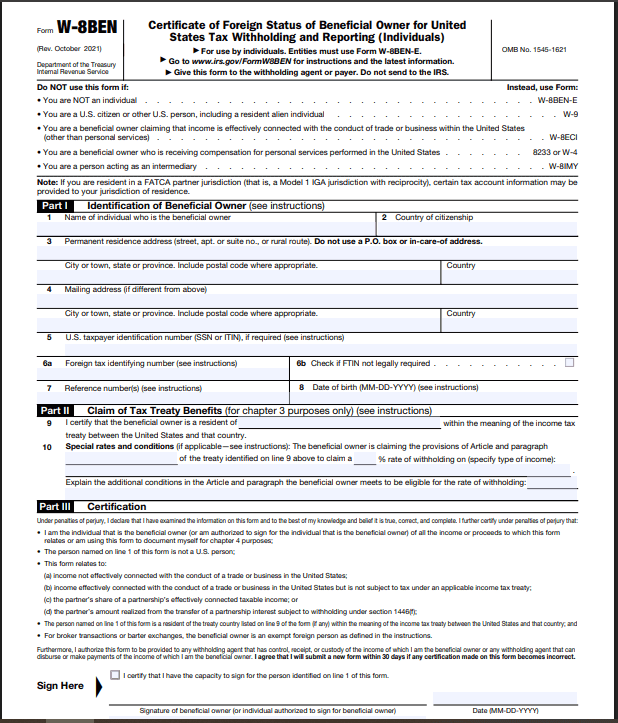
✔️ Form W-8BEN-E (for foreign entities): W-8BEN-E is completed by foreign companies or organizations providing services to your US business.
![How to Pay International Contractors in [year]: Currency, Accounts, Taxes & Best Practices](https://www.doola.com/wp-content/uploads/2026/03/image-4.png "How to Pay International Contractors in [year]: Currency, Accounts, Taxes & Best Practices")
These forms establish two critical facts:
- They are foreign persons or foreign entities: This formally documents that they are not US taxpayers.
- US withholding typically does not apply (if services are performed outside the US): In most cases, payments for services performed entirely outside the United States are not subject to US withholding tax, but you must have documentation to support this.
Without a properly completed W-8 form on file, you may face uncertainty around withholding obligations and reporting requirements.
🔖 Related Reading: W-9 vs W-8BEN vs W-8BEN-E: Which Tax Form Do You Actually Need?
2. 1099 Rules for Foreign Contractors
![How to Pay International Contractors in [year]: Currency, Accounts, Taxes & Best Practices](https://www.doola.com/wp-content/uploads/2026/03/image-2-1080x473.png "How to Pay International Contractors in [year]: Currency, Accounts, Taxes & Best Practices")
A common point of confusion among US-based business owners is whether to issue Form 1099-NEC.
You generally do not issue Form 1099-NEC to foreign contractors who:
- Are non-US persons: Properly documented with a valid W-8 form.
- Perform services entirely outside the United States: Meaning the income is considered foreign-sourced.
However, we repeat: you “generally” don’t need to. Your documentation must clearly support both the contractor’s foreign status and the location where services were performed.
🔖 Related Reading: What Is a 1099 NEC Form and How Does It Work
3. Deductibility of International Contractor Payments
International contractor payments are typically deductible, but only if they meet established IRS standards. Payments are generally tax-deductible if they are:
- Ordinary and necessary: Common and helpful for your type of business.
- Properly documented: Supported by agreements, invoices, and payment records.
- Directly related to business operations: Tied to revenue generation, product development, marketing, or other core activities.
| 📌 Key Takeaway for US-based Entrepreneurs If you can’t prove the contractor’s foreign status or clearly demonstrate the business purpose of the expense, deductions may be disallowed. That means maintaining signed contracts, detailed invoices, payment confirmations, FX records, and the correct tax forms is a protective measure. |
Practical Tips for Paying International Contractors Smoothly
Hiring globally unlocks talent without borders, but when payments are inconsistent, unclear, or error-prone, even great working relationships can deteriorate.
The goal isn’t just to “send money.” It’s to create a predictable, transparent, and scalable payment system that supports long-term collaboration and protects your financial infrastructure.
Here’s how experienced business owners do it:
1. Match invoice currency with payment currency: If a contractor invoices you in EUR, pay in EUR. Mismatched currencies can create confusion, reconciliation issues, and unnecessary FX conversion costs on either side.
2. Agree on currency and payment method upfront: Define in your contractor agreement whether payments will be made in USD or local currency, and whether you’ll use wire transfer, ACH, or a global payment platform.
3. Clarify who absorbs FX fees: Exchange rate spreads and transfer fees can add up. Decide in advance whether the contractor receives the exact invoiced amount net of fees, or whether they absorb intermediary charges.
4. Automate recurring payments: For ongoing retainers, automation reduces missed deadlines and administrative overhead. Scheduled payments ensure consistency and free up time for strategic work.
5. Reconcile monthly: Don’t wait until quarter-end or tax season. Match invoices, payments, FX conversions, and bank statements every month to catch discrepancies early and maintain clean books.
6. Maintain a contractor payment calendar: Track invoice due dates, contract renewal dates, and compliance documentation deadlines in one place. This prevents late payments and expired paperwork.
7. Communicate payment timelines clearly: Set expectations around processing times, especially for cross-border transfers that may take several business days.
When contractors know they’ll be paid accurately and on time, without confusion or follow-up emails, your company earns credibility. And this credibility and repute compounds as you scale.
How doola Helps You Stay Compliant While Paying International Contractors

Building globally is one of the most exciting phases of growth. But as your contractor base expands across borders, the backend complexity scales just as quickly.
This is where structure matters, and where doola steps in.
With doola, entrepreneurs can form a US LLC, obtain an EIN and complete essential tax setup. When you’re ready to go global with clarity and compliance confidence, doola handles the backend infrastructure so you can scale without hesitation.
Sign up to know more and get started today.
FAQs

What is the best way to pay international contractors with low fees?
Platforms like Wise often offer lower FX spreads and transparent fees compared to traditional banks or PayPal. The best choice depends on geography and payment volume.
Should I pay contractors in USD or their local currency?
Pay in USD for accounting simplicity. Pay in local currency for contractor satisfaction and potential FX efficiency. Decide upfront and document it.
Can I pay international contractors from my personal bank account?
No. This creates compliance, bookkeeping, and legal risks. Always use a dedicated business account.
Are payments to foreign contractors tax-deductible?
Generally yes, if they are ordinary and necessary business expenses and properly documented.
Do I need to collect tax forms like W-8BEN from international contractors?
Yes, if you are a US company paying foreign contractors. This documents foreign status and supports proper tax treatment.
How do I record currency conversion in my accounting books?
Record the expense using the exchange rate on the payment date. Track FX gains or losses if significant. Accounting software can automate this.
What are the biggest mistakes to avoid when paying overseas contractors?
Using personal accounts, ignoring tax documentation, not clarifying FX responsibility, poor record-keeping, overpaying in hidden FX fees.
![How to Pay International Contractors in [year]: Currency, Accounts, Taxes & Best Practices](https://doolastaging.wpengine.com/wp-content/uploads/2024/12/black-butotn.png "How to Pay International Contractors in [year]: Currency, Accounts, Taxes & Best Practices")
Table of Contents
Why Currency Choice Matters When Paying International ContractorsBest Ways to Pay International Contractors: Tools & MethodsBusiness Account vs. Personal Account: What Business Owners Must KnowInvoices, Expenses & Record-Keeping for Global PaymentsTax & Compliance Considerations (What Most Entrepreneurs Miss)Practical Tips for Paying International Contractors SmoothlyHow doola Helps You Stay Compliant While Paying International ContractorsFAQsStart Your Dream U.S. Business Today.
![How to Pay International Contractors in [year]: Currency, Accounts, Taxes & Best Practices](https://www.doola.com/wp-content/uploads/2025/05/5-sidebar.png "How to Pay International Contractors in [year]: Currency, Accounts, Taxes & Best Practices")

![How to Pay International Contractors in [year]: Currency, Accounts, Taxes & Best Practices](https://www.doola.com/wp-content/uploads/2025/06/construction-bottom.jpg "How to Pay International Contractors in [year]: Currency, Accounts, Taxes & Best Practices")

![How to Pay International Contractors in [year]: Currency, Accounts, Taxes & Best Practices](https://doolastaging2.wpenginepowered.com/wp-content/uploads/2025/11/pop-up-cta-1080x365.webp "How to Pay International Contractors in [year]: Currency, Accounts, Taxes & Best Practices")
![How to Pay International Contractors in [year]: Currency, Accounts, Taxes & Best Practices](https://doolastaging2.wpenginepowered.com/wp-content/uploads/2025/11/pop-up-cta-mobile.webp "How to Pay International Contractors in [year]: Currency, Accounts, Taxes & Best Practices")
