

One paycheck can lower your business’s taxable income, give your child legitimate earned income, and help them start investing early. This guide explains how hiring your child in your LLC for tax savings works in 2026.
A parent on r/smallbusiness asked a practical question about hiring their 8-year-old through an LLC:
Will the IRS be suspicious of an 8-year-old employee, and how do you actually prove the work happened?
![Hiring Your Child in Your LLC for Tax Savings: What the IRS Actually Allows in [year]](https://www.doola.com/wp-content/uploads/2026/08/image-1080x561.jpg "Hiring Your Child in Your LLC for Tax Savings: What the IRS Actually Allows in [year]")
That’s a common question from business-owning parents.
The answer depends on your business structure, your child’s age, the type of work, and how well you document it.
If you’re wondering whether you can pay your child through your LLC and have it actually hold up, this blog explains how hiring your child through your business can create legitimate tax deductions, which IRS rules apply in 2026 and how the tax treatment changes based on your business structure.
Is It Actually Legal to Pay Your Kids Through Your LLC? (Yes, Here’s Why)
Yes. Hiring your child in your LLC for tax savings is legal when the arrangement reflects genuine employment rather than a payment made only to claim a deduction.
Your business can deduct money it spends on necessary expenses, including what you pay your employees according to Section 162 of the tax code. This rule is the same whether your employee is your child or someone you do not know.
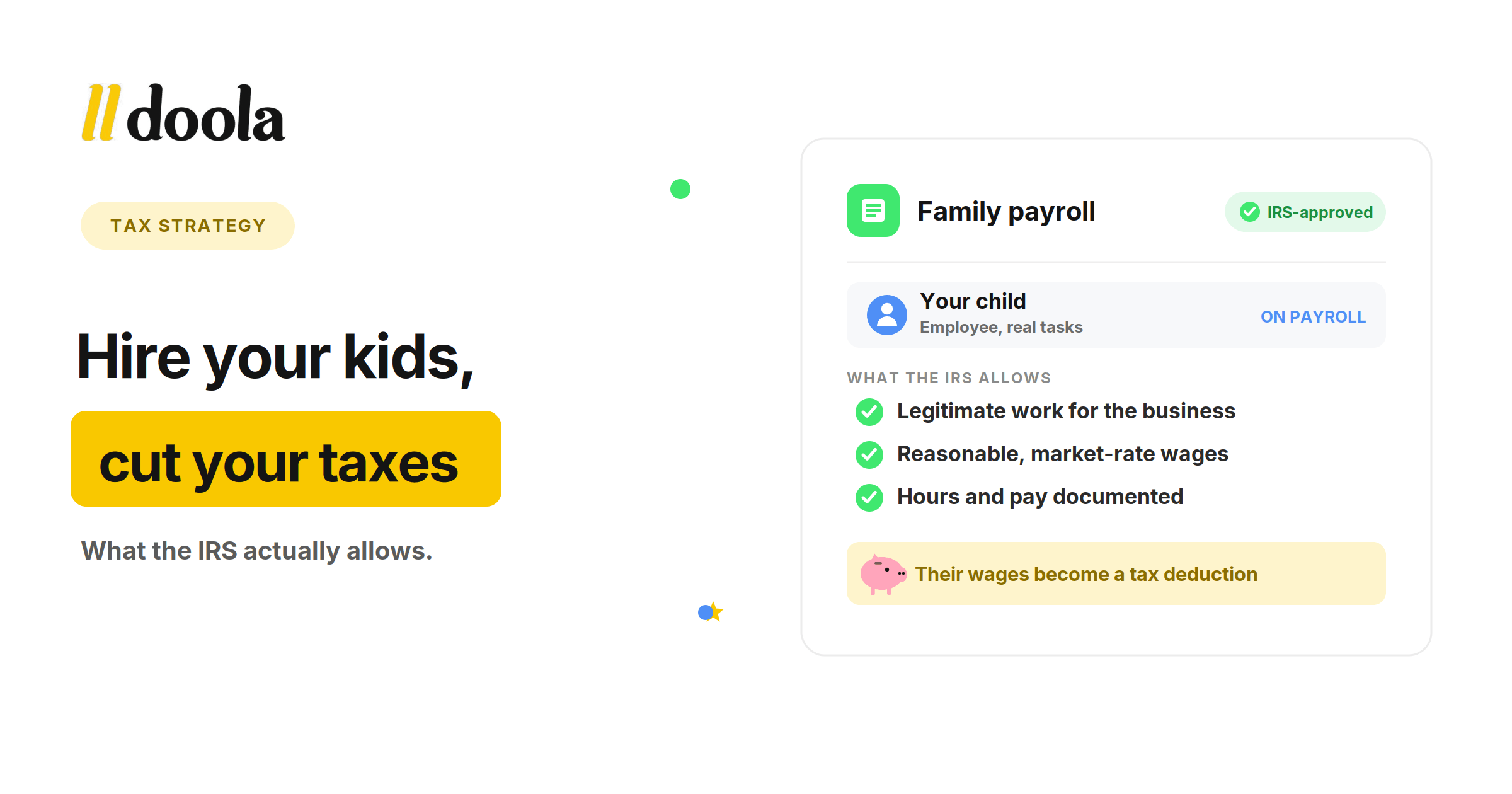
Your child must perform real work that the business actually needs, and their pay should be reasonable for the role, responsibilities, hours worked and local market rates. The job and wages should be comparable to what you would offer an unrelated employee for the same work.
The S corporation detail mentioned in the Reddit post is important because the tax treatment can change depending on how the business is structured.
The sections below explain those entity differences. It also covers the relevant 2026 tax figures, the types of jobs that are easiest to justify, the records you should maintain, and the questions the IRS may ask if the arrangement is audited.
How Much Can You Pay Your Child Tax-Free in 2026?
If you’re wondering, “How much can I pay my child tax-free in 2026?” The federal income tax answer may be as much as $16,100.
That is the 2026 standard deduction for a single filer. If wages from your business are your child’s only income for the year, they can generally earn up to that amount without owing federal income tax.
For this to work as intended:
- Your child must perform genuine work for the business.
- The work should be appropriate for their age and abilities.
- Their wages must be reasonable for the job and hours worked.
- You must maintain payroll records and report the wages correctly.
- Other income earned by the child could affect how much tax they owe.
What the potential tax savings look like
Suppose you operate a single-member LLC taxed as a sole proprietorship and fall within the 37% marginal federal income tax bracket.
You pay your teenager $16,100 over the year for legitimate work, such as:
- Filing invoices
- Organizing business records
- Managing the company’s Instagram account
- Updating website copy
- Helping with administrative tasks.
The $16,100 may qualify as a deductible wage expense for the business. At a 37% marginal rate, that deduction could reduce your federal income tax by approximately $5,957.
Your child may owe no federal income tax on those wages because the standard deduction covers the full amount.
In 2026, you can pay your child up to $16,100 (the standard deduction) with $0 federal income tax owed by the child.
If your business is a sole proprietorship or single-member LLC, those wages are also exempt from Social Security and Medicare tax if the child is under 18, and FUTA-exempt if under 21.
| Children employed | Total wages paid | Child’s federal tax owed | Parent’s tax saved (37% bracket) |
|---|---|---|---|
| 1 | $16,100 | $0 | $5,957 |
| 2 | $32,200 | $0 | $11,914 |
| 3 | $48,300 | $0 | $17,871 |
These figures assume that:
- Each child performs real work;
- The compensation is reasonable;
- Wages are properly documented;
- Each child has no additional income that creates a federal tax liability; and
- The parent receives the full benefit of the deduction at the 37% marginal rate.
The actual savings may differ depending on the rest of the parents’ tax return, state taxes, and the child’s other income.
What about Social Security and Medicare taxes?
Payroll-tax treatment depends on how the business is structured.
Wages paid to your child are generally exempt from Social Security and Medicare taxes while the child is under 18 when the business is:
- A sole proprietorship;
- A disregarded single-member LLC; or
- A partnership in which every partner is the child’s parent.
The wages may also be exempt from federal unemployment tax until the child turns 21.
These exemptions generally do not apply when the business is taxed as a corporation, including an S corporation. This is why entity structure can significantly change the tax benefit of hiring your child in your LLC for tax savings.
Does the Kiddie Tax Apply?
The “kiddie tax” is the informal nickname for the rule taxing a child’s unearned income at the parent’s higher marginal rate instead of the child’s own lower rate.
It got its name because it was created to stop parents from shifting investments into their kids’ names purely to dodge higher tax brackets , a practice more formally known as income shifting.
The kiddie tax generally applies to unearned income, such as:
- Interest
- Dividends
- Capital gains
- Certain investment income.
It does not generally apply to wages your child earns by performing genuine work for the business. Those wages are treated as earned income, provided the work is real and the pay is reasonable.
Can The Wages Fund A Roth IRA Or 529 Plan?
You might’ve caught this earlier: the parent who posted on r/smallbusiness mentioned a common strategy: paying a child through the business, then splitting those wages between a Roth IRA and a 529 plan.
This is a pretty common move once you decide to pay your child through your LLC. The catch is that these two accounts follow completely different eligibility rules, so it’s worth separating them out.
Roth IRA
A Roth IRA requires the child to have earned income. Legitimate wages paid for real work in the business satisfy that requirement.
The contribution itself is capped at whichever is lower: the child’s total earned income for the year, or the annual IRA contribution limit, which is $7,500 for 2026.
This means the wages set the ceiling on what can go into the Roth, pay the child $8,000 for the year, and only $7,500 of it can be contributed.
529 Plan
A 529 plan has no earned income requirement at all. It can be funded with the child’s wages, gifts from relatives, parental savings, or any other source, and contribution limits are set by the state plan rather than the IRS.
Some families use both accounts, depending on how much they want to set aside for education and retirement.
The Takeaway
Wages from the business are what make the Roth IRA option possible in the first place. Without earned income, that account isn’t available to the child.
The 529 plan, by contrast, can be funded regardless of whether the child works for the business at all.
Why the Entity You Choose Changes the Savings
Before committing to the numbers, it is essential to ensure your business is structured correctly. This is where many parents encounter unexpected hurdles, as the IRS provides specific payroll tax breaks that are only accessible to certain entity types.
Specifically, the federal government offers two primary exemptions for children employed by their parents:
- Under IRC Section 3121(b)(3)(A), wages paid to a kid under 18 skip Social Security and Medicare tax (FICA) entirely.
- Under IRC Section 3306(c)(5), wages paid to a kid under 21 skip federal unemployment tax (FUTA) too.
To qualify for these exemptions, however, your business must operate under one of the following three setups:
- A sole proprietorship, just you, no partners
- A single-member LLC (the IRS treats this the same as a sole prop for this exemption)
- A partnership where every partner is a parent of the kid
If you and your spouse run an LLC together, you are likely still covered; a jointly-owned LLC typically defaults to partnership taxation, which preserves the exemption under the partnership-of-parents rule in IRC Section 3121(b)(3)(A).
The landscape changes significantly if your business is taxed as an S-corp or C-corp. Because corporations are viewed as separate legal entities from the parents, they do not qualify for these family exemptions.
In these cases, full FICA and FUTA taxes apply to your child’s wages just as they would for any other employee.
However, if your operating business is already an S-corp, you can still utilize this strategy by employing a workaround.
Some families establish a separate family management company LLC (taxed as a sole prop) to handle marketing or administrative tasks. This company then bills the main S-corp for those services.
This setup keeps the FICA and FUTA exemptions alive for the child employee while allowing the main business to deduct the management fees.
While this is a powerful LLC for family tax planning move, it requires careful execution and should be reviewed by a CPA or tax attorney to ensure full compliance.
| Entity | FICA Exempt (Under 18) | FUTA Exempt (Under 21) | Notes |
|---|---|---|---|
| Sole proprietorship | Yes | Yes | Simplest structure for this strategy |
| Single-member LLC (disregarded) | Yes | Yes | Treated the same as a sole proprietorship |
| LLC owned by both parents (partnership) | Yes | Yes | Exemption holds since both partners are parents |
| S-corp or C-corp | No | No | Full payroll taxes apply regardless of age |
| Family management company | Yes | Yes | Separate entity to preserve the exemption; needs CPA/attorney setup |
What Jobs Can Your Child Actually Do?
Aside from the tax benefits, there’s a federal rule you should know about.
Under FLSA child labor rules, if you solely own your business, your kids can actually work for you at any age and for any amount of hours, as long as the job isn’t hazardous.
While mining and manufacturing are off-limits, having your 8-year-old model for a product photo or your 16-year-old handle the books is perfectly fine under labor law.
The real challenge isn’t usually their age; it’s passing the “stranger test.”
Essentially, the IRS wants to know: would you pay a complete stranger this exact wage for this exact task? If the answer is yes, you’re on solid ground. If the pay is way higher than market rates, the IRS might see it as a tax-free gift rather than a business expense.
Here is the breakdown of roles based on the age groups.
Ages 7 to 9
The job has to be genuinely simple here, since it has to be something a young kid can actually do without much supervision.
For example, shredding documents, stuffing envelopes, modeling for marketing materials and product photos.
Keep the hours short and the tasks obviously age-appropriate. This is also the band that draws the most scrutiny, so documentation matters more here than anywhere else.
Ages 10 to 13
Kids this age can take on work with a bit more structure to it. For example, data entry, basic social media content assistance, filing, light research tasks
Ages 14 to 17
This is where the job starts looking like an actual part-time role. You can assign bookkeeping support, website updates, customer service, and complex admin work
At this age, the easiest way to set the wage is to check what a local business would pay a first-time employee for the same role, then match it.
Whatever the age, the wage needs to match what you’d pay an unrelated person for the same task.
Paying more than that turns the wage into a disguised gift rather than compensation, which is exactly what a reasonable wage for child employee IRS standards are built to catch.
doola’s Pro Tip
Keep proof the work happened, and match the proof to the job.
For a modeling role, save the actual photos or marketing materials the child appeared in, since that’s harder to dispute than a written job description alone.
For data entry or admin work, keep the actual files or logs of the work produced.
For customer service or bookkeeping, timesheets and whatever records the software itself generates are enough.
How to Legally Pay and Document It
Here are a few steps you can take to legally pay your child:
1. Set Up a Genuine Role
Create a written job description before your child starts working, not after payments have already been made.
The job description should spell out the tasks your child will complete, their expected hours, their rate of pay, who will supervise them, and how their work will be reviewed.
The role should serve a real business need and be appropriate for your child’s age and abilities.
You will also generally need an Employer Identification Number (EIN) to run payroll and submit employee wage forms.
2. Classify and Pay Them Correctly
In most parent-child arrangements involving regular, supervised work, the child will be treated as a W-2 employee rather than an independent contractor.
Employee status is more likely when the business:
- Assigns the child’s tasks
- Decides when the work is completed
- Provides the tools or accounts they use
- Reviews and controls how the work is performed
Paying someone through Form 1099-NEC does not automatically make them an independent contractor. The IRS looks at how the working relationship operates in the business environment.
Run the wages through a payroll system or transfer each payment into an account in your child’s name. Avoid paying cash without supporting records. A clear payment trail helps show that the wages were genuinely paid.
3. Document the Work
For each pay period, maintain a detailed work log or timesheet.
Ensure you track:
- Specific dates of work
- Total hours completed
- Exact tasks performed
- Hourly wage rate
- Gross amount paid
The logged hours must correspond accurately with payroll documentation, and all assignments should correspond directly with the formal job description.
Keep examples of completed work where possible, such as:
- Social media posts
- Spreadsheets
- Invoices or filing records
- Photographs
- Website updates
- Edited images or videos
These records help show that your child earned the wages by performing legitimate work for the business.
4. File the Required Forms
Prepare and file Form W-2 when your child is treated as an employee.
Family employment may qualify for special payroll-tax treatment, but the exemption depends on your child’s age and how the business is structured.
For example, wages paid to a child under 18 may be exempt from Social Security and Medicare taxes when the child works for:
- A parent’s sole proprietorship
- A single-member LLC taxed as a sole proprietorship
- A partnership in which every partner is the child’s parent
The wages may also be exempt from federal unemployment tax until the child turns 21. These exemptions generally do not apply when the business is taxed as a corporation, including an S corporation.
Does Hiring Your Child Avoid Payroll Taxes? The FICA and FUTA Exemption Explained
FICA and FUTA exemptions can reduce the payroll taxes you pay when employing your child in a qualifying family-owned business.
FICA taxes include Social Security and Medicare taxes, which are normally shared by the employer and employee. FUTA is the federal unemployment tax paid by the employer.
For a sole proprietor or a single-member LLC taxed as a sole proprietorship:
- Wages paid to your child before age 18 may be exempt from Social Security and Medicare taxes
- Wages paid to your child before age 21 may be exempt from federal unemployment tax
These family employment rules can make the self-employed hiring your child payroll taxes lower than they would be for an unrelated employee.
The exemptions do not remove your obligation to:
- Run payroll correctly
- Keep timesheets and payment records
- Issue the required wage forms
- Pay a reasonable wage for genuine work
The exemptions generally do not apply when your LLC is taxed as a corporation, including an S corporation.
Learn more: Basics of Payroll Taxes
Turning Wages Into Long-Term Wealth: Roth IRA for Kids
Hiring your child in your LLC for tax savings can also help them start investing early. Because wages from genuine work count as earned income, your child may be eligible to open a custodial Roth IRA.
What Is a Custodial Roth IRA?
A custodial Roth IRA is a retirement account owned by a child but managed by a parent or guardian until the child reaches legal adulthood, usually at age 18 or 21.
The money belongs to the child from the beginning. The adult custodian manages the account and investments until control transfers to them.
How Much Can Your Child Contribute?
For 2026, your child can contribute up to the lower of:
- $7,500
- Total earned income for the year
For example, a child who earns $5,000 can contribute up to $5,000. If they earn $10,000, they can contribute up to the $7,500 limit.
When you pay your child through your LLC, the wages must come from legitimate work and be properly documented.
How Early Contributions Can Grow
Suppose your child contributes $7,500 each year from age 10 through 18. That equals $67,500 in total contributions.
If the money remains invested until age 65 and earns an average annual return of 7%, it could grow to around $2.3 million, through decades of tax-free compounding.
| Age | Milestone | Illustrative Balance* |
|---|---|---|
| 10–18 | Contributes $7,500/year (9 years, $67,500 total) | ~$96,100 by age 18 |
| 18–65 | Left untouched, no further contributions | ~$2,300,000 by age 65 |
This is only an illustration. Investment returns are not guaranteed.
Why Payroll Matters
Roth IRA contributions require earned income. Gifts and allowances do not qualify.
Putting your child on payroll for genuine work gives them the earned income needed to contribute. A parent may also fund the account on the child’s behalf, as long as the contribution does not exceed the child’s earned income or the annual limit.
This is one of the long-term benefits of hiring your children in a business: their wages can help them begin building retirement savings early.
What Happens If the IRS Audits Your Child Payroll Arrangement?
Once you have set up payroll and decided how your child’s wages will be saved or invested, the next concern is whether the deduction would survive an IRS review.
The IRS will mainly look at two things:
- Did your child perform genuine work for the business?
- Was the compensation reasonable for the services provided?
Business compensation is generally deductible only when it is reasonable and paid for services actually performed.
What Could Trigger IRS Scrutiny?
An arrangement may be harder to defend when:
- A young child receives unusually high wages
- The job description was created after the work began
- There are no timesheets or work samples
- The wage is much higher than the market rate
- Payments cannot be traced to the child’s account
- A large payment is made at year-end with little supporting documentation
Missing records are another red flag. The deduction becomes harder to defend when there are no timesheets, work samples, payroll reports, or bank transfers showing what the child did and how they were paid.
Audit-Defense Checklist
There is no single IRS audit checklist written specifically for child payroll. The checklist in this guide is a practical way to apply the IRS’s broader rules on legitimate compensation and payroll recordkeeping.
But keep the following documents intact with you:
- A written job description created before work begins
- Signed timesheets for every pay period
- Payroll reports and bank-transfer records
- Payments deposited into an account in the child’s name
- Form W-2 and other applicable payroll filings
- Examples of the child’s completed work
- Evidence supporting the wage, such as similar job postings
- Records showing that the tasks were appropriate for the child’s age
When determining a reasonable wage for a child employee, IRS rules focus on whether the compensation matches the work actually performed. The wage should be similar to what you would pay another person with comparable skills and responsibilities.
What Happens If the Deduction Is Disallowed?
If the IRS decides that the work was not genuine or the wage was excessive, it may disallow some or all of the deduction. The business could then owe:
- Additional income tax
- Interest on the unpaid tax
- Possible penalties
An accuracy-related penalty can equal 20% of the portion of the tax underpayment caused by negligence, disregard of tax rules, or a substantial understatement. It is not automatic in every audit.
Getting Started: Do You Need an LLC? Or Can You Do This as a Sole Proprietor?
You do not need to form an LLC before hiring your child.
A sole proprietor can place a child on payroll, deduct reasonable wages for genuine work, and potentially qualify for the family-employment payroll tax exemptions.
Like we mentioned earlier, the exemptions may apply when the business is structured as:
- A sole proprietorship owned by the child’s parent
- A single-member LLC owned by the parent and disregarded for federal tax purposes
- A partnership, including an LLC taxed as a partnership, in which every partner is a parent of the child
In these qualifying structures, wages paid to a child under age 18 are generally exempt from Social Security and Medicare taxes. Wages paid before age 21 are generally exempt from FUTA, or federal unemployment tax. Federal income tax withholding rules still apply.
These exemptions generally disappear if the business is a corporation or the LLC elects to be taxed as an S corporation or C corporation.
If you already operate as a sole proprietor, you can hire your child without forming a new entity. You must still set up payroll correctly, document the work, pay a reasonable wage, file the required forms, and follow federal and state child-labor rules.
When an LLC May Still Make Sense
An LLC is not required for the tax strategy, but it may be worth considering as the business grows. LLCs can protect an owner’s personal assets from many business liabilities, although that protection has limits and depends on state law and how the company is operated.
Using an LLC for family tax planning should therefore be part of a broader entity decision based on liability, ownership, administrative costs, and the business’s long-term plans, not only the potential payroll-tax savings.
A family management company LLC is a more advanced arrangement and is not necessary simply to employ your child. It should have a legitimate business purpose, perform real services, and be reviewed by a CPA or tax attorney before it is created.
The benefits of hiring your children in a business can also extend beyond the current tax year. A genuine role can teach them how a business operates, help them develop work habits, and give them earned income they may be able to save or invest.
If you decide that an LLC is suitable, doola can assist with LLC formation, bookkeeping and tax-compliance services. Payroll setup, employee filings, and W-2 support should be confirmed based on the services included in your plan.
Your CPA or tax attorney should still review the entity choice and child-employment arrangement based on your ownership structure, state rules, and specific tax situation.
A Few Details Worth a Closer Look

IRS guidance published for 2024, 2025, and 2026 has remained consistent on the core family-employment rules: the outcome depends on how the business is taxed, who owns it, the child’s age, and whether the payroll arrangement is genuine.
How the LLC Is Taxed Matters
Having an LLC does not automatically qualify or disqualify you for the payroll-tax exemptions.
Wages paid to a child under 18 can generally be exempt from Social Security and Medicare taxes when the child works for:
- A parent’s sole proprietorship;
- A qualifying single-member LLC; or
- A partnership in which every partner is a parent of the child.
Wages paid before age 21 can also qualify for the federal FUTA exemption.
However, these exemptions generally do not apply when the business is a corporation or the LLC has elected to be taxed as an S corporation or C corporation.
A disregarded single-member LLC must still report payroll using the LLC’s own name and EIN.
When Both Parents Own the LLC
A husband-and-wife LLC is not automatically disqualified because it is taxed as a partnership. If both spouses are the only partners and each is a parent of the child, the federal family-employment exemption may still apply.
That changes if another partner who is not the child’s parent owns part of the business. In that case, the child’s wages are generally subject to Social Security, Medicare, and FUTA taxes.
What Strong Documentation Looks Like
Your records should show the work performed, hours completed, wage rate, payroll filings, and payments made to the child.
The IRS generally requires employment-tax records to be retained for at least four years. Also remember that wages may still be subject to federal income-tax withholding rules even when they qualify for FICA and FUTA exemptions.
When using an LLC for family tax planning, confirm the entity’s federal tax treatment, your state’s employment rules, and the payroll process before issuing the first paycheck.
FAQs

Can I hire my child at any age?
Yes, as long as the work is age-appropriate and complies with federal and state child labor rules.
Younger children are typically limited to simple tasks like modeling for marketing materials; older teens can take on more complex admin or bookkeeping work.
How much can I pay my child?
There’s no fixed IRS cap. The wage has to be reasonable for the work performed, in line with what you’d pay an unrelated employee for the same task.
Do I still need to run payroll for my child?
Yes. Even when FICA and FUTA don’t apply, you still need to issue a W-2, track hours, and keep payroll records.
Can I put my child on payroll if I have an LLC?
Yes. Whether your business is a sole proprietorship or a single-member LLC taxed as a sole proprietorship, you can add your child to payroll the same way.
The LLC itself doesn’t change the process; what matters is whether the entity is disregarded for tax purposes or taxed as a corporation, since that determines whether the FICA and FUTA exemptions apply.
Can my child contribute to a Roth IRA?
Yes, up to the lesser of the annual contribution limit ($7,500 for 2026) or their total earned income for the year.

![Hiring Your Child in Your LLC for Tax Savings: What the IRS Actually Allows in [year]](https://www.doola.com/wp-content/uploads/2026/04/bottom-cta-new.png "Hiring Your Child in Your LLC for Tax Savings: What the IRS Actually Allows in [year]")
