
![Which Countries Can Fully Use PayPal in [year]?](https://doolastaging2.wpenginepowered.com/wp-content/uploads/2025/11/banner-cta-new.png "Which Countries Can Fully Use PayPal in [year]?")
The Easiest Way to Start and Scale Your U.S. Business.


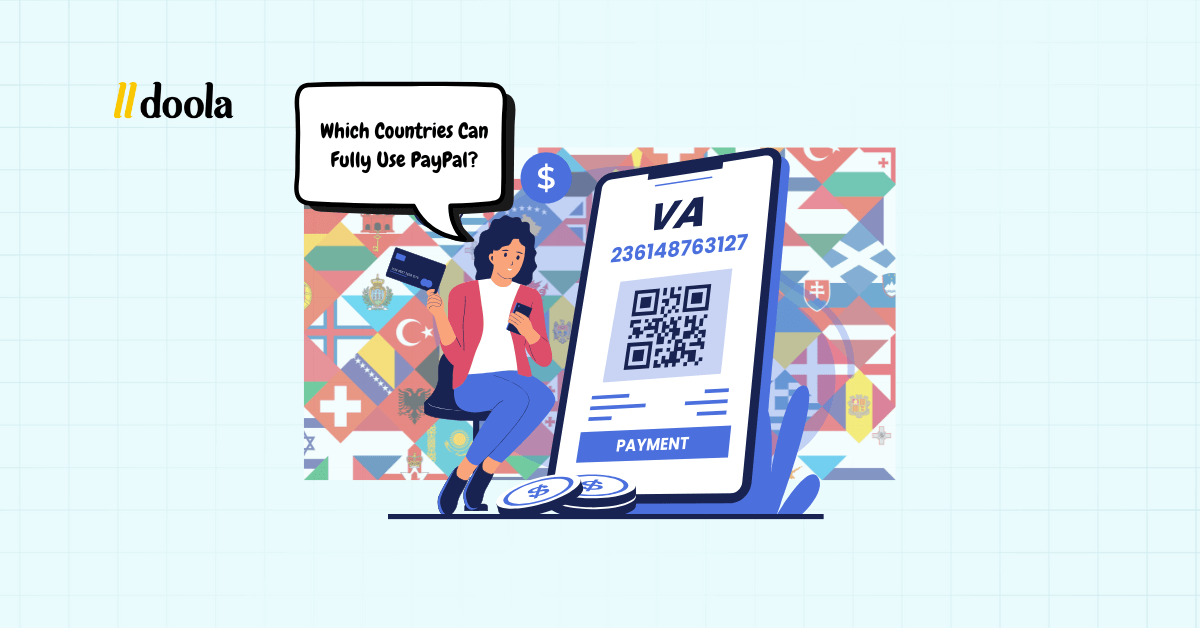
When PayPal works fully in your country, you can use it to send and receive payments, withdraw funds to a bank account, and access PayPal Business tools (invoicing, subscriptions, integrations).
However, many articles claim PayPal is “available” in dozens of countries, but availability doesn’t always mean full PayPal international availability.
In reality, full PayPal access goes far beyond simply signing up for an account. Many countries allow sign-ups but restrict one or more of these core features.
That’s where freelancers, e-commerce sellers, and founders run into trouble, especially when they try to scale internationally.
That’s exactly what doola helps you avoid. We help founders worldwide form a U.S. LLC or C-Corp, giving your business a legal presence that PayPal fully supports.
To make things clear, this guide separates PayPal countries into three real categories:
- Full access (commercial-ready)
- Partial access (limited features)
- Restricted or unavailable
We’ll also explain why PayPal works differently by country, what those limitations mean for online businesses, and what you can do if PayPal is restricted where you live, especially if you’re selling globally.
Which Countries Can Fully Use PayPal in 2026?
When we say a country can fully use PayPal, we mean using PayPal to receive payments, withdraw funds to a local bank, and operate PayPal Business accounts for commercial use.

That’s why we have created a region-by-region breakdown of PayPal-supported countries in 2026.
📌 Important note:
PayPal features may vary slightly due to local regulations, but all countries listed below are part of PayPal receiving and withdrawing countries.
They support full commercial use, including receiving and withdrawing funds, as well as using PayPal Business tools.
North America
Country
Receive Payments
Withdraw to Local Bank
PayPal Business
United States
✔️
✔️
✔️
Canada
✔️
✔️
✔️
Mexico
✔️
✔️
✔️
Europe
Country
Receive Payments
Withdraw to Local Bank
PayPal Business
United Kingdom
✔️
✔️
✔️
Ireland
✔️
✔️
✔️
Germany
✔️
✔️
✔️
France
✔️
✔️
✔️
Netherlands
✔️
✔️
✔️
Spain
✔️
✔️
✔️
Italy
✔️
✔️
✔️
Belgium
✔️
✔️
✔️
Austria
✔️
✔️
✔️
Switzerland
✔️
✔️
✔️
Sweden
✔️
✔️
✔️
Norway
✔️
✔️
✔️
Denmark
✔️
✔️
✔️
Finland
✔️
✔️
✔️
Poland
✔️
✔️
✔️
Portugal
✔️
✔️
✔️
Czech Republic
✔️
✔️
✔️
Slovakia
✔️
✔️
✔️
Hungary
✔️
✔️
✔️
Estonia
✔️
✔️
✔️
Latvia
✔️
✔️
✔️
Lithuania
✔️
✔️
✔️
Asia-Pacific
Country
Receive Payments
Withdraw to Local Bank
PayPal Business
Australia
✔️
✔️
✔️
New Zealand
✔️
✔️
✔️
Japan
✔️
✔️
✔️
Singapore
✔️
✔️
✔️
Hong Kong
✔️
✔️
✔️
South Korea
✔️
✔️
✔️
Taiwan
✔️
✔️
✔️
Countries like India, Indonesia, Thailand, the Philippines, Vietnam, Malaysia, Pakistan, Bangladesh, Sri Lanka, Nepal, and most of South Asia and Southeast Asia are not part of PayPal business account countries and do NOT have full PayPal functionality.
Middle East
Country
Receive Payments
Withdraw to Local Bank
PayPal Business
Israel
✔️
✔️
✔️
United Arab Emirates (UAE)
✔️
✔️
✔️
Countries such as Qatar, Kuwait, Oman, Bahrain, Jordan, Egypt, and others either have partial access or withdrawal restrictions, despite allowing sign-ups.
Latin America
Country
Receive Payments
Withdraw to Local Bank
PayPal Business
Brazil
✔️
✔️
✔️
Chile
✔️
✔️
✔️
Argentina
✔️
✔️
✔️
Colombia
✔️
✔️
✔️
Peru
✔️
✔️
✔️
Why This List Matters
If your country appears above, it’s part of the PayPal full account countries. This means you can:
- Run a PayPal Business account
- Accept international customer payments
- Withdraw funds locally
- Integrate PayPal with e-commerce platforms like Shopify, Amazon, WooCommerce, and invoicing tools
If your country is not on this list, PayPal may still be available, but with serious limitations. That’s exactly what we’ll cover next.
🔖 Related Read: How to Create a US PayPal Account – International Founder Guide
Countries With Partial PayPal Access (And What’s Missing)
In many countries, PayPal technically “works”, but only in a limited way. This is where most founders get caught off guard.
They sign up successfully, receive their first payment, and then discover they can’t withdraw funds, can’t run a business account, or face sudden account limitations.
Understanding partial PayPal access is crucial if you’re a freelancer, e-commerce seller, or SaaS founder who relies on international payments.
What “Partial PayPal Access” Actually Means
In countries with partial access, users may be able to do some of the following, but not all:
Send payments, but do not receive them
Some regions allow PayPal accounts only for outbound payments. You can pay for tools or subscriptions, but you can’t accept customer payments.
Receive payments but can’t withdraw locally
This is one of the most common limitations. Funds may appear in your PayPal balance, but you’re forced to:
- Withdraw via expensive intermediary methods, or
- Convert and route funds through supported foreign accounts
Personal use only (no PayPal Business tools)
In several countries, PayPal allows personal accounts but restricts:
- Business profiles
- Invoicing tools
- Subscription billing
- Marketplace integrations
This makes PayPal unusable for legitimate commercial activity.
Common Limitations in Partial-Access Countries
Across regions, PayPal imposes similar restrictions. You may not be able to link a local bank account at all, or withdrawals may be delayed, capped, or routed through third-party processors.
In some cases, users may face forced currency conversion. PayPal often auto-converts payments into a supported currency at unfavorable exchange rates, cutting directly into your margins.
Cross-border selling from a restricted country increases the likelihood of an account freeze or other actions, such as:
- Sudden account reviews
- Temporary balance holds
- Permanent limitations without appeal
These issues usually appear after you start receiving international payments, when it’s already costly to switch systems.
Why Partial PayPal Access Is a Problem for Businesses
PayPal can tighten restrictions at any time based on regulatory changes, leaving businesses locked out of their funds overnight.
Partial access isn’t just inconvenient. It’s unstable.
👉🏼 For freelancers: Delayed or blocked withdrawals can lead to cash flow issues. You might get paid, but not access your money when you need it.
👉🏼 For e-commerce sellers: E-commerce platforms like Shopify and Amazon expect a reliable payment infrastructure. Limited PayPal access can disrupt payouts, refunds, and customer trust.
👉🏼 For SaaS founders: Subscription billing, recurring payments, and cross-border compliance are nearly impossible with partial PayPal functionality.
That’s why many international founders ultimately seek a structure that provides them with full PayPal access, regardless of their location, which is exactly what we’ll cover next.
Countries Where PayPal Is Restricted or Not Available in 2026
While PayPal operates in many parts of the world, there are still countries where PayPal is either completely unavailable or heavily restricted.
In these regions, users may be unable to create accounts or face severe limitations due to PayPal restrictions by country.
Countries With No PayPal Access or Severe Restrictions
PayPal does not operate, or is functionally unusable, in countries affected by:
- International sanctions
- High regulatory risk
- Weak or non-compliant banking systems
Examples typically include countries under U.S. or international sanctions, such as:
- Iran
- North Korea
- Syria
- Cuba
- Sudan
- Crimea region of Ukraine
In these regions, PayPal accounts cannot be created, accessed, or used legally.
Countries With Heavy Regulatory Limitations
Some countries technically allow PayPal sign-ups, but impose such strict regulations that:
- Funds cannot be withdrawn
- Business accounts are unavailable
- Cross-border payments trigger frequent reviews or freezes
These restrictions are often unpredictable and subject to sudden changes based on local laws or regulatory pressure.
Commonly affected countries include:
- India
- Indonesia
- Thailand
- Vietnam
- Philippines
- Malaysia
- Pakistan
- Bangladesh
- Sri Lanka
- Nepal
- Saudi Arabia
- Qatar
- Kuwait
- Oman
- Bahrain
- Egypt
- Nigeria
- Kenya
- Ukraine (outside restricted regions, limited functionality)
- Kazakhstan
- Uzbekistan
Why PayPal Restricts Certain Countries
PayPal’s country availability isn’t arbitrary. Restrictions are typically driven by:
👉🏼 Banking infrastructure limitations
If local banks can’t reliably support electronic settlements or reporting requirements, PayPal limits or disables withdrawals.
👉🏼 Compliance and AML laws
PayPal must comply with anti–money laundering (AML) and know-your-customer (KYC) regulations. Countries that don’t meet these standards face tighter controls.
👉🏼 Sanctions and regulatory risk
U.S. sanctions and international financial regulations legally prevent PayPal from operating in certain jurisdictions.
What You Should Not Attempt
When PayPal is restricted, some users attempt shortcuts that can have permanent consequences. Avoid:
- Using VPNs to disguise your location
- Registering accounts with fake addresses
- Opening PayPal accounts under someone else’s identity
- Linking unsupported foreign bank accounts
These actions almost always lead to account freezes, permanent bans, and seized funds, often without appeal.
If PayPal is restricted in your country, the solution isn’t to trick the system. You should use a compliant business structure that PayPal supports globally.
That’s why many international founders choose to operate through a properly formed U.S. business, which we’ll explain next.
🔖 Related Read: PayPal Payments Set-up for US and Non-US Founders
PayPal for International Businesses & E-Commerce Sellers
For international founders, PayPal can be either a powerful growth tool or a constant source of friction.
The difference usually comes down to where your business is registered, not where you live.
Why PayPal Works Best With U.S.-Registered Businesses
PayPal is a U.S.-based financial institution, which means its systems are designed to work most smoothly with:
- U.S.-registered businesses
- Recognized legal entities (LLCs or corporations)
- Clear ownership and compliance structures
When a business is registered in the U.S., PayPal can more easily verify:
- Business identity
- Tax reporting obligations
- Banking relationships
This reduces risk in PayPal’s eyes, and fewer risk flags mean fewer limitations.
Common Problems Faced by Non-U.S. Founders
Founders operating PayPal accounts from countries with partial or restricted access often face serious challenges:
👉🏼 Account limitations and reviews
As soon as transaction volume increases or cross-border payments rise, PayPal may request additional verification or limit the account entirely.
👉🏼 Sudden freezes
Funds can be held for weeks or months while PayPal reviews compliance, sometimes without clear timelines or explanations.
👉🏼 Inability to scale payments
Features like subscriptions, mass payouts, or platform integrations may be unavailable, making it hard to grow beyond early-stage revenue.
These issues don’t usually appear on day one. Instead, they surface when the business starts to succeed.
Why E-Commerce and Platform Sellers Care So Much
For sellers on platforms like Shopify, Stripe-powered stores, and SaaS tools, PayPal country access directly affects:
- Checkout acceptance rates
- Customer trust and conversion
- Speed and reliability of payouts
- Refunds, disputes, and chargebacks
If PayPal can’t operate fully in your country, it can block:
- Shopify Payments integrations
- Marketplace payouts
- Subscription billing workflows
That’s why many international founders avoid relying on personal PayPal accounts or those restricted to specific countries.
Instead, they use a business structure that PayPal fully supports, ensuring stable payments as their store or platform scales.
In the next section, we’ll show how founders use doola to unlock full PayPal functionality, no matter where they live.
🔖 Related Read: The Ultimate Guide to Global Business Banking
How doola Helps You Use PayPal Fully (No Matter Where You Live)
If PayPal doesn’t fully work in your country, the issue usually isn’t the platform. It’s business structure and compliance.
PayPal is designed to support properly registered, low-risk businesses in jurisdictions it trusts, especially the United States.
doola helps founders form a U.S. LLC or C-Corp from anywhere in the world, giving PayPal what it needs to offer full functionality.
With a U.S. entity in place, you can use PayPal Business with:
- Full receiving capabilities
- Reliable withdrawals to a U.S. business bank account
- Fewer account limitations and freezes
- Access to invoicing, subscriptions, and platform integrations
This setup works smoothly with Shopify, Amazon, SaaS tools, and international clients.
We also help you get an EIN and a compliant business setup to remove most of the limitations international founders face.
This eliminates common issues like mismatched information, missing documents, or unnecessary account reviews during PayPal approval.
PayPal doesn’t just check compliance once. It monitors businesses continuously. That’s why doola supports you long-term with:
🚀 Ongoing tax and filing support
🚀 Banking alignment and documentation
🚀 Annual compliance management
Instead of relying on VPNs, fragile personal accounts, or restricted country setups, doola gives you a compliant, scalable way to use PayPal fully, no matter where you live.
Get started with doola and unlock PayPal the right way.
FAQs
What countries can fully use PayPal in 2026 for business?
Countries with full PayPal functionality allow users to receive payments, withdraw funds to local banks, and use PayPal Business tools.
These include the United States, Canada, most of Western and Northern Europe, Australia, New Zealand, Japan, Singapore, Hong Kong, South Korea, Taiwan, the UAE, Israel, and parts of Latin America (such as Brazil and Chile).
Can I use PayPal if my country only has partial access?
Yes, but with limitations. In partial-access countries, you may be able to send payments or receive funds but face issues like no local withdrawals, forced currency conversion, or no PayPal Business tools.
This can work for light personal use, but it’s risky and often impractical for freelancers, e-commerce sellers, or SaaS founders who need reliable payouts.
Why can’t some countries withdraw PayPal funds to local banks?
This usually comes down to local banking infrastructure, regulatory requirements, and compliance rules.
If PayPal can’t integrate cleanly with domestic banks or meet AML/KYC standards in a country, it restricts withdrawals to reduce risk.
Is it legal to use a U.S. PayPal account while living abroad?
Yes, if it’s tied to a legitimate U.S.-registered business (like a U.S. LLC or C-Corp) and you’re compliant with PayPal’s terms, tax rules, and reporting obligations.
What’s not legal (and risky) is using fake addresses, VPNs, or misrepresenting your location or business details.
Does PayPal work differently for personal vs business accounts?
Absolutely. Personal accounts are meant for casual transactions and often have stricter limits.
Business accounts unlock invoicing, subscriptions, integrations (Shopify, Amazon), and higher transaction volumes.
However, they also require stronger compliance, proper documentation, and sometimes a supported jurisdiction.
Can PayPal freeze accounts based on country restrictions?
Yes. PayPal may limit or freeze accounts if it detects activity from restricted countries, inconsistent location data, or compliance risks, often during reviews triggered by higher volumes or cross-border sales.
What is the safest way to use PayPal if it’s limited in my country?
The safest option is to operate through a compliant business structure PayPal fully supports, such as a U.S. LLC or C-Corp, with proper EIN, banking, and ongoing compliance.
This avoids risky workarounds and provides stable access to receiving and withdrawing funds at scale.
![Which Countries Can Fully Use PayPal in [year]?](https://doolastaging.wpengine.com/wp-content/uploads/2024/12/black-butotn.png "Which Countries Can Fully Use PayPal in [year]?")
Table of Contents
Which Countries Can Fully Use PayPal in 2026?Countries With Partial PayPal Access (And What’s Missing)Countries Where PayPal Is Restricted or Not Available in 2026PayPal for International Businesses & E-Commerce SellersHow doola Helps You Use PayPal Fully (No Matter Where You Live)FAQsStart Your Dream U.S. Business Today.
![Which Countries Can Fully Use PayPal in [year]?](https://www.doola.com/wp-content/uploads/2025/05/5-sidebar.png "Which Countries Can Fully Use PayPal in [year]?")

![Which Countries Can Fully Use PayPal in [year]?](https://www.doola.com/wp-content/uploads/2025/06/construction-bottom.jpg "Which Countries Can Fully Use PayPal in [year]?")

![Which Countries Can Fully Use PayPal in [year]?](https://doolastaging2.wpenginepowered.com/wp-content/uploads/2025/11/pop-up-cta-1080x365.webp "Which Countries Can Fully Use PayPal in [year]?")
![Which Countries Can Fully Use PayPal in [year]?](https://doolastaging2.wpenginepowered.com/wp-content/uploads/2025/11/pop-up-cta-mobile.webp "Which Countries Can Fully Use PayPal in [year]?")
