

The Easiest Way to Start and Scale Your U.S. Business.


Having supported 10K+ global entrepreneurs from over 175 countries by now, there’s one crucial fact we keep emphasizing to non-resident entrepreneurs aiming to expand into the US market:
0% US tax is real, legal, and achievable for many foreign entrepreneurs.
And it’s not automatic or universal… and definitely not something you get by “forming a US LLC”.
The US follows a source-based taxation system, not a “company-location” system. That single distinction is what separates entrepreneurs who owe nothing in US income tax from those who accidentally create US tax exposure, often without hiring a single employee or opening an office.
This guide breaks it all down in simple terms:
- How foreign business owners pay 0% US tax legally
- Which types of income is taxable by IRS (and which isn’t)
- What Effectively Connected Income (ECI) really means
- How to stay compliant while optimizing taxes the right way
If you’re a non-resident entrepreneur running a global business with a US entity, this is the rulebook you need in 2026.
Also, this is exactly where do’ers like you doola it!
At doola, we help foreign entrepreneurs form US businesses the right way, structure ownership correctly, secure EINs, and stay compliant with IRS reporting, even in scenarios where the lawful outcome is potentially 0% US tax.
How the US Taxes Foreign Business Owners in 2026
Even before numbers, forms, or structures, the US tax system will ask one important question:
Are you a US person for tax purposes, or not?
That single classification determines whether the IRS looks at your worldwide income or only a limited slice of it. Everything else flows from here.
US Persons vs Non-Resident Aliens (NRAs)
US taxation operates on two completely different frameworks depending on your status. Here’s how the system divides taxpayers:
1. US Citizens & Tax Residents
US citizens and individuals who meet US tax residency rules (such as the substantial presence test or green card test) are taxed on their worldwide income, regardless of where it is earned or where the company is incorporated.
If you fall into this category, the IRS expects you to report global earnings, whether generated in New York, Singapore, Berlin, or anywhere else.
2. Non-Resident Aliens (NRAs)
Non-resident aliens, by contrast, are generally taxed only on US-source income and certain types of income effectively connected to a US trade or business. The IRS does not automatically claim jurisdiction over worldwide income simply because a US entity exists.
Instead, taxation depends on whether income is sourced to the United States and whether it becomes Effectively Connected Income (ECI).
Most foreign entrepreneurs operating from outside the US fall into the second category: non-resident aliens.
This means the US does not automatically tax your global business income simply because:
- You formed a US LLC or corporation
- You use US-based payment processors
- You have US customers
- Your company is registered in a US state
Instead, the IRS focuses on two technical but decisive factors:
- Where is the income sourced?
- Is the income connected to a US trade or business?
That’s why two entrepreneurs with identical US entities can have completely different tax outcomes: one paying 0% and the other paying substantial federal tax.
To navigate this correctly, there are a few key concepts every foreign entrepreneur must understand.
| Key concepts you’ll see throughout this guide: ✔️ US-source income ✔️ Foreign-source income ✔️ Withholding obligations vs filing obligations |
We want you to master these fundamentals to legally optimize your US tax exposure in 2026.
The Key Rule That Makes 0% US Tax Possible: Source of Income
For every 0% US tax outcome, there’s one deceptively simple principle, and it’s the one most foreign entrepreneurs misunderstand or overlook entirely. Before the IRS looks at entities, bank accounts, or customers, it looks at where income is actually generated.
Here’s the rule that changes everything:
Where the work is performed matters more than where the company is registered.
This is the core of the US source-based taxation system, and it’s why a foreign entrepreneur can legally operate a US company without owing US income tax, if the activity is structured correctly.
What counts as US-source income?
US-source income is income that the IRS considers to be generated within the United States, either because the underlying activity takes place there or because it is directly tied to a US trade or business.
According to IRS rules, US-source income typically includes:
- Services performed inside the US: If work is physically carried out in the US (whether by the entrepreneur, employees, or agents) the resulting income is generally US-source.
- Certain US-based interest, rents, or royalties: Income paid by US payers or tied to US-based assets can be classified as US-source, even if the recipient lives abroad.
- Income connected to a US trade or business: Once business activity rises to the level of operating in the US, income generated through that activity can be treated as US-source or Effectively Connected Income (ECI).
Basically, US-source income is determined by activity and connection, not by where profits are deposited.
What counts as foreign-source income?
Foreign-source income is income generated outside the United States, where the underlying work, value creation, or operational activity takes place abroad.
A few common examples include:
- Services performed outside the US: Consulting, development, design, or management work done entirely abroad is typically foreign-source.
- Software development, marketing, or operations handled overseas: If your product is built, marketed, and maintained outside the US, the income usually follows that activity.
- Digital products created and managed abroad: Courses, templates, SaaS tools, or digital assets developed and operated outside the US are often treated as foreign-source, even when sold globally.
This distinction is what allows many foreign entrepreneurs to operate US entities while keeping their income outside the US tax net.
Real-World Use Cases: How Source Rules Apply in Practice
Let’s look at how source-of-income rules play out across three common business models.
1. SaaS business: If a SaaS product is built, managed, supported, and operated outside the US, with no US employees or offices, the income is often foreign-source. The location of users or subscribers does not override where the work happens.
2. E-commerce brand: Selling to US customers alone does not make income US-source. What matters is where inventory is stored, orders are fulfilled, and operations are managed. A fully offshore operation can still result in foreign-source income, even with strong US sales.
3. Consulting or freelancing: For service providers, the rule is especially clear: income is sourced where the consultant performs the work, not where the client lives or pays from. A US client does not automatically mean US-source income.
| ⚡ doola Insight for Entrepreneurs A US LLC is not automatically taxable in the US. For foreign-owned US LLC taxes, the IRS does not stop at the entity level. It looks straight through the company and examines the actual business activity: where work is performed, where decisions are made, and where operations live. |
Put simply, get the source-of-income analysis right, and 0% US tax is not a loophole; it’s the logical outcome of how US tax law is written.
Effectively Connected Income (ECI): The Line You Must Not Cross
Effectively Connected Income is the point at which otherwise non-taxable income becomes subject to US federal tax. Foreign entrepreneurs often cross this threshold unintentionally, turning a compliant 0% structure into a taxable one.
What Is ECI?
Effectively Connected Income is income that is economically and operationally tied to carrying on a trade or business in the United States. It’s not about where your company is registered or where your customers live, it’s about whether meaningful business activity is happening on US soil.
Once income is classified as ECI, it becomes subject to US federal income tax, even if:
- The owner lives outside the US, and
- The company earns money globally.
Example: Say a non-US entrepreneur owns a US LLC and sells a SaaS product worldwide. Initially, all development, marketing, and operations are handled from outside the US, creating no ECI.
Later, the entrepreneur hires a US-based operations manager who oversees customer onboarding and billing. Even though the product didn’t change, the income is now connected to US business activity, and the IRS may treat part (or all) of it as ECI.
Activities That Commonly Create ECI (And Why)
The following activities are the common ways foreign entrepreneurs unintentionally trigger ECI.
1. Hiring US-based employees
When you employ staff in the US, their work is considered core business activity performed in the US.
If those employees generate revenue, manage customers, or make operational decisions, the income they help produce is viewed as effectively connected to a US trade or business.
2. Operating from a US office
A physical office signals permanence and continuity, two key indicators the IRS uses to determine a US trade or business.
Even a small office used for management or sales can anchor income to the US, creating ECI regardless of where customers are located.
3. Using a US warehouse or fulfillment center
Storing inventory and fulfilling orders from within the US creates a logistical and operational nexus.
The IRS sees this as income being generated through US-based infrastructure, which commonly converts otherwise foreign-source profits into ECI.
4. Entrepreneurs actively running operations while physically in the US
This is one of the most overlooked triggers. If an entrepreneur spends significant time in the US negotiating contracts, managing teams, or directing strategy, the IRS can argue that the business itself is being operated from the US, pulling income into ECI territory.
Activities That Usually Do Not Create ECI
If the business activity never crosses into US soil, these scenarios typically fall outside ECI net.
1. Non-US entrepreneurs operating entirely from abroad
When entrepreneurs make decisions, manage teams, and run the business exclusively from outside the US, there is no US operational footprint.
In contrast, relocating even temporarily to the US to run the business can flip this outcome.
2. Foreign contractors and teams
Independent contractors based outside the US do not create ECI because the work is performed abroad and does not establish a US trade or business. This differs sharply from US employees, whose presence ties activity directly to the US.
3. US customers without US operations
Selling to US customers alone does not create ECI. The IRS does not tax based on demand, it taxes based on activity.
Without US offices, staff, or fulfillment, customer location by itself is not enough to trigger ECI.
Why ECI Matters More Than Revenue
This is the part international entrepreneurs need to pay close attention to.
The IRS doesn’t exactly ask: “How much money did you make?”
It asks: “Where was the business actually run?”
📌 Example: Let’s say, Entrepreneur A earns $1.2 million per year through a US LLC while running the entire operation from abroad. There are no US-based employees, no office, and no warehouse.
In short, no operational footprint inside the United States. Despite the seven-figure revenue, the result is straightforward: US tax due is $0.
Entrepreneur B, by contrast, earns just $120,000 per year through the same type of US entity.
Now what’s the main difference here? A single US-based employee is handling sales, with no other structural or operational changes.
That one decision is enough to pull the business into ECI territory, resulting in potential US taxes running into the tens of thousands.
This is why ECI matters more than revenue, customers, or payment processors. Once income is effectively connected to a US trade or business, the entire tax profile changes, often retroactively for the year.
Cross the ECI line, and the 0% US tax advantage disappears fast. Avoid it deliberately, and the law works exactly as intended.. for you, not against you.
Common Business Structures That Result in 0% US Tax
At this point, now that you’ve seen how ECI operates, it’s important to understand something fundamental: structure drives tax outcomes.
The way your US entity is set up, and how it’s classified for tax purposes, can legally result in 0% US income tax if paired with the right operational model.
Let’s start with the structure most foreign entrepreneurs use.
Single-member US LLC owned by a non-resident
This is the most common and most misunderstood structure among global entrepreneurs. So, we’ll first understand the basics of pass-through taxation.
How pass-through taxation works
A single-member US LLC owned by a non-resident is typically treated as a “disregarded entity” for US tax purposes.
That means the IRS does not tax the LLC itself. Instead, it “looks through” the entity and taxes the owner directly. The LLC is legally separate, but for income tax purposes, it is invisible.
In practical terms, the IRS asks:
“What income did the foreign owner earn, and is that income taxable under US rules?”
The LLC becomes a legal wrapper, but the tax analysis happens at the owner level.
When Profits Are Taxable (and When They’re Not)
The outcome depends entirely on source of income and ECI status, not on the existence of the LLC.
Let’s discuss two distinct use case scenarios here.
1. Foreign-source income + no ECI → 0% US income tax
If a non-resident entrepreneur operates fully outside the US and the income is foreign-source, it can legally result in 0% US federal income tax.
Example: An entrepreneur in India owns a US LLC providing digital marketing services. All services are performed outside the US. Annual revenue: $500,000. No US employees, no office, no warehouse.
Because the services are performed abroad and there is no ECI, the IRS does not tax that $500,000 at the federal level, and US tax due is $0.
2. US-source income or ECI → Taxable in the US
Now, consider a shift in operations.
If the same individual hires a US-based marketing manager who directly generates revenue from US clients, or begins operating from a US office, the income may become effectively connected to a US trade or business.
Say, here’s where the business is at:
| Revenue | Expenses | Net Profit |
| $500,000 | $200,000 | $300,000 |
If classified as ECI, that $300,000 could become subject to US federal income tax at graduated rates applicable to non-residents. The difference between $0 and taxable income can be substantial, and it hinges on activity, not incorporation.
This is why foreign-owned US LLC tax outcomes vary dramatically between entrepreneurs who appear to have identical companies on paper.
Important Distinction: Tax vs. Compliance
This is yet another compliance aspect where we’ve seen global entrepreneurs making mistakes.
You can legally owe $0 in US income tax and still have mandatory IRS filing obligations.
Tax liability and compliance requirements are not the same thing.
Even a fully foreign-operated LLC with no US tax due may still be required to file informational forms annually. Skipping them because “there’s no tax” can trigger automatic penalties, even when the actual tax owed is zero.
And this exactly is where things get worse.
Because while structure determines whether you qualify for 0% US tax, compliance determines whether you get to keep it without penalties.
In the next section, we’ll break down the common filing obligations most foreign entrepreneurs overlook, and why ignoring them can cost more than the tax itself.
The Compliance Side Most People Miss (And Why It Matters)
A harsh reality many foreign entrepreneurs discover too late is:
“No tax” does not mean “no responsibility.”
A foreign-owned US LLC can legally owe 0% US income tax, and still have mandatory IRS reporting obligations every single year.
The US tax system separates tax liability from reporting transparency. Even if your income is entirely foreign-source and not Effectively Connected Income (ECI), compliance is still required.
The IRS doesn’t just care about how much you owe. It cares about who owns the company, how money moves, and whether the structure is being properly disclosed.
Key IRS Filings Foreign-Owned LLCs Must Not Ignore
For a single-member US LLC owned by a non-resident, compliance typically revolves around informational reporting rather than income tax payment. And that typically includes:
1. Form 5472: Disclosure of Foreign Ownership & Transactions
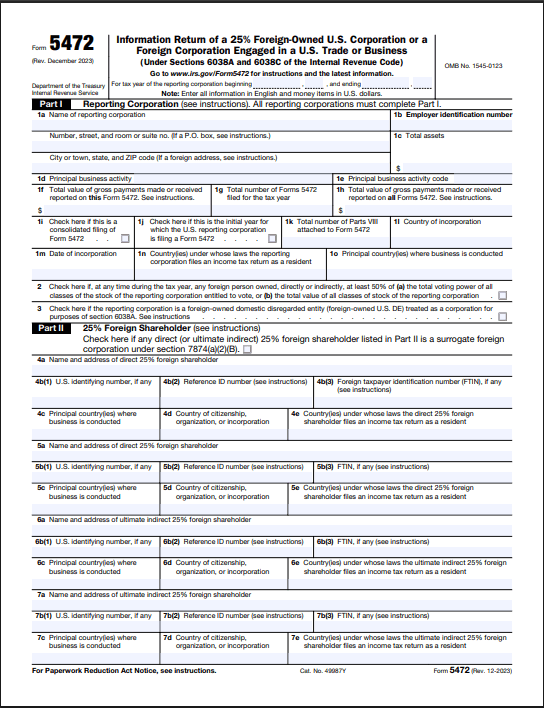
Form 5472 reports the existence of a foreign owner and any “reportable transactions” between the LLC and its owner (such as capital contributions, loans, reimbursements, or distributions).
Even if those transactions are routine or the amounts are modest, the IRS requires formal disclosure to maintain transparency.
2. Pro Forma Form 1120: The Cover Return
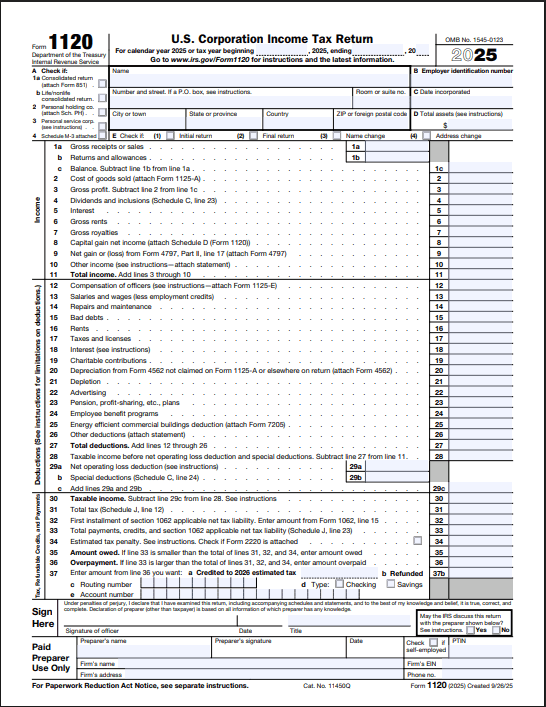
Although a disregarded LLC does not file a full corporate tax return, a pro forma Form 1120 must be submitted alongside Form 5472. It acts as the formal vehicle through which the IRS processes the foreign ownership disclosure.
3. EIN (Employer Identification Number)
An EIN is required even if the LLC has no employees and owes no tax. The EIN is the IRS’s tracking mechanism for the entity, enabling proper filing and compliance oversight.
These filings exist for one reason: visibility. The IRS wants to know who controls US entities and how funds move across borders, even if the ultimate tax due is zero.
The Cost of Getting It Wrong
Many entrepreneurs assume that penalties only apply when tax is unpaid. That assumption is dangerously wrong.
❌ Failure to file Form 5472 may trigger five-figure penalties
The penalty is assessed per year, per form, and can escalate if the failure continues after IRS notification. The absence of tax due does not reduce the penalty amount.
❌ Penalties apply even when your tax due is $0
The IRS treats informational reporting as a separate legal obligation. You can owe nothing in income tax and still face significant penalties purely for non-compliance.
In other words, the IRS does not punish you for paying 0% tax. It penalizes you for failing to properly disclose why you owe 0%.
Now, only a properly structured foreign-owned LLC with foreign-source income can legitimately result in 0% US income tax. But that advantage only holds if the structure is correctly reported and maintained.
This is why serious entrepreneurs don’t DIY compliance, they doola it.
With doola, entrepreneurs get a properly structured US entity, accurate tax classification, and ongoing compliance handled the right way, so even your 0% tax stays legal, defensible, and penalty-free.
Real Scenarios: When Foreign Owners Do (and Don’t) Pay US Tax
The difference between 0% US tax and meaningful US tax exposure often comes down to where business activity happens, not how much revenue the company generates.
Below are four practical scenarios global entrepreneurs frequently encounter, complete with examples and simplified calculations to show why outcomes differ so dramatically.
1. Non-US entrepreneur with US LLC, all operations abroad (0% tax)
Consider an entrepreneur based in Singapore who owns a single-member US LLC. The company sells SaaS subscriptions globally.
All development, marketing, support, and management are performed outside the United States. The entrepreneur has never operated the business while physically present in the US.
Now, let’s say here’s where the business is at:
| Annual Revenue | Expenses | Net Profit |
| $800,000 | $300,000(global contractors, software tools, ads) | $500,000 |
Under US tax rules for non-residents, the key question is: Where were the services performed?
Since the services were performed entirely outside the US and there is no US trade or business, the income is foreign-source and not Effectively Connected Income (ECI).
As a result, US federal income tax due is $0.
Even though the entity is a US LLC, some customers are in the US, and payments flow through US financial systems, the IRS does not tax this income because the economic activity generating the profit occurred outside the US.
The entrepreneur may owe tax in their home country, but at the US federal level, the liability is “zero”.
2. US customers, no US presence (still potentially 0% tax)
Now, consider an entrepreneur in Brazil who sells digital design templates through a US LLC.
Say, for example, here’s their revenue breakdown:
| Total Revenue | Revenue From US Customers | Revenue From non-US Customers |
| $600,000 | $400,000 | $200,000 |
Now, say all design work is done in Brazil and marketing is handled by Brazilian contractors. The individual never travels to the US for business and doesn’t have US employees or facilities.
Many assume that because 67% of revenue comes from US customers, US tax must apply.
But the IRS does not tax based on customer location alone.
Here, the services are still performed outside the US. There is no US office, no US staff, no US warehouse, and no US trade or business. The income remains foreign-source and not ECI.
So, if the revenue is around $600,000, with expenses of $250,000, and a net profit of $350,000, the US federal income tax due is still $0.
3. US warehouse or US-based contractor (likely taxable due to ECI)
Operational presence often triggers ECI. Now, let’s explain this with an example.
A businessman in Germany runs an e-commerce brand through a US LLC. Products are manufactured in Asia but stored in a US warehouse for fast domestic shipping.
Say, here’s where the business is at:
| Annual Revenue | Cost of Goods Sold (COGS) | Operating Expenses | Net Profit |
| $1,000,000 | $500,000 | $200,000 | $300,000 |
Because inventory is stored and orders are fulfilled from within the US, the business now has a US operational footprint. The warehouse creates a US trade or business. The income generated from those sales is likely treated as Effectively Connected Income.
If the $300,000 net profit is considered ECI, it becomes subject to US federal income tax at graduated rates applicable to non-residents.
For illustration, assume an effective federal tax rate of roughly 22–24% on taxable income after deductions.
Approximate US federal tax: $300,000 × 23% ≈ $69,000
That exactly is the difference between:
- A fully foreign-operated model (possibly $0 US tax)
- A US-fulfilled model (tens of thousands in federal tax)
The revenue didn’t change because of entity structure, it changed because of operational presence.
4. Entrepreneur relocates to the US (rules change)
In this case, consider a businessperson from India who previously operated entirely from abroad and paid 0% US federal income tax.
Let’s say they’re generating a revenue of $700,000 with expenses of $250,000, and net profit of around $450,000.
While operating from India, there was no US trade or business and no ECI.
But then the individual moves to the US for one year and continues running the company from a US apartment: negotiating contracts, managing contractors, directing marketing campaigns, and making executive decisions while physically in the US.
Now, the IRS may determine that the business is being carried on within the US. The income becomes effectively connected to a US trade or business.
If the entrepreneur meets substantial presence thresholds, they may even become a US tax resident, potentially exposing worldwide income to US taxation.
Using the same $450,000 profit example:
If classified as ECI and taxed at an effective federal rate of 24%:
$450,000 × 24% ≈ $108,000 in federal tax
It is the same business, generating the same revenue through the same LLC. Yet a different physical presence leads to a fundamentally different tax outcome.
Where Most Foreign Entrepreneurs Go Wrong (And How ECI Turns Small Errors Into Expensive Ones)
Across hundreds of international entrepreneurs doola has worked with, ECI problems almost never come from pushing the limits. They come from misunderstanding how the rules actually apply.
The following breakdown outlines the most common errors, their practical impact under ECI regulations, and how to structure operations to avoid them.
| Mistake | Business Impact (ECI Risk) | How to Avoid / Do It Right |
| ❌ Confusing incorporation with tax residency | Entrepreneurs assume a US LLC automatically makes income taxable. This often leads to unnecessary tax payments or poor restructuring decisions that actually create ECI (e.g., moving operations to the US “since tax applies anyway”). | Treat incorporation as a legal setup, not a tax trigger. Always analyze where work is performed and whether activities create a US trade or business. Entity location ≠ tax residency. |
| ❌ Assuming Stripe or Amazon automatically means US tax | Entrepreneurs conflate payment reporting with taxation. This can cause panic-driven changes, like adding US staff or warehouses, that unintentionally trigger ECI. | Separate money flow from tax rules. Platforms may report transactions, but the IRS still applies source-of-income and ECI tests. |
| ❌ Skipping filings because “there’s no tax” | Even with $0 tax due, missing required filings can trigger automatic penalties and attract IRS scrutiny, sometimes reopening the question of whether ECI exists at all. | Understand that no tax ≠ no compliance. File all required informational forms every year to protect your non-ECI position and avoid penalties. |
| ❌ Following generic startup advice that are not built for non-residents | Advice meant for US entrepreneurs (hire in the US, open offices early, relocate entrepreneurs) can instantly create ECI for non-residents, converting future profits into US-taxable income. | Use the guidance designed specifically for foreign entrepreneurs. Before hiring, relocating, or expanding, evaluate whether the change creates a US trade or business. |
Note: Platforms like Amazon or Stripe may report transactions, but reporting isn’t the same as taxation. The IRS will still apply “source-of-income” and Effectively Connected Income rules.
So, foreign entrepreneurs who preserve the 0% US tax outcome aren’t exploiting loopholes, they’re simply respecting how the law actually works.
How doola Helps Foreign Entrepreneurs Stay Legal While Optimizing Taxes

We’ve been in the trenches. We’ve helped international entrepreneurs expand into the US market, structure their operations correctly, and even build their US businesses from the ground up.
We know what works, and more importantly, we know what breaks when global entrepreneurs set foot in the American market.
Because forming a US company is easy. Forming it correctly as a non-resident, while protecting your 0% tax position and staying fully compliant, is where experience matters.
With doola, foreign entrepreneurs get:
- US business formation tailored specifically for non-residents: We structure your company with foreign ownership in mind, so the entity aligns with source-of-income rules and avoids accidental tax exposure.
- Proper EIN setup and ownership structuring: We ensure your EIN, responsible party details, and ownership disclosures are handled accurately.
- Ongoing IRS compliance monitoring: From Form 5472 to pro forma filings, we make sure required reports are submitted on time, even when your tax due is $0.
Most importantly, you’ll have the peace of mind that your filings are handled, even when tax is zero. Because “no tax” doesn’t mean “no responsibility,” and missing a filing can cost more than the tax itself.
As a final word: 0% US tax is never a loophole.
It’s just how US tax law is written, it benefits those who understand the rules, respect compliance, and build with trusted partners like doola.
Sign up for our services today and expand into the US market with clarity, confidence, and control.
FAQs

Can a foreigner really pay 0% US tax with a US LLC?
Yes, a foreign owner can owe 0% US income tax when the LLC’s income is foreign-source and the business does not create Effectively Connected Income (ECI).
Does having US customers automatically create US tax liability?
No, selling to US customers by itself does not trigger US income tax. The IRS looks at where the work is performed and where the business operates, not where buyers are located.
What’s the difference between no tax and no filing?
You can legally owe $0 in US income tax and still be required to file mandatory IRS forms.
The US tax system separates tax liability from reporting obligations, and skipping filings, even with zero tax, can lead to severe penalties.
Does Stripe or Amazon report my income to the IRS?
Platforms like Amazon or Stripe can report payment activity, but that does not automatically mean the income is taxable.
Reporting helps the IRS see that money moved. Taxability is determined later using source-of-income and ECI rules, not payment processor data alone.
What happens if I accidentally create ECI?
Once an income becomes Effectively Connected Income, it is generally subject to US federal income tax, and your filing obligations expand.
Do I need a tax treaty to qualify for 0% US tax?
Not always. Many entrepreneurs qualify for 0% US tax even without a tax treaty because US law already limits taxation to US-source income for non-residents.
Treaties can provide additional protection, but they are not the starting point.
Can my tax status change as my business grows?
Absolutely. Adding US staff, moving operations, raising capital, or relocating personally can all change your tax profile.

Table of Contents
How the US Taxes Foreign Business Owners in 2026The Key Rule That Makes 0% US Tax Possible: Source of IncomeEffectively Connected Income (ECI): The Line You Must Not CrossCommon Business Structures That Result in 0% US TaxThe Compliance Side Most People Miss (And Why It Matters)Real Scenarios: When Foreign Owners Do (and Don’t) Pay US TaxWhere Most Foreign Entrepreneurs Go Wrong (And How ECI Turns Small Errors Into Expensive Ones)How doola Helps Foreign Entrepreneurs Stay Legal While Optimizing TaxesFAQsStart your 30-day free trial of our bookkeeping software today