

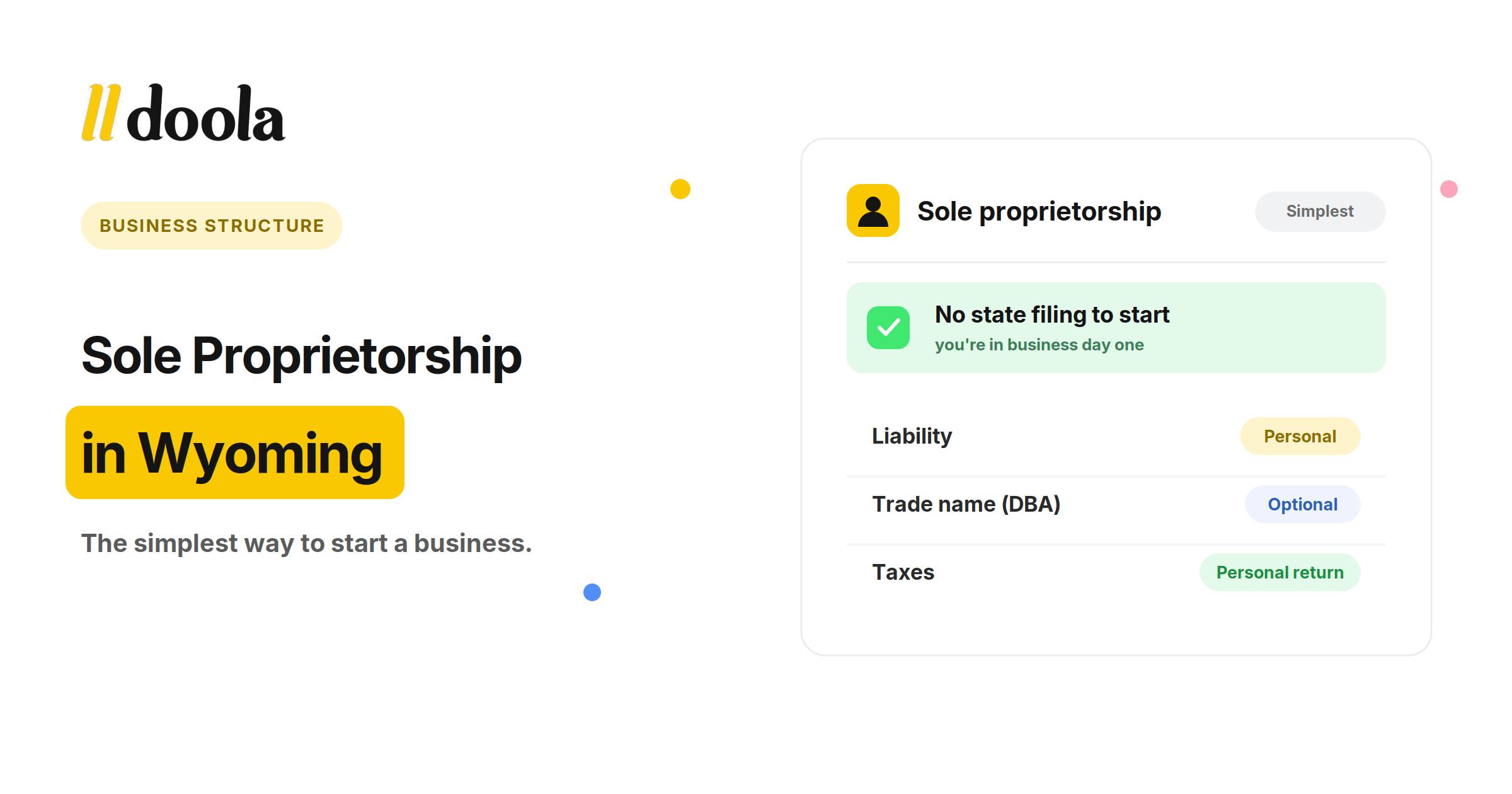
A sole proprietorship in Wyoming forms automatically as soon as you start doing business as an individual. While that means no state registration fees or filings with the Secretary of State, this low-friction setup comes with a few critical caveats. This guide covers all of them.
Quick Check: What Would You Do?
You’re in Lagos, earning $6,000 a month building websites from your desk for two agencies in the US. Then a friend drops by with some serious advice:
“You need to register a Wyoming sole proprietorship to make that income official in America.”
So, what do you do?
Register it immediately: you can’t legally take US money without a US business setup.
Panic slightly: if your clients are in the US, you probably owe uncleared taxes to the IRS.
Register it anyway: it’s the easiest way to trick Stripe into giving you a US business account.
Ignore him: you’re working in Nigeria, so a Wyoming sole proprietorship is completely useless to you.
Pick your answer, then open the box below.
Reveal the Answer
✓ The answer is D
Give yourself a hand. You know more about tax law than your friend does.
Why the Other Three Are Wrong
A: Wyoming Won’t Take Your Filing
Wyoming does not record sole proprietorships, so there is no form, registry, or state fee to register one. Your clients don’t need you to hold a US business to pay you, either. They send you a W-8BEN, you sign it to confirm you live in Nigeria, and they wire the funds.
B: The IRS Tracks Your Desk, Not Your Client
What matters is where you sit when you build the site, not where your client’s office is. Work done from Lagos is generally foreign-source income, so US clients paying your invoice doesn’t trigger a US tax return. Your local tax authority in Nigeria still expects its cut. The exception: if you build websites from a hotel in Atlanta, that work becomes US-source income.
C: Banks Look Past Labels
A sole proprietorship isn’t a company. It’s just you, operating under your own name. Telling Stripe or a US bank you’re a “Wyoming sole proprietor” gets you nowhere because there’s no state database for them to verify. The moment they ask for a US home address and a US tax ID, the application stalls.
So, where does that leave you?
If your clients wire money directly to your bank account in Nigeria, your current setup is ABSOLUTELY fine. You do the work locally, hand over a W-8BEN, and pay local taxes. That’s it.
The setup starts breaking down when you need actual US business infrastructure. If what you need is a US bank account, Stripe, Amazon payouts, or a registered business entity that corporate clients can verify, a sole proprietorship won’t get you there.
That is usually the moment where a Wyoming LLC makes more sense.
Now, if you live and work inside Wyoming, the story changes. You become a sole proprietor the day you take on business, with no state filing and no state personal income tax (though federal taxes still apply).
That setup works while the business stays small, but you’ll want an LLC once bigger contracts, higher liability, a co-founder, or the need for a dedicated business bank account enters the picture.
The rest of this guide breaks down how the Wyoming sole proprietorship setup functions, what changes for non-US founders, what you still need to register, what taxes apply in 2026, and when to make the leap to an LLC.
Which Path Are You Actually On?
You can usually figure out the right direction pretty quickly.
- You live outside the US and work with American clients
You may not need a US business. If you perform the work from your home country, the income is generally not US-source. Clients will usually ask for a W-8BEN, and your local tax rules still apply.
- You need a US bank account, Stripe, or Amazon payouts
US residents can often operate as sole proprietors using an SSN or EIN. Non-US founders usually need a US entity, commonly a Wyoming LLC, to access US banking and payment platforms.
- You live in Wyoming and want to start small
A sole proprietorship may be enough. There is no state formation filing, though local licenses or a sales tax license may still apply.
- You want to use a business name
Wyoming lets you register a trade name for $100. It helps with branding and invoicing, but for non-US founders, it does not replace having a US entity.
- You are thinking about taxes
Wyoming has no personal state income tax. US residents still owe federal income tax and usually 15.3% self-employment tax on net profit. If you live abroad, US tax generally depends on where the work is performed and how the business is structured.
- You want liability protection
A sole proprietorship gives you no legal separation from the business. If the business is sued or cannot pay its debts, your personal assets may be exposed.
- You are comparing a sole proprietorship with a Wyoming LLC
A Wyoming LLC costs about $100 to form, plus a $60 minimum annual report. The bigger difference is legal separation and liability protection. For non-US founders, an LLC also gives banks and payment processors a US entity they can verify.
- Your business is growing
Larger contracts, employees, partners, higher revenue, or more liability risk are good reasons to consider an LLC. Switching later can mean moving contracts, banking, payment processors, licenses, and sometimes tax registrations.
Quick Answer
- Do you need to register a sole proprietorship in Wyoming?
No. Wyoming has no sole proprietorship filing. You may still want a trade name ($100, optional), a sales tax license if you sell taxable goods, and whatever license your city requires.
- Can a non-US resident use one?
Rarely in any useful way. If you’re outside the US and need a US bank account or Stripe, the practical route is a Wyoming LLC, which costs $100 to file and at least $60 a year to keep.
Why a Sole Proprietorship in Wyoming Never Shows Up in the State’s 830,000 Filings
A Wyoming sole proprietorship does not show up in the Secretary of State’s business-entity records because there is usually nothing to file.
Wyoming registers entities such as LLCs, corporations, partnerships, and trade names. A sole proprietorship is different. Wyoming’s own guide, The Choice Is Yours, says there is no mandatory state filing required to operate as a sole proprietor.
If one person starts offering services or selling products in their own name, without forming an LLC or corporation, the business is already being operated as a sole proprietorship.
There is no separate company sitting between the owner and the business.
That means:
- The owner reports the business income personally;
- The owner is personally responsible for the business’s debts; and
- If the business is sued, the owner does not get the liability protection an LLC or corporation can provide.
This is also where the phrase “Wyoming sole proprietorship” can create confusion.
There is no Wyoming entity certificate that turns someone into a Wyoming sole proprietor.
If a person lives in Ohio, works from Ohio, serves clients from Ohio, and has not formed a Wyoming entity, simply describing the business as a “Wyoming sole proprietorship” does not move the business to Wyoming.
For someone outside the US, the picture gets more complicated. You cannot simply call the business a “Wyoming sole proprietorship” and expect Wyoming to become its legal or tax home.
A few things determine how the business is actually treated:
- Where you live: Your country of residence may tax the income, regardless of the Wyoming label.
- Where you do the work: If you are running the business from India, the UK, Germany, or anywhere else, that location can trigger local tax and compliance rules.
- Whether you have US-source income: Some types of US business activity can create US tax or filing obligations.
- Whether you can actually use US banking and payment tools: A non-US sole proprietor may run into additional requirements around bank accounts, payment processors, addresses, and tax IDs.
- Whether a sole proprietorship gives you anything useful in the first place: If the goal is to build a US business presence, separate personal liability, or make banking and payments easier, a sole proprietorship may not solve those problems.
Living Outside the US? Why a Wyoming Sole Proprietorship Usually Won’t Get You Paid
If you live outside the US, a Wyoming sole proprietorship usually does not give you the things people expect from a US business setup.
There is no Wyoming company being created. No entity is filed with the state, and legally the business is still just YOU.
That becomes a problem when you want a US bank account, Stripe account, Amazon payouts, or another service that expects to verify a US business.
The provider is not looking at a Wyoming company. It is looking at you, the individual owner, and asking whether you have the US identity, tax information, or business presence it requires.
Before setting one up, the first question should be simpler:
Do you need a US business at all?
That is also one of the questions that comes up often in one-on-one conversations with international founders. Many assume that working with US clients means they need to register something in the US. In plenty of cases, they don’t.
Here are some questions that we keep getting asked during our consultation calls:
I Freelance From Abroad for US Clients. Do I Need a US Business at All?”
Often, no.
For nonresident aliens, the IRS generally looks at where the work is physically performed when deciding where personal-service income comes from.
So if you live in the Philippines and design websites from your apartment in Manila for a client in New York, the fact that the client is American does not automatically make that income US-source.
A typical setup may look like this:
- You perform all the work outside the US.
- The US client pays you directly.
- You give the client a Form W-8BEN to confirm your foreign status rather than providing a W-9.
- You deal with the tax rules in your own country.
For example, a designer in Manila billing a US agency $4,000 a month does not automatically need to create a Wyoming business just because the customer is in the US.
If the client can already pay you through a bank transfer, Wise, or another service available in your country, a Wyoming sole proprietorship may add paperwork without solving a real problem.
“What If I Actually Work in the US?”
That changes the tax picture.
Services physically performed in the US are generally treated as US-source income. A nonresident may then have US filing obligations, including potentially filing Form 1040-NR.
You may also need an ITIN if you do not qualify for an SSN. The application is made using Form W-7, often together with the federal tax return that creates the need for the ITIN.
There is also a separate immigration question.
Being allowed to enter the US does not automatically mean you are allowed to work there. doola’s own guide for non-residents also points out that immigration status can affect whether and how a nonresident can operate a US business.
So, if you plan to physically perform the work in the US, the problem is no longer just “Should I register a Wyoming sole proprietorship?”
Tax and immigration rules both come into play.
Selling physical products into the US is another case again, because product sales use different sourcing and sales-tax rules than freelance services.
“Why Doesn’t a Wyoming Sole Proprietorship Solve Stripe or US Banking?”
Because there is no separate US company for the provider to verify.
With a sole proprietorship, the owner and the business are the same person. So when a bank or payment processor reviews the account, it can ask for information tied directly to that individual, such as:
- personal tax identification;
- residential or business address;
- proof of identity;
- country of residence; and
- other eligibility information required by the provider.
Simply describing yourself as a “Wyoming sole proprietor” does not create a Wyoming entity, EIN-bearing company, or separate legal person.
That is the key difference from an LLC.
A Wyoming LLC gives a bank or payment processor an actual registered entity to verify. The LLC appears in state records, can obtain its own EIN, and exists separately from its owner.
That still does not guarantee that every bank or payment processor will approve the account, but it gives the founder an actual US entity rather than just a Wyoming label attached to a foreign individual.
“So What Do Non-US Founders Usually Do?”
It depends on what they are actually trying to achieve.
If you simply work from abroad and invoice US clients:
You may not need a US entity at all. If clients can pay you directly and you do not need US banking or payment infrastructure, creating a Wyoming sole proprietorship may offer very little.
If you specifically need US business infrastructure:
If the goal is a US business bank account, Stripe, Amazon US payouts, or contracts where the customer expects to deal with a US company, founders usually look at forming an actual US entity instead.
For many solo international founders, that means a Wyoming LLC with an EIN obtained without an SSN. doola’s guide to Wyoming LLC covers that setup separately.
Which Setup Fits You? Non-US Founder Scenarios
If you do live and work in Wyoming, or you simply want to see what the state asks for, here is what setting one up actually involves.
Do You Have to Register a Wyoming Sole Proprietorship? The One $100 Form Worth Considering
No. Wyoming does not require you to register a sole proprietorship with the Secretary of State.
You can start operating as a sole proprietor without filing a formation document. But depending on how you run the business, you may still need to register a trade name, collect sales tax, get a local license, or apply for an EIN.
The $100 Trade Name Filing
If you operate under your own legal name, you usually do not need to register a business name.
If you want to use a name such as Okafor Studio instead of Jane Okafor, Wyoming lets you register it as a trade name, which is the state’s version of a DBA.
The filing is voluntary. Under Wyo. Stat. § 40-2-104, a person using a trade name may file it with the Secretary of State.
The current filing details are:
- Registration fee: $100
- How to file: The form must be notarized and mailed
- Registration period: 10 years
- Renewal: $50
- Cancellation: $10
Whether the filing is worth it comes down to how you want to present and use the business name.
If clients pay Jane Okafor and the money goes into an account under that name, you may not need a trade name registration.
And, if you plan to invoice clients as Okafor Studio, open a bank account under that name, or maintain consistency across payment providers, securing a trade name certificate is extremely helpful.
Banks and payment platforms often request this certificate as proof before letting you operate under a business name.
One naming rule to know: A sole proprietor should not use terms such as LLC, Inc., or Corp. in the business name because those terms imply that a separate registered legal entity exists.
Sales Tax, Local Licenses, and EINs Are Separate
Not registering the sole proprietorship itself does not mean there are no other registrations.
- Sales tax: If you sell goods or services that are taxable in Wyoming, you may need a sales tax license from the Wyoming Department of Revenue. Wyoming’s state sales tax rate is 4%, with local taxes potentially added on top.
- Local licenses: Wyoming does not have one general statewide business license for every sole proprietor, but cities and counties can impose their own licensing requirements.
- Regulated professions: Businesses such as contracting, cosmetology, and other licensed trades may need approval from the relevant state board.
- EIN: You generally need an EIN if you hire employees or have certain federal filing obligations. Some sole proprietors also get one voluntarily so they do not have to give clients their Social Security number on forms such as a W-9.
One more point: you do not get a new EIN for every trade name. The EIN belongs to the sole proprietor, not to each DBA or trade name.
Wyoming Sole Proprietorship Setup Checklist
Fees, filing requirements, tax rules, banking eligibility, and processing requirements can change, and some depend on your location, business activity, or ownership status. We’ve used the latest information available for 2026, but always check the linked state, IRS, bank, or platform source before you file or make a decision.
Wyoming Sole Proprietorship Taxes in 2026: Zero State Tax, Four New IRS Rules
A Wyoming sole proprietor DOES NOT pay Wyoming personal income tax on business profit as the state has no individual income tax.
The tax bill is mainly federal.
For a US taxpayer, business profit is generally reported on Schedule C with Form 1040. That profit can then be subject to:
- Federal income tax, based on the owner’s total taxable income.
- Self-employment tax, which covers Social Security and Medicare.
The self-employment tax rate is generally 15.3%: 12.4% for Social Security up to the annual limit and 2.9% for Medicare, with an additional 0.9% Medicare tax for some higher-income taxpayers.
Sole proprietors may also need to make quarterly estimated tax payments because there is usually no employer withholding tax for them.
For 2026, four federal changes stand out.
1. The 1099-NEC and 1099-MISC Threshold Is Now $2,000
For payments made in 2026, the reporting threshold for Forms 1099-NEC and 1099-MISC increased from $600 to $2,000.
That changes when a client has to send you a tax form. It does not change when your income becomes taxable.
If eight clients each pay you $1,500, you may receive no 1099-NEC forms, but you still earned $12,000 and must report that income.
2. The 1099-K Threshold Is Back to $20,000 and 200 Transactions
For payment processors such as PayPal, Stripe, and Shopify Payments, the federal Form 1099-K threshold is again more than $20,000 and more than 200 transactions.
The proposed $600 threshold was delayed several times, after estimates showed it could dramatically increase the number of forms issued.
The key point for founders is simple: if you do not receive a 1099-K, the income is still taxable.
3. The QBI Deduction Is Permanent
Eligible sole proprietors can continue using the qualified business income deduction. It can allow eligible owners to deduct up to 20% of qualified business income when calculating federal taxable income.
From 2026, eligible taxpayers with at least $1,000 of qualified business income can also qualify for a minimum deduction of $400. Higher-income owners and some service businesses can face additional limits.
4. The Social Security Tax Cap Increased to $184,500
For 2026, the Social Security wage base increased to $184,500, up from $176,100.
That means the 12.4% Social Security portion of self-employment tax can apply to a larger amount of net earnings than it did in 2025.
A sole proprietor with earnings at or above the cap could therefore pay up to $22,878 in the Social Security portion of self-employment tax, before Medicare tax and federal income tax.
No Form 1099 Still Means Taxable Income
The 2026 thresholds change who has to send you a form. The tax you owe is calculated the same way.
Keep your own income records from the first invoice, especially if money arrives through PayPal or a plain bank transfer.
One detail matters for the bigger decision. A single-member LLC is taxed exactly like a sole proprietorship by default, QBI deduction included. Everything above assumes you are a US resident.
For a non-resident alien most of it works differently, as covered in the non-US section earlier in this guide.
Wyoming LLC vs. Sole Proprietorship: What $60 a Year Actually Buys You
The difference between the two is $100 once and $60 a year paid to the state. By default the tax math comes out nearly identical.
Where they part ways is personal liability, and whether a US bank will open an account for you.
Three-Year State Cost: Wyoming Sole Proprietorship vs. LLC
The figures cover the main state and federal fees we verified for 2026. Your actual cost may be higher once you add things like registered agent fees, local licenses, notary charges, banking fees, insurance, or professional help.
Add registered agent fees to the LLC row. The annual report fee is $60 or $0.0002 per dollar of assets located in Wyoming, whichever is greater, so most small online businesses pay the minimum.
Why Banks Look Harder at Wyoming LLCs
ICIJ found that one address accounted for over 40% of new Wyoming incorporations from 2019 to 2024, and it cited a 2023 GAO review in which more than 70% of 989 recipients of allegedly fraudulent PPP loans were shell companies or fictitious entities.
Banks read the same reports. Using a reputable registered agent and a signed operating agreement helps a Wyoming LLC through that scrutiny, and you should expect a few extra questions at account opening.
Privacy Survived 2026, for Now
Senate File 82 would have required registered agents to keep the names and addresses of the owners behind each Wyoming entity. It passed the Senate and died in a House committee.
A working group is studying registered agent rules ahead of the 2027 session, so treat today’s privacy as current law that may change. Separately, FinCEN no longer requires US-formed companies to file beneficial ownership reports.
The Filing Foreign Owners Can’t Skip
A foreign-owned single-member LLC files Form 5472 with a pro forma Form 1120 every year, even in a year with zero US tax and zero revenue. The penalty for missing it is $25,000.
When a Sole Proprietorship in Wyoming Is the Smart Move (Yes, Sometimes It Is)
A sole proprietorship can make sense when you are starting small, testing an idea, and do not yet need the protection or infrastructure of an LLC.
It is usually a reasonable fit when:
- you live and operate the business in Wyoming;
- you are the only person working in the business;
- you are testing a new idea before committing more money to it;
- your business has little legal or financial risk;
- you are not selling products that could create product-liability claims;
- you are not signing large contracts with heavy penalties; and
- your revenue is still low enough that keeping costs and paperwork minimal matters.
For example, if you are doing freelance design, consulting, tutoring, or another low-risk service on the side, forming an LLC on day one may be more structure than you need.
The trade-off is that there is no legal separation between you and the business. If the business owes money or gets sued, your personal assets are not automatically protected. That is usually the point where founders start reconsidering the structure.
You may want to move to an LLC when:
- revenue becomes meaningful;
- you sign larger client contracts;
- you hire people;
- you start selling higher-risk products or services; or
- you simply want a clearer separation between your personal finances and the business.
You do not have to get the decision perfect on day one. Plenty of founders start as sole proprietors, prove the idea, and form an LLC once the business is worth protecting.
5 Wyoming Sole Proprietorship Risks That Never Show Up on a Fee Schedule
Here are the five problems founders tend to run into:
1. One Bad Client Dispute Can Become Your Personal Problem
There is no legal wall between you and the business.
Say you are a freelance developer and a client claims your work caused them a $50,000 loss. If the client sues and wins, the claim is not limited to some separate business account. Your personal money and other assets can be exposed too.
This is one of those risks that feels theoretical until the first serious contract, refund dispute, or legal notice lands in your inbox.
2. Switching to an LLC Later Is Not Just Changing the Name
Founders often assume they can start as a sole proprietor and simply “convert” everything later.
It is rarely that easy.
Imagine you have 12 active client contracts under your own name, then form an LLC six months later. Those contracts do not automatically become contracts with the LLC.
You may need new signatures, client approval, or a formal assignment. The same goes for invoices, software accounts, insurance, and sometimes banking details. This pattern becomes annoying right after the business starts growing, which is exactly when you have less time to deal with admin.
3. Adding a Co-founder Means Rebuilding the Structure
A sole proprietorship can only have one owner.
So, if a friend joins and you agree they now own 30% of the business, you cannot simply add their name to the sole proprietorship. You need a new structure, usually an LLC or partnership, and then move the business into it.
That can mean transferring contracts, intellectual property, domains, accounts, and other assets. Founders tend to discover this after the partnership conversation has already happened, not before.
4. Mixing Personal and Business Money Gets Ugly Fast
As there is no separate legal entity, many sole proprietors use the same account for everything.
A client pays $3,000. Groceries come out of the same account. Then a software subscription, rent, a flight, and another client payment all get mixed together. Six months later, you are trying to figure out which transactions belong to the business and which do not.
That is where bookkeeping gets painful, especially when you do not receive a tax form for every payment. doola’s Bookkeeping guide covers how to separate business and personal money from the start.
5. Bigger Clients May Stop Taking You Seriously as a Vendor
Small clients may not care whether you are a sole proprietor. Larger companies often do.
For example, a procurement team may ask for a registered business name, EIN, insurance certificate, company bank account, or entity documents before they add you as a vendor.
If you are operating only in your own name, the deal can stall until you form an LLC and redo the paperwork. This tends to happen at the exact point when the business starts landing better clients.
The pattern is pretty simple: A sole proprietorship works well while the business is small and uncomplicated. The risks show up when the business stops being small and uncomplicated.
How to Switch to an LLC in 7 Steps
Here is how you can switch to an LLC from a sole proprietorship:
Step 1: Pick a Name the State Will Accept and a Registered Agent You Trust
Wyoming requires an LLC’s name to include “Limited Liability Company” or an accepted abbreviation such as “LLC” or “L.L.C.” It also has to be distinguishable from every other name on file.
Run it through the free business search before you fall in love with it. If your trade name is already “Okafor Studio,” then “Okafor Studio LLC” is the obvious choice, provided nobody else got there first.
Every Wyoming LLC needs a registered agent with a physical street address in the state, someone who will accept legal papers and state mail on the company’s behalf.
If you live in Wyoming you can act as your own. If you don’t, you hire a commercial agent.
Given everything reported about 30 N. Gould St., choose one that actually asks who you are and forwards your mail the day it arrives. A bank reviewing your account will look at that address too.
Step 2: File Articles of Organization Online ($100)
File through the Wyoming Business Center. The state filing fee is $100.
The form asks for the LLC’s name, the registered agent, a mailing address, and the person organizing the filing, and Wyoming also requires the registered agent’s written consent to the appointment. It doesn’t ask you to list the members, which is where the state’s privacy reputation comes from.
Online filings are usually approved quickly. Save the approved Articles as a PDF the moment they arrive, because nearly everyone you deal with from here on will ask for them.
Step 3: Sign an Operating Agreement, Even if You’re the Only Member
Wyoming doesn’t require you to file an operating agreement with the state, and it doesn’t require a single-member LLC to have one at all. Write one anyway.
It records who owns the company, how money moves in and out, who can sign for it, and what happens if you die or sell. Banks routinely ask for it, and it is part of how you show a court that the LLC is a real business separate from you.
A single-member agreement can be a few pages long. Sign and date it, then keep it with the Articles.
Step 4: Get a New EIN for the LLC
The EIN from your sole proprietorship belongs to you as an individual and doesn’t carry over. The IRS confirms that a new LLC needs its own EIN in this situation.
If you have an SSN or ITIN, the IRS online application takes a few minutes. If you don’t, you file Form SS-4 by fax or mail, listing yourself as the responsible party.
Fax is the faster of the two, and mail can take several weeks. The confirmation letter the IRS sends with your number is another document banks expect to see, so keep it next to the Articles.
Step 5: Open a Bank Account in the LLC’s Name
Bring the approved Articles, the EIN confirmation, the operating agreement, and your passport or other ID. US residents can walk into most banks.
Non-residents apply online, with fintech banks that accept foreign-owned LLCs, and should expect identity checks and, now and then, a request for a website or a couple of sample invoices.
From the first day, business money goes through this account and personal spending stays off it, rent included.
Step 6: Move Clients, Contracts, Payments, and Licenses Into the LLC
Your old contracts name you personally.
For each active client, either sign a short assignment moving the contract to the LLC or sign a fresh agreement in the LLC’s name, and send the client updated payment and tax details so future invoices match the new entity.
Then work through everything else that carries your personal name. Stripe, PayPal, Shopify, and Amazon accounts need updating, and some processors make you open a fresh account under the LLC and its EIN.
If you collect sales tax, register the LLC with the Wyoming Department of Revenue and close the old account once the switch is done.
Licenses are trickier, because most are issued to a specific person or entity. Ask whoever issued yours whether it can be transferred or has to be reissued. Equipment, domains, and inventory move into the LLC as a capital contribution or a documented sale, and either way you want it written down.
Your invoices and website should show the full LLC name from here on, so nobody mistakes which entity they’re dealing with.
Step 7: Deal With Your Old Trade Name and Close Out the Sole Proprietorship
Your old trade name was registered to you personally. Cancel it with the Secretary of State for $10, or, if you want the LLC to keep trading under that name, register a new trade name in the LLC’s name for $100.
The sole proprietorship itself has nothing to dissolve with the state, because nothing was ever filed. US residents report the months before the switch on a final Schedule C with their personal return.
The LLC picks up from the day it took over.
After the Switch: The Calendar That Keeps the LLC in Good Standing
Wyoming LLC annual reports are due each year on the first day of your company’s anniversary month, along with a minimum $60 license tax.
Missing this deadline can lead to state dissolution, creating serious complications during routine banking reviews.
Foreign owners must also file Form 5472 alongside a pro forma Form 1120 by the federal deadline every year, regardless of whether the business generated revenue. Missing this requirement carries a $25,000 penalty per unfiled form.
Switching From a Wyoming Sole Proprietorship to an LLC: Costs and Paperwork
Switching from a sole proprietorship to an LLC in Wyoming requires a step-by-step transition process rather than a simple conversion form.
Because a sole proprietorship is legally indistinguishable from you, converting means establishing a brand-new legal entity and transferring your operations over to it.
Here is a step-by-step breakdown of how the process works, what it costs, and the essential documents you must keep on file:
These numbers are based on the standard Wyoming and IRS requirements. Your actual total can vary depending on your registered agent, bank, local licenses, notary or filing fees, and whether contracts or permits need to be reissued. Always check the linked state, IRS, and provider requirements before making the switch.
Outgrowing Your Wyoming Sole Proprietorship? Here’s How doola Helps

Like we mentioned earlier, a sole proprietorship is the easiest way to start, but it leaves your personal assets exposed.
When you’re ready for more protection, doola can make the switch to a Wyoming LLC simple.
With doola, we help you file your Wyoming LLC, get your EIN, and give you a registered agent and a US business address. And, that’s everything you need to start operating as a separate legal entity.
From there, we can keep your books organized from day one, so expenses from your sole proprietorship years and your new LLC stay clearly separated.
Still running a small, low-risk side business? A sole proprietorship may be all you need for now. When the time comes to grow, doola is ready.
FAQs

Do I need a business license for a sole proprietorship in Wyoming?
Wyoming has no general state business license. Check your city and county, any license your trade requires, and register for sales tax with the Department of Revenue if you sell taxable goods or services.
Does Wyoming tax sole proprietors?
No. Wyoming has no personal income tax. US residents still owe federal income tax and 15.3% self-employment tax, with the Social Security portion capped at $184,500 of earnings in 2026.
My client didn’t send me a 1099 in 2026. Do I still report the income?
Yes. The $2,000 threshold only decides who has to send a form. Every dollar of business income goes on your return.
Can I use “LLC” in my sole proprietorship’s name?
No. A sole proprietor’s trade name can’t include LLC, Inc., or Corp., because no registered entity stands behind it.
Can a foreigner run a Wyoming sole proprietorship?
Nothing blocks the label, but it rarely helps. Work done abroad is generally foreign-source income for a nonresident, and US banks and payment processors want a verifiable US business.
Most non-US founders who need US accounts form a Wyoming LLC.
Is a single-member LLC taxed like a sole proprietorship?
Yes, by default, including the 20% QBI deduction for US owners. A foreign-owned single-member LLC also files Form 5472 with a pro forma 1120 each year.

![Sole Proprietorship in Wyoming: Free to Start, Costly to Get Wrong in [year]](https://www.doola.com/wp-content/uploads/2026/04/bottom-cta-new.png "Sole Proprietorship in Wyoming: Free to Start, Costly to Get Wrong in [year]")
