
![Best Bank Accounts for Small Businesses in [year]: Compare Fees, Features and Choose the Right One](https://www.doola.com/wp-content/uploads/2025/11/banner-cta-new.png "Best Bank Accounts for Small Businesses in [year]: Compare Fees, Features and Choose the Right One")
Form Your LLC Today. Foreign Founders Welcome.

Best Bank Accounts for Small Businesses in 2026: Compare Fees, Features and Choose the Right One

The best business bank account is the one that fits how your business actually operates. A freelancer sending a few invoices each month needs something very different from an e-commerce brand processing thousands of transactions or a startup preparing to raise funding.
That’s why choosing a business bank account can feel overwhelming.
Every provider claims to be the “best,” every comparison ranks them differently, and the fine print on fees often tells a different story than the marketing headline.
Instead of looking for a one-size-fits-all winner, it’s better to compare accounts based on your business model, banking needs, and long-term goals.
What looks like the “top” pick in one roundup might charge you hidden monthly fees, lock you into minimum balances you can’t realistically maintain, or simply not support the way you actually get paid.
This guide skips the generic rankings. Instead, you’ll get a practical, decision-first breakdown of the best business bank accounts in 2026, organized by fees, features, and the specific type of business you’re running, so, you can match an account to your needs instead of guessing.
Before you choose a business bank account, make sure your business is set up the right way. Start your US LLC with doola →
TL;DR: Best Bank Accounts for Small Businesses
- Best overall: Mercury, for $0 monthly fees, strong FDIC coverage, and a clean dashboard that works well for most LLCs
- Best for low fees: Relay, with no minimum balance and no monthly maintenance fee on its Starter plan
- Best for freelancers and solopreneurs: Lili, built specifically for sole proprietors and single-member LLCs
- Best for startups: Mercury for it’s business-friendly tools, API access, and strong FDIC sweep coverage
- Best for e-commerce: Novo, with built-in invoicing, Stripe and Shopify integrations, and ATM fee reimbursements
- Best for international payments: Wise Business or Airwallex, for multi-currency holding and low FX fees
- Key deciding factor: fees matter less than fit. Match the account to your transaction volume, business stage, and whether you need physical branches or pure online banking
Who This Guide Is For
This guide is for you if you fall into one of these groups:
- You’re a freelancer or solopreneur who needs to separate personal and business income without paying for features you’ll never use
- You’re a startup owner who needs an account that scales with fundraising, payroll, and investor reporting
- You’re running an e-commerce business and need integrations with Stripe, Shopify or Amazon, plus tools to track inventory spend separately from marketing spend
- You run an agency or service business and need to manage client payments, contractor payouts, and tax set-asides without juggling spreadsheets
Note: If you’re a side hustler still testing an idea, you can usually start with a no-fee account and upgrade later. If you’re scaling fast, prioritize an account that won’t force a migration once you outgrow it.
And if you do business internationally, whether that’s paying overseas contractors or collecting payments from customers abroad, multi-currency support should weigh heavily in your decision.
What Is a Business Bank Account (And Why It Matters)
You register a business bank account under your company’s legal name and EIN, not your own. It keeps your business income and expenses separate from your personal finances, which matters for both legal protection and tax clarity.
How It Works for Small Businesses
The flow is straightforward: your business receives income into the account, you pay expenses and vendors out of it, and at tax time, your bookkeeping is clean because every transaction in the account is a business transaction.
Compare that to a personal account, where business and personal spending get mixed together and every tax season becomes an exercise in untangling receipts.
If your business is structured as an LLC, keeping finances separate isn’t just good practice.
Mixing personal and business funds can lead a court to “pierce the corporate veil,” which strips away the liability protection an LLC is supposed to provide in the first place. However, keep in mind, this is one factor among several and varies by state.
End-to-End Money Flow
Here’s the simplest way to think about it.
A customer pays your business. The payment lands in your business bank account. You use that account to pay for expenses like software subscriptions, contractor payments, or inventory. Whatever remains is your profit. Then, you set aside a portion of that profit for taxes.
A good business bank account makes each of these steps easier to track, often with sub-accounts or tagging tools built in specifically for that purpose.
How to Choose the Right Business Bank Account
Business bank accounts can look almost identical on paper until you start using them.
The differences show up in the details: transaction limits, integrations, fees, and features that match your stage of growth. Let’s break them down.
Based on Your Business Type
- Freelancers and solopreneurs generally want low (or no) fees and simple interfaces, since they’re not managing payroll or multiple team cards.
- Startups need accounts that support investor reporting, cap table tools, and eventually payroll integrations.
- E-commerce businesses benefit most from accounts with strong Stripe, Amazon, or Shopify integrations and cash back on inventory and ad spend.
Based on Transaction Volume
If you’re processing a high volume of transactions, check whether the account caps free transactions per month or charges per-transaction fees beyond a certain threshold.
Many online-first accounts advertise “unlimited” transactions, but it’s worth confirming this applies to ACH, wires, and card payments, not just one type.
Based on Fees & Cost Structure
Most online business banking platforms now charge $0 in monthly fees, a significant shift from a few years ago when even basic business checking carried a monthly charge.
Don’t focus only on the headline fee. Pay close attention to minimum balance requirements. Check wire transfer costs, too.
Also, see what happens to your fee structure if your balance falls below the required threshold.
Quick Comparison: Best Business Bank Accounts at a Glance
| Bank | Monthly Fee | Minimum Balance | Best For | Key Feature |
|---|---|---|---|---|
| Slash | $0 | None | Spend management and growing businesses | FDIC coverage up to hundreds of millions via partner sweep network |
| Mercury | $0 | None | Startups and most LLCs | Up to $5M in FDIC sweep coverage |
| Relay | $0 (Starter) | None | Profit-first budgeting | Up to 20 sub-accounts |
| Novo | $0 | None | E-commerce | Stripe and Shopify integrations |
| Lili | $0 | None | Freelancers and sole proprietors | Built-in tax and set-aside tools |
| Wise Business | $0 (one-time setup fee may apply) | None | International payments | Multi-currency holding in 40+ currencies |
| Airwallex | $0 | None | Global e-commerce | 20+ currencies, FX at near interbank rates |
| Bluevine | $0 | None | Earning interest on balances | Competitive APY on checking |
Note: Fees and features change frequently. Confirm current terms directly with each provider.
Best Bank Accounts for Small Businesses
We’ve compared some of the best business bank accounts based on what they do best, from managing everyday expenses to supporting international payments and fast-growing businesses.
Slash: Best for Spend Management & Growing Businesses
Monthly fees: $0 on the Free plan
Minimum balance: None
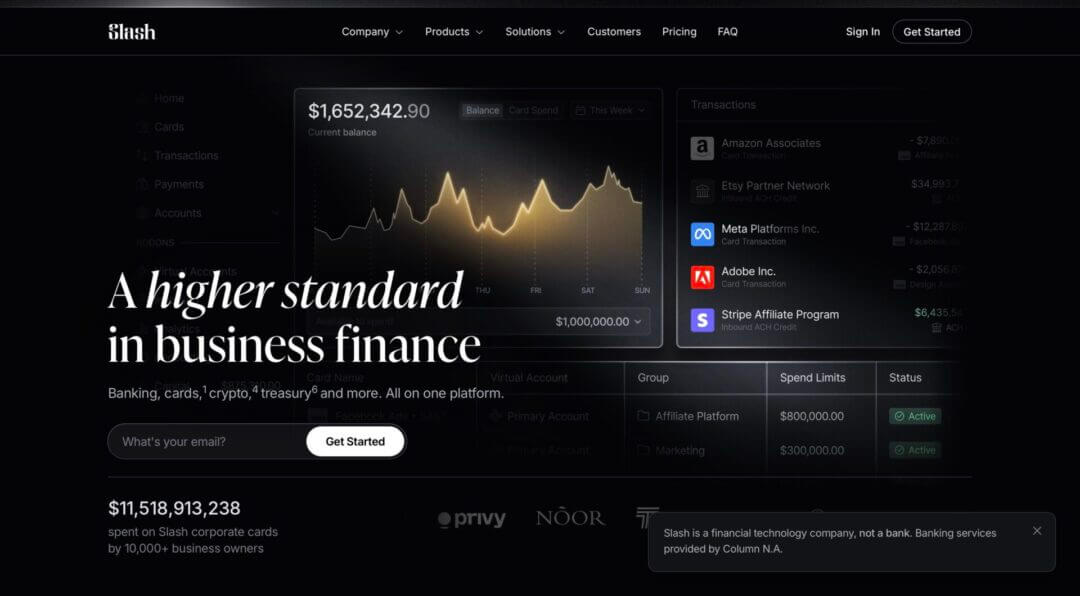
Slash combines business banking, corporate cards, and spend management into a single platform, making it especially appealing for fast-growing startups and small businesses.
With built-in expense controls, generous cashback, and deep accounting integrations, it helps entrepreneurs manage cash flow and team spending without juggling multiple tools.
Key features: FDIC coverage up to hundreds of millions through partner bank Column N.A.’s sweep network, unlimited virtual cards with granular spend controls, up to 2% cashback with no caps, free domestic wires and ACH on qualifying plans, direct integrations with QuickBooks, Xero, and NetSuite
Pros:
- No monthly fees or minimum balance on the core plan
- Cashback with no spending caps or bonus categories to track
- Strong spend controls, letting you set vendor-specific limits and get alerts on unauthorized activity
- Fast setup, with most accounts verified and ready to use the same day
Cons:
- International wires carry a flat $25 fee
- Lending products run through credit partners rather than Slash directly, so approval timelines vary
Why choose this?
Slash is doola’s banking partner, which means it’s built to work seamlessly with the formation and compliance setup you’re already handling through doola.
If you want banking, cards, and cash flow visibility in one dashboard without monthly fees, Slash is one of the strongest fits for a growing small business.
Mercury: Best for Startups, SaaS companies, & US LLCs
Monthly fees: $0
Minimum balance: None
Mercury is one of the most popular fintech platforms for startups and LLCs, offering a clean, fee-free banking experience with modern financial tools.
It’s particularly well-suited for entrepreneurs who want fast onboarding, strong integrations, and a scalable banking solution that grows with their business.
Key features: Free domestic and international USD wires, API access, advanced user permissions, FDIC sweep coverage up to $5 million
Pros:
- No monthly fees or minimum balance requirements
- Strong integrations for startups, including cap table and investor update tools
- Fast online approval, often within minutes once documents are submitted
Cons:
- Doesn’t work with certain industries, including crypto and cannabis businesses
- No physical branches
- Tightened requirements mean it now generally expects a physical US address rather than a registered agent address
Why choose this?
If you want a single account that covers most small business needs without monthly costs, Mercury is the most well-rounded option on the market.
Relay: For Low Fees & Budgeting
![Best Bank Accounts for Small Businesses in [year]: Compare Fees, Features and Choose the Right One](https://www.doola.com/wp-content/uploads/2026/07/image-4-1080x513.jpg "Best Bank Accounts for Small Businesses in [year]: Compare Fees, Features and Choose the Right One")
Monthly fees: $0 on the Starter plan
Minimum balance: None
Relay is designed to simplify business budgeting by letting you create multiple checking accounts for different financial goals, such as taxes, payroll, and operating expenses.
It’s an excellent choice for entrepreneurs who want better cash flow organization without paying monthly banking fees.
Key features: Up to 20 individual checking accounts per business, up to 50 free Visa debit cards, cash back on card spend.
Pros:
- No minimum balance or monthly maintenance fee
- Easiest platform for separating operating, tax, and profit funds
- Strong FDIC coverage through its banking partner
Cons:
- No support for holding non-USD currencies
- Requires a physical US operating presence to qualify
Why choose this?
If staying organized matters more than any single feature, Relay’s sub-account structure does the budgeting work for you automatically.
Novo: Best for E-Commerce

Monthly fees: $0
Minimum balance: None
Novo is built with online businesses in mind, offering seamless integrations with platforms like Shopify, Amazon, and Stripe to reduce manual financial admin. It’s streamlined banking experience makes it a strong fit for entrepreneurs running ecommerce brands or digital-first businesses.
Key features: No fees on ACH transfers or incoming wires, ATM fee reimbursement up to $7 per month, built-in invoicing, direct Stripe integration.
Pros:
- Designed specifically around e-commerce workflows
- Simple, fast online setup
- Some account tiers now offer interest on balances
Cons:
- Requires beneficial owners to hold a US Social Security Number, which rules it out for many non-resident entrepreneurs
- Limited international wire support compared to multi-currency platforms
Why choose this?
If your business lives on Shopify or Amazon, Novo’s integrations remove a layer of manual reconciliation work.
Lili: Best for Freelancers & Solopreneurs
Monthly fees: $0 on the core plan
Minimum balance: None
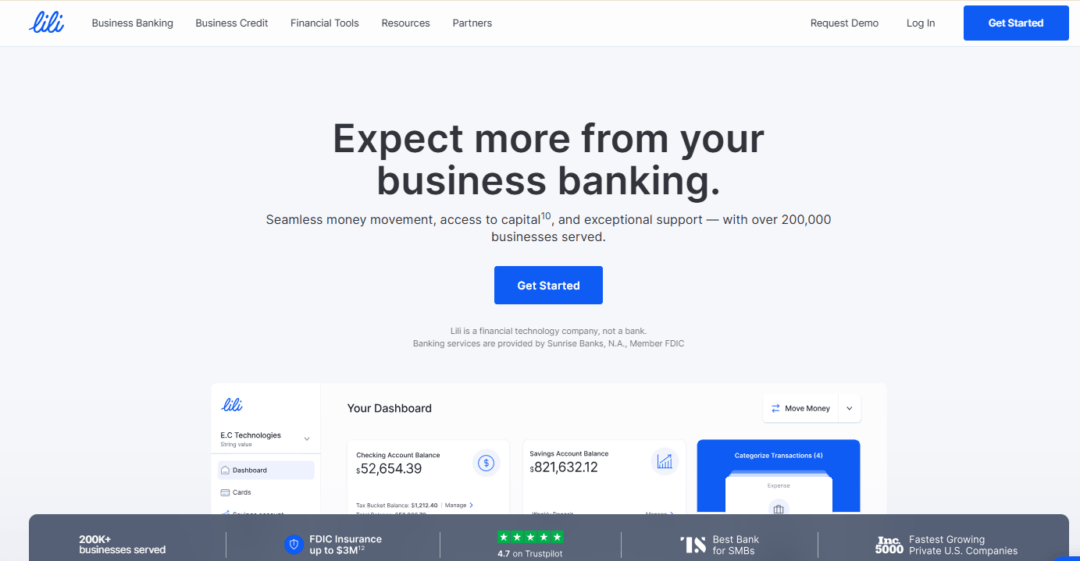
Lili focuses on the needs of freelancers, contractors, and solo business owners by combining banking with built-in bookkeeping and tax tools. Its simple interface and self-employed-friendly features make it easy to separate business finances without unnecessary complexity.
Key features: Built-in tax set aside calculator, expense tracking by category, access to working capital for eligible accounts
Pros:
- Simple setup with minimal documentation required
- Tax tools built for self-employed income, not just generic business banking
- Doesn’t require a physical US address for some account types
Cons:
- Fewer advanced tools for businesses with employees or high transaction volume
- Some premium features are excluded for non-US citizens
Why choose this?
If you’re a one-person business that just needs clean separation between personal and business money, Lili is built around exactly that use case.
Wise Business: Best for International Payments

Monthly fees: $0, though a small one-time setup fee may apply
Minimum balance: None
Wise Business specializes in helping companies send, receive, and manage money across borders with low foreign exchange fees and multi-currency accounts. It’s particularly valuable for businesses with international clients, contractors, or suppliers that want to avoid expensive traditional bank conversion rates.
Key features: Hold and convert 40+ currencies, mid-market exchange rates, available in 170+ countries
Pros:
- Among the easiest accounts for non-US residents to get approved for
- Significantly lower FX fees than most traditional banks
- Provides a real US routing and account number accepted by major payment processors
Cons:
- Wise is a licensed money services business, not a bank. Your funds automatically receive FDIC pass-through insurance for up to 250,000 USD through their Program Bank
- Doesn’t build US business credit history the way a traditional bank relationship would
Why choose this?
If your business regularly sends or receives money across borders, Wise removes a meaningful chunk of the currency conversion cost.
🔖 Related Reading: 6 Wise Alternatives for Non-US Residents in 2026
Airwallex: Best for Global E-commerce
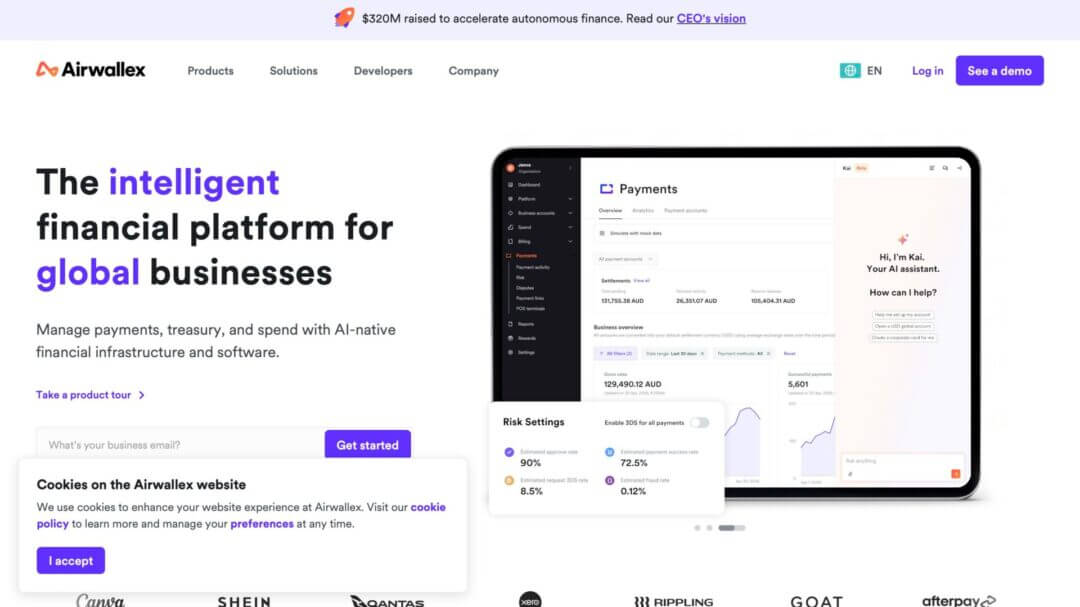
Monthly fees: $0 on standard plans
Minimum balance: None
Airwallex is a global financial platform built for businesses operating across multiple countries and currencies. It combines multi-currency accounts, international payments, and foreign exchange tools into one solution, making it ideal for companies scaling globally.
Key features: Multi-currency accounts in 20+ currencies, near-interbank FX rates, payments to 120+ countries
Pros:
- Avoids forced currency conversion on incoming international payments
- Strong automation tools for global vendor payments
- Competitive option for entrepreneurs excluded from other platforms due to country restrictions
Cons:
- More built for scaling global operations than simple domestic banking
- Onboarding documentation requirements can be more involved than domestic-first platforms
Why choose this?
If your customers or suppliers span multiple countries and currencies, Airwallex is built to handle that complexity without bleeding money on conversion fees.
Bluevine: Best for Earning Interest
![Best Bank Accounts for Small Businesses in [year]: Compare Fees, Features and Choose the Right One](https://www.doola.com/wp-content/uploads/2026/07/image-3-1080x566.jpg "Best Bank Accounts for Small Businesses in [year]: Compare Fees, Features and Choose the Right One")
Monthly fees: $0 on the standard checking plan
Minimum balance: None
Bluevine is a digital business banking platform that stands out by offering competitive interest on eligible checking balances alongside everyday business banking features. It’s a strong option for businesses that maintain higher cash reserves and want their idle funds to generate additional returns.
Key features: Competitive APY on checking balances, line of credit options for qualifying businesses
Pros:
- One of the stronger options for earning interest on a business checking balance
- No monthly fees or minimum balance requirements
Cons:
- Fewer multi-account organizational tools compared to Relay
- Lending products require separate underwriting
Why choose this?
If you tend to keep a healthy cash buffer in your business account, Bluevine lets that balance work for you instead of sitting idle.
Best Business Bank Accounts by Category
✔️ Best for Freelancers
Lili leads here, with tax set aside tools and a setup process built around solo operators rather than teams.
✔️ Best for Startups
Mercury remains the default for tech and SaaS entrepreneurs, particularly once investor reporting and payroll integrations come into play.
If spend management and cashback matter more to you, Slash is a strong alternative, especially once you’re issuing cards to a growing team.
✔️ Best for E-Commerce Businesses
Novo’s Stripe and Shopify integrations make it the strongest fit for online sellers managing inventory and ad spend.
✔️ Best for Low Fees
Relay and Mercury both charge $0 per month with no minimum balance, making either a safe default if cost is your top priority.
✔️ Best for International Transactions
Wise Business (formerly Transfer Wise) and Airwallex both outperform domestic-first banks on currency holding and FX rates, making them the clear picks if your business operates across borders.
Key Features to Look for in a Business Bank Account
- Transaction Limits & Charges: Confirm whether ACH transfers, incoming wires, and debit transactions are genuinely unlimited or capped at a certain volume before fees kick in. A business processing hundreds of transactions a month can hit limits that a freelancer never will.
- Integrations with Accounting Tools: Look for direct integrations with bookkeeping software. An account that syncs automatically with your accounting tools saves hours of manual reconciliation every month.
- Online & Mobile Banking Experience: Since most of these accounts have no physical branches, the quality of the app and dashboard matters more than it would with a traditional bank. Check for mobile check deposit, real-time transaction alerts, and how easily you can issue cards to team members.
- Access to Credit & Financing: Some platforms offer lines of credit or working capital advances tied to your account history. If you anticipate needing financing down the line, banking with a provider that offers this can simplify approval since they have visibility into your cash flow.
- Customer Support Quality: Online-only banks vary widely in support responsiveness. If your business depends on fast resolution during a payment issue, read recent reviews specifically about support response times before committing.
Common Fees That Can Eat Into Your Profits
- Monthly maintenance fees: Traditional banks often charge $15 to $25 per month, though many waive this with a minimum balance or linked spending
- Transaction fees: Some accounts charge per-transaction fees once you exceed a free monthly allotment
- ATM and cash deposit fees: Online-first banks frequently charge for cash deposits since they lack their own branch network
- International transfer fees: Currency conversion markups can be the single largest hidden cost for businesses paying international vendors or contractors
- Penalties: Falling below a minimum balance or exceeding transaction limits can trigger fees that erase the “free” account marketing
Documents Required to Open a Business Bank Account
- Employer Identification Number (EIN) confirmation letter from the IRS
- Business formation documents, such as Articles of Organization or Incorporation
- Operating Agreement, required by some providers
- Government-issued photo ID for all owners and authorized signers
- Proof of business address, which may need to be a physical US address depending on the provider
- Basic business details, including expected monthly transaction volume, industry, and revenue estimates
Step-by-Step: How to Open a Business Bank Account
- Choose your US bank based on your business type, fee tolerance, and whether you need international support
- Gather your documents, including your EIN, formation documents, and ID for all signers
- Apply online or in person, depending on the provider
- Complete identity verification, which typically includes KYC checks on all beneficial owners
- Activate your account and link it to your payment processor, accounting software, or payroll system
Pros and Cons of Business Bank Accounts
Pros:
- Keeps personal and business finances cleanly separated
- Protects LLC liability status by avoiding commingled funds
- Builds a financial track record for your business that can support future lending
- Simplifies tax filing and bookkeeping
Cons:
- Some providers require minimum balances or charge fees that can offset the convenience
- Online-only accounts may lack the in-person support some business owners prefer
- Approval can be more difficult for non-US residents depending on the provider’s current requirements
Common Mistakes to Avoid
Even the best business bank accounts in the US can become an expensive mistake if you choose it for the wrong reasons.
So, avoid these common pitfalls before opening your account to save time, money, and operational headaches as your business grows.
| Mistake | Business Impact | Solution |
|---|---|---|
| Choosing based on brand recognition alone | You could end up paying higher fees while getting fewer features than newer, business-focused banking platforms offer. | Compare accounts based on the pricing, integrations, and business features and not just the bank’s name. |
| Ignoring the fee structure until after signing up | Monthly maintenance fees, wire fees, and other hidden charges can quietly reduce your profits over time. | Review the full fee schedule upfront, including transfer fees, minimum balance requirements, and cash deposit costs. |
| Not planning for scale | As your business grows, switching bank accounts can be disruptive, requiring new account numbers, payment processor updates, and vendor changes. | Choose a banking platform that can support your business as it adds customers, employees, and higher transaction volumes. |
| Overlooking integrations | Without built-in integrations for accounting software and payment processors, you’ll spend more time on manual reconciliation and increase the risk of errors. | Prioritize accounts that integrate seamlessly with bookkeeping, invoicing, payroll, and payment tools. |
Real Example: Choosing the Right Bank Account
Situation: An e-commerce entrepreneur selling on Shopify was using a personal checking account to manage business income, making tax season a multi-week cleanup project every year.
Decision: She opened a dedicated business account with strong Shopify and Stripe integration, and used its automatic categorization tools to separate inventory spend, ad spend, and profit.
Outcome: Bookkeeping that once took weeks dropped to just a few hours each month. She also had a much clearer picture of her finances. That made it easier to qualify for a small line of credit when she needed to restock inventory before a seasonal sales spike.
What This Example Shows
This business owner didn’t choose the account with the lowest fees or the biggest marketing claims. She chose the one that solved her biggest operational challenges. That’s exactly how you should evaluate your options.
Is the “Best” Bank Account the Same for Every Business?
No, your revenue stage matters: an early-stage solo entrepreneur has different needs than a business with five employees.
Your business type matters: a service-based agency rarely needs the inventory-focused tools an e-commerce account offers. And your growth plans matter: an account that’s perfect today might not support payroll or multi-currency needs you’ll have in a year.
There is no one-size-fits-all best business bank account. There’s only the account that fits where your business is now and where it’s headed next.
Verdict: Which Business Bank Account Should You Choose?
If you want a dependable, no-fee account that works for most small businesses, Mercury is the safest starting point.
The right choice isn’t about finding the single “best” bank, it’s about matching the account to how your business actually operates.
If staying organized matters more to you than any single feature, Relay’s sub-account structure does that work automatically.
Freelancers and solo operators are usually better served by Lili’s simpler, tax-focused setup.
E-commerce sellers should lean toward Novo for its native integrations, and any business with international customers or vendors should strongly consider pairing a domestic account with Wise Business or Airwallex to avoid unnecessary FX costs.
Make Business Banking the Easy Part With doola

Opening the right bank account is one piece of a much bigger compliance puzzle, especially if you’re forming a US LLC from outside the country.
doola helps you handle company formation, EIN registration, and ongoing compliance so you can open a US business bank account with the right documents in hand from day one.
Instead of piecing together formation, tax registration, and banking eligibility on your own, doola gets the foundation right so your bank application isn’t the bottleneck.
Start your US LLC with doola →
FAQs

What is the best bank account for small businesses?
There’s no single best option for the best bank account for small businesses.
Mercury is the strongest overall pick for most LLCs due to its $0 fees and broad feature set.
Freelancers, e-commerce sellers, and internationally-operating businesses each have better-suited alternatives depending on their specific needs.
Can I open a business bank account online?
Yes, you can open a business bank account online.
Most modern business banking providers, including Mercury, Relay, Novo, and Wise Business, allow you to apply and get approved entirely online, often within a few business days once your LLC and EIN are in place.
Which bank has zero balance accounts?
Several providers offer zero balance accounts, including Mercury, Relay, Novo, and Wise Business, offer accounts with no minimum balance requirement and no monthly maintenance fee.
Do freelancers need a business bank account?
Technically no, freelancers don’t need a business bank account. However, it’s strongly recommended.
A dedicated business account keeps your income separate from personal spending, which simplifies tax filing and protects you if you ever convert to an LLC structure.
How long does it take to open one?
Most online business bank accounts approve applications within one to five business days once your EIN and formation documents are ready, though some platforms approve in as little as ten minutes.
What fees should I watch out for?
Beyond the advertised monthly fee, check minimum balance penalties, wire transfer costs, international transaction fees, and any cap on free transactions per month.
These hidden costs are often where “free” accounts stop being free.
![Best Bank Accounts for Small Businesses in [year]: Compare Fees, Features and Choose the Right One](https://www.doola.com/wp-content/uploads/2024/12/black-butotn.png "Best Bank Accounts for Small Businesses in [year]: Compare Fees, Features and Choose the Right One")
Table of Contents
TL;DR: Best Bank Accounts for Small BusinessesWho This Guide Is ForWhat Is a Business Bank Account (And Why It Matters)How to Choose the Right Business Bank AccountQuick Comparison: Best Business Bank Accounts at a GlanceBest Bank Accounts for Small BusinessesBest Business Bank Accounts by CategoryKey Features to Look for in a Business Bank AccountCommon Fees That Can Eat Into Your ProfitsDocuments Required to Open a Business Bank AccountStep-by-Step: How to Open a Business Bank AccountPros and Cons of Business Bank AccountsCommon Mistakes to AvoidReal Example: Choosing the Right Bank AccountIs the “Best” Bank Account the Same for Every Business?Verdict: Which Business Bank Account Should You Choose?Make Business Banking the Easy Part With doolaFAQsHow Businesses Stay Compliant.
![Best Bank Accounts for Small Businesses in [year]: Compare Fees, Features and Choose the Right One](https://www.doola.com/wp-content/uploads/2025/05/5-sidebar.png "Best Bank Accounts for Small Businesses in [year]: Compare Fees, Features and Choose the Right One")

![Best Bank Accounts for Small Businesses in [year]: Compare Fees, Features and Choose the Right One](https://www.doola.com/wp-content/uploads/2026/04/bottom-cta-new.png "Best Bank Accounts for Small Businesses in [year]: Compare Fees, Features and Choose the Right One")
