

Choosing between a Wyoming vs New Mexico LLC comes down to one core question: do you want the absolute lowest lifetime cost, or bulletproof statutory asset protection?
As a non-US resident trying to set up a US entity, your browser tabs probably look like everyone else’s: Wyoming on the left, Delaware on the right.
You’ve likely skimmed those identical “Delaware vs. Wyoming” articles, figured Delaware is overkill unless VC money is on the table, and leaned toward Wyoming.
But then, right before pulling the trigger, you come across a thread on r/SaaS where someone drops a comment:
“Why is everyone sleeping on New Mexico? It’s $50 flat, zero annual reports, total privacy.”
And suddenly, you are down a rabbit hole, five forum pages deep, reading hot takes from internet lawyers just to settle the Wyoming vs New Mexico LLC debate that’s costing you your mental peace and sleep.
We get it. We see this exact decision paralyze hundreds of founders every week.
TL;DR | Wyoming LLC vs New Mexico LLC
If cost and low upkeep come first
Wins on cost
- You run a solo online business, freelance practice, or small agency
- You want the lowest possible upkeep and will track federal deadlines yourself or through a service
If protection or crypto comes first
Wins on legal certainty
- The LLC holds assets, IP, or investments
- You have real personal creditor exposure
- You’re building a crypto, DAO, or Web3 project
If you’re a non-US founder
Cost vs protection
- Both work for banking and Stripe
- Decide on cost versus protection, not on rumors
Bottom line: New Mexico wins on cost. Wyoming wins on legal certainty.
For what it’s worth, that Reddit commenter isn’t lying.
New Mexico charges $50 to file Articles of Organization and never sends a renewal bill. Wyoming charges $100 to form and a minimum $60 annual report license tax every year after that.
What the internet threads often forget to mention, though, is that “no state annual report” doesn’t mean “zero yearly paperwork.”
No matter which state you pick:
- The IRS still demands its cut of paperwork
- Your registered agent still wants to get paid
- Banks still expect your paperwork to match
The actual decision isn’t about saving a couple of bills on day one. It comes down to one clear trade-off:
Do you want the absolute cheapest LLC to keep on life support, or the one with the thickest legal armor if someone ever tries to sue you?
What We’ll Cover in This Guide on Wyoming vs New Mexico LLC
- The Cost Case: Why New Mexico is the absolute lowest-maintenance state for a US entity.
- The Protection Case: What Wyoming’s extra $60/year actually buys you when things get ugly.
- The Direct Head-to-Head: Fees, privacy rules, IRS tax obligations, and bank approvals compared side-by-side.
- The 30-Second Founder Rule: How to decide right now, and how to migrate your entity later if your business changes.
Wyoming vs New Mexico LLC Debate
Why People Pick New Mexico
- $50 total startup fee: You pay once to file your Articles of Organization and you’re done.
- Zero state annual reports: No yearly filings, no state maintenance portals to remember.
- Zero recurring state fees: No annual license taxes or statutory state renewal dues.
- No state franchise tax: For standard pass-through LLCs, the state takes $0 ongoing.
Why People Still Spend More on Wyoming
- Unbeatable single-member asset protection: Wyoming’s LLC statutes explicitly grant single-member LLCs “exclusive charging order protection”. If a personal creditor sues you, state law blocks them from seizing your LLC’s assets or forcing a payout. New Mexico’s statute isn’t nearly as clear for solo owners.
- Active public verification: Wyoming’s annual report creates a regular, verifiable state paper trail showing your business is alive and in good standing, which banks, payment processing platforms, and merchant services love to see.
Wyoming vs New Mexico LLC: At a Glance
If you only have a minute, pay attention to this table before you get into the details.
It covers the factors that can change your business decision.
Official state fees per the Wyoming Secretary of State fee schedule (effective July 1, 2026) and NMSA 53-19-63, verified October 1, 2026. Registered agent service is a third-party cost, estimated here at $100 a year in both states. State fees change, so confirm current amounts before filing.
Neither state is better in general. The right one depends on which row or factor matters most to you.
Wyoming vs. New Mexico LLC: The Founder’s Scorecard
This scorecard grades how each state performs on the metrics that matter most, from upfront fees and yearly upkeep to liability protection and bank friction.
The grades reflect doola’s assessment based on state statutes, filing requirements, and state costs. They are not official state ratings.
What This Actually Means for Your Business
1. The Cost Trap: State Fees vs. Total Ownership
New Mexico takes the crown for purely keeping an entity “alive” on a budget. Over five years, you pay $50 once versus Wyoming’s $340.
However, don’t confuse state costs with total maintenance, you still have to pay a local Registered Agent in both states every 12 months, and foreign-owned single-member LLCs still face mandatory federal IRS filings (Form 5472) regardless of location.
2. The Creditor Shield: Why Wyoming Costs More
That extra $60 a year in Wyoming isn’t a random state cash grab; it buys explicit legal armor. Wyoming state law specifically states that a charging order is the exclusive remedy for single-member LLCs.
If a creditor sues you personally, they cannot seize your company’s bank account or force a liquidation. New Mexico’s statute doesn’t explicitly guarantee this for solo owners, leaving room for a judge to “pierce the corporate veil.”
3. The Paperwork Paradox: “No Annual Report” Can Backfire
Zero annual filings sounds great until Mercury, Stripe, or an enterprise vendor asks for proof that your business is active and in Good Standing. Because Wyoming collects a $60 annual report every year, its Secretary of State database shows an active, updated paper trail.
New Mexico doesn’t track year-to-year status, meaning you’ll often have to pay $25 out-of-pocket for an official certificate every time a bank or partner demands verification.
New Mexico vs Wyoming: Best LLC State for Non-Residents?
If you’re running the company from outside the US, this table is probably the one that’s going to help you a lot.
Neither state requires US residency, citizenship, or a Social Security number to form an LLC.
What both require is an in-state registered agent, and below is how each remaining factor plays out for someone running the company from outside the US.
Read down the winner column and the pattern shows: New Mexico takes cost, Wyoming takes legal certainty, and the federal rows are a tie.
The Wyoming Play: Ironclad Protection & Operational Smoothness
If you choose Wyoming, you pay an extra $60/year to buy statutory protection and institutional trust.
The Reality
Wyoming’s LLC statute explicitly codifies exclusive charging order protection for single-member LLCs.
If a client sues you personally or a legal dispute hits your business, state law strictly prevents creditors from seizing your company assets or forcing a payout. New Mexico’s statutes stay silent on single-member exclusivity, leaving a potential opening for a judge to step in.
The Practical Edge
Wyoming requires a $60 annual license tax. While that’s an extra cost, every annual report you file refreshes your entity’s public record with the Secretary of State.
When banks, CPAs, or US fintech platforms look up a Wyoming LLC, they immediately see an active, compliant history with zero friction.
The Universal Truth: The IRS Doesn’t Care Which State You Pick
A common trap for foreign founders is assuming New Mexico’s “no annual state report” means zero annual paperwork.
Regardless of whether you choose Wyoming or New Mexico, if your LLC is foreign-owned and single-member, federal compliance is identical:
- You must obtain an EIN (Employer Identification Number).
- You must file IRS Form 5472 alongside a pro forma Form 1120 every single year.
- Your Registered Agent must be paid every 12 months to maintain a local state address.
What Do You Actually Get With a New Mexico LLC?
New Mexico’s pitch is the lowest maintenance of any US LLC. You file once, and the Secretary of State never bills you again.
- $50 filing fee: Set by NMSA 53-19-63 and paid once to the New Mexico Secretary of State, which now takes formation filings online.
- No annual report: New Mexico requires no annual report and no yearly fee from LLCs.
- No franchise tax on a default LLC: The $50 corporate franchise tax applies to corporations, including LLCs taxed as corporations, according to New Mexico Taxation and Revenue publication FYI-350.
- No member names required on the Articles: NMSA 53-19-8 asks for the LLC’s name, registered agent, registered office, principal place of business, and a single-member statement if one applies. There is no line for owners.
- Delayed effective date: NMSA 53-19-10 lets the LLC’s existence begin on a later date stated in the Articles. If you’re filing in, say, November, you can use this to start on January 1 and skip a short first tax year. The online form is reported to cap the date at 90 days out.
- Name reservation: $20 holds a name for 120 days under NMSA 53-19-4, if you need time before filing.
The Reality Check: Who Is This Best For?
If you’re a solo founder based outside the US running a lean online business, with no local employees, no physical property in New Mexico, and few personal assets a US lawsuit could target, New Mexico fits well.
In that situation, Wyoming’s higher yearly costs buy legal protections you may never actually need.
Which brings us to the obvious question every founder asks at this point: If New Mexico is this cheap and low-maintenance, what’s the catch?
No Annual Report: Is There a Catch With New Mexico?
Short answer: There’s no hidden state fee. The real catch is that because New Mexico never checks in on you, the entire burden of keeping your company alive and compliant falls on you.
When nobody is sending you annual reminders, here is where foreign founders usually get tripped up:
1. There’s no initial report.
Some registered agents sell an “initial report” filing for New Mexico LLCs, sometimes described as due within 30 days of formation.
The New Mexico LLC Act contains no such requirement. If an agent tells you otherwise, ask for the statute before you pay.
2. What keeps a New Mexico LLC in good standing is the registered agent.
The Secretary of State can revoke an LLC that goes 30 days without a registered agent, or 30 days without filing a change of agent or office.
Filing that change costs $20. If revocation happens, NMSA 53-19-66.2 sets out reinstatement.
3. Proving the LLC is active takes one extra step.
Banks, payment processors, and other states’ foreign-registration offices may ask for a certificate of good standing. New Mexico charges $25 for a certificate.
Wyoming’s annual report doubles as a yearly public record, and its Secretary of State issues good standing certificates online at no cost.
4. The “0% state income tax” claim is wrong as stated.
New Mexico has a personal income tax, with rates running from 1.5% to 5.9% since the 2024 bracket changes took effect in 2025. It reaches residents and non-residents with New Mexico-source income.
A non-resident selling online from abroad with no New Mexico activity usually owes the state nothing, so the ad is right in effect for many readers, just for a different reason.
No Annual Report Doesn’t Mean No Compliance
- Registered agent: Required continuously. A 30-day gap can lead to revocation.
- Form 5472: A foreign-owned single-member LLC files it each year with a pro forma Form 1120. The penalty for a missed or incomplete form is $25,000.
- Gross receipts tax: Applies to selling property, leasing, or performing services in New Mexico, or to remote sellers with at least $100,000 of New Mexico taxable receipts. It follows your customers, not your formation state.
- No state reminders: Nothing arrives each year to prompt you, so your calendar has to.
Then there’s privacy, which is where both states get oversold.
Is New Mexico LLC vs Wyoming Better for Privacy?
Short answer: No. Both states give you public-record privacy, not anonymity.
What New Mexico’s Public Record Shows
In New Mexico, the required contents of the Articles cover the LLC name, registered agent and office, and principal place of business, with no member list.
Whoever signs as organizer can still show up on the filing, so the simplest fix is to let your registered agent or formation service sign as organizer.
What Wyoming’s Public Record Shows
Wyoming’s Articles need only the LLC name and registered agent, so members stay off the public record there too.
The trade-off sits with your agent: Wyoming requires the registered agent to keep the names and addresses of managers and a communications contact on file at the registered office.
Who Still Knows Who Owns Your LLC
In both states, three parties still know exactly who owns the LLC:
- The IRS, through the responsible party named on your EIN application.
- Your bank and payment processors, which collect ownership details during KYC. Mercury, for example, asks for every owner with 25% or more.
- Your registered agent, which holds your contact details and can be reached by subpoena.
Verdict: New Mexico is marginally quieter because there’s no annual report generating a new filing each year. For a founder, this practical difference is small.
The Federal Baseline: CTA and FinCEN Update
On the federal side, the picture is identical for both states. FinCEN’s March 26, 2025 interim final rule removed beneficial ownership (BOI) reporting for companies formed in the US.
On August 11, 2026, FinCEN announced a final rule making that exemption permanent. Only entities formed under foreign law and registered to do business in the US remain reporting companies.
What this means for your choice:
- It applies equally to both states, so it doesn’t tip the decision.
- It leaves untouched the separate Customer Due Diligence rule, which requires banks to collect ownership information when you open an account.
What Are You Really Paying For With a Wyoming LLC?
Wyoming doesn’t try to win on price. The extra $60 a year buys a clearer statute, a longer track record with banks and advisors, and a yearly filing that keeps your records current.
- $100 formation fee: Paid to the Wyoming Secretary of State, plus a small card fee online. Optional expedited service now costs $700 for next-day or $1,400 for same-day.
- $60 minimum annual report license tax: The tax is $60 or $0.0002 per dollar of assets located and employed in Wyoming, whichever is greater, so it rises above $60 only past $300,000 of Wyoming assets. The report is due on the first day of the anniversary month each year.
- No state income tax: Wyoming has no personal or corporate income tax. Federal obligations still apply, as covered in Wyoming LLC taxes.
- The annual report as proof of life: It confirms the LLC is active and keeps the registered agent and address current, which makes good standing easy for a bank or counterparty to check.
- Name recognition: Wyoming has been a default recommendation for non-US founders for years, which is part of why founders pick Wyoming. Most US formation services, CPAs, and fintech onboarding teams see Wyoming LLCs routinely.
Single-Member & Holding LLCs: Which State Actually Protects Your Assets?
If you face personal lawsuit risks, this section alone should determine your choice. Wyoming’s $60 annual fee isn’t just an admin cost; it directly buys statutory asset protection.
When a creditor wins a personal lawsuit against you, they can request a court charging order against your LLC. This allows the creditor to intercept cash distributions sent to you, but it prevents them from taking company property or seizing control of operations.
Statutory Comparison: Exclusive vs. Ambiguous
- Wyoming (Explicit & Exclusive): A charging order is strictly defined as the exclusive remedy available to a judgment creditor; explicitly naming sole-member LLCs and prohibiting foreclosure on your ownership interest.
- New Mexico (Silent on Exclusivity): New Mexico permits charging orders and caps creditor access to an assignee’s rights, but it stays silent on whether charging orders are the exclusive remedy, omitting mention of single-member protection or foreclosure bans.
Why New Mexico’s Silence Opens the Door
The danger of statutory silence became clear in Olmstead v. FTC (2010), where the Florida Supreme Court forced a single-member LLC owner to surrender his full ownership interest because Florida’s law failed to designate charging orders as the sole remedy.
New Mexico shares that exact statutory omission today.
The Reality: Where Wyoming’s Shield Has Limits
While Wyoming offers stronger statutory language, its protection isn’t absolute:
- Untested Language: Wyoming state courts have yet to issue a ruling directly testing its sole-member clause.
- Out-of-State Jurisdiction: Courts in your home state or country may apply local laws over Wyoming’s statutes if sued outside Wyoming.
- Bankruptcy Rules: Federal bankruptcy proceedings can bypass state charging order limits.
- Veil-Piercing Risks: Poor accounting breaks protection. In GreenHunter Energy (2014), the Wyoming Supreme Court pierced a single-member LLC’s liability shield due to underfunding and commingled funds.
- Personal vs. Business Liabilities: A charging order protects your business from personal debts; it provides zero protection against debts incurred directly by the LLC.
Crypto, Web3 & DAO Businesses: Wyoming’s Regulatory Head Start
If your business touches Web3 or digital assets, New Mexico’s general LLC framework provides no specialized rules, whereas Wyoming actively builds tailored infrastructure:
- DAO LLC Supplement (2021): The first US jurisdiction to formally grant legal entity status to Decentralized Autonomous Organizations.
- Specialized Banking Charters: Wyoming created Special Purpose Depository Institutions (SPDIs) specifically to give digital asset businesses access to regulated banking services.
- State-Backed Digital Infrastructure: The state launched the Frontier Stable Token (FRNT), becoming the first US sovereign state entity to issue a fully-reserved, fiat-backed stablecoin.
Wyoming vs. New Mexico: Is the Extra $60 a Year Worth It for a Lean Online Business?
If your business setup consists primarily of a laptop and a Stripe account, probably not.
If you have no employees, no significant personal assets, and no realistic lawsuit exposure, Wyoming’s legal advantages may never come into play. You would simply be paying $60 every year for statutory asset protection you never actually lean on.
When Wyoming Earns Its $60 Annual Fee
Wyoming justifies its recurring cost in three specific scenarios:
- You hold valuable IP or corporate capital: You are accumulating cash reserves, building software, or holding brand assets inside the entity.
- You plan to raise outside capital or add partners: US banks, institutional investors, and venture partners strongly favor Wyoming’s established corporate court history.
- You want frictionless banking verification: Paying the $60 annual report keeps a live public record updated with the Secretary of State, making it quick to pull a free Certificate of Good Standing if a merchant gateway flags your account.
The Bottom Line
If none of those three scenarios apply to your current roadmap, New Mexico’s savings are immediate and real.
Save the $60 a year, skip the extra annual reporting, and deploy that capital directly back into your business.
Wyoming vs. New Mexico LLC: What’s the Real Cost Over 5 Years?
When you run the actual numbers over five years, the total state-fee gap comes out to roughly $290 (assuming you use a standard third-party registered agent for both).
Every single dollar of that difference comes directly from Wyoming’s recurring annual license tax.
Before diving into the 5-year math, here is how the initial filing breaks down in each state:
5-Year Total Cost Comparison: Wyoming vs New Mexico LLC
Figures reflect official state fees plus an estimated $100 per year for a third-party registered agent, verified October 1, 2026. The calculation excludes optional expedited filing fees, foreign qualification, and local licenses.
For Wyoming, the first annual report is due on the first day of the LLC’s anniversary month in Year 2. So, over five years of ownership, the LLC would typically pay:
- $100 formation fee
- 4 annual reports × $60 minimum = $240
- 5 years of registered agent fees at ~100/year = ~500
That puts the estimated five-year total at about $840, assuming the minimum Wyoming annual license tax applies.
doola’s Verdict
- For a solo online business with minimal personal risk: New Mexico’s savings are genuine. There’s no operational reason to spend more.
- For a holding company or anyone with creditor exposure: Wyoming’s explicit statutory protection is worth far more than $60 a year.
The Hidden Cost: Ongoing Operational Compliance
If you’re sketching out a budget, state fees will likely end up being your smallest expense. The far bigger costs stem from wasted time and missed deadlines.
- Setup Overhead: You still need a registered agent, Articles of Organization, an internal Operating Agreement, and an EIN regardless of state lines.
- Banking Alignment: Your EIN confirmation document must match what your bank and payment processors (Stripe, Mercury, Wise) have on file, character for character.
- Deadline Tracking: You have to track your Wyoming annual report, federal IRS filings (Form 5472 and pro forma 1120 due April 15 for calendar-year filers), and any state tax registrations triggered by operations.
With New Mexico, there’s one critical catch: Since there are no state renewal notices, no automated reminder ever comes in your inbox. If a deadline slips, nobody flags it except you. So you need to be careful.
Using an all-in-one platform like doola consolidates your registered agent, EIN acquisition, and compliance calendar into a single dashboard, keeping state report dates and federal tax filings aligned in one place.
Why It Matters Even More for Non-US Founders
- No SSN: The IRS online EIN application needs a responsible party with an SSN or ITIN, so without one you’ll likely apply for an EIN by fax or mail, which takes longer.
- Remote banking: Processors such as Stripe match your legal name and EIN against IRS records exactly, including punctuation.
- Form 5472: This is the most common and most expensive miss for foreign-owned single-member LLCs in both states. The IRS instructions treat money you put into or take out of the LLC as reportable, so most LLCs file in year one even with no revenue.
The state fee is the easy part. Staying compliant after formation is where founders lose money, especially if the LLC ends up registered in two states.
Why Compliance Matters Even More for Non-US Founders
The real friction, and where international founders lose serious money, comes down to federal compliance and payment processor requirements:
- No US SSN or ITIN: The IRS online portal only works if you have a US tax ID. Without one, your EIN application has to be submitted manually via fax or mail (Form SS-4), adding weeks to your timeline before you can launch or open accounts.
- Strict Banking Matching: Payment processors like Stripe and platforms like Mercury verify your company using automated IRS checks. Your legal business name, address, and EIN must match IRS records down to the exact punctuation, or your payout account gets flagged.
- The $25,000 IRS Penalty (Form 5472): This is the single most expensive mistake foreign owners make. If you own a foreign-single-member LLC, you must file IRS Form 5472 alongside a pro forma Form 1120 every year, even if you have zero revenue. The IRS treats initial setup capital or money you put in as a reportable transaction, and missing this deadline triggers an automatic $25,000 penalty.
Setting up an LLC is not a challenging task. Maintaining your federal tax obligations and keeping payment gateways happy is where the focus needs to go.
The Foreign Qualification Trap: Will You Owe Fees in Two States?
Neither state exempts you. If your LLC is transacting business in your home state, through an office, employees, or regular local operations, that state generally requires you to register as a foreign LLC.
What Counts as “Doing Business” in New Mexico?
You must register as a foreign LLC ($100 state fee) if your business maintains a substantial physical or operational footprint in New Mexico, such as:
- Operating a physical office, retail store, or warehouse inside the state.
- Hiring local employees on payroll.
- Regularly conducting face-to-face commercial transactions within state borders.
What DOES NOT Count as “Doing Business” in New Mexico?
You do not need to register or file as a foreign LLC in New Mexico if your company is only:
- Holding bank accounts: Opening or using a bank account located in New Mexico.
- Interstate commerce: Selling goods/services across state lines to New Mexico buyers from another state or country.
- Independent contractors: Selling products or services through local independent contractors (rather than employees).
- Taking non-local orders: Accepting customer orders outside New Mexico that are fulfilled elsewhere.
- Handling internal/legal matters: Holding board meetings, managing lawsuits, or owning stocks/interests in other New Mexico companies.
What This Means for Non-US Founders
If you are running a remote online business from abroad, you almost certainly do not trigger this requirement.
As long as you have no physical warehouse, no local storefront, and no employees in New Mexico, you do not need to register as a foreign business there, and your default New Mexico LLC formation is all you need.
Wyoming vs. New Mexico LLC: The Decision Framework
Choosing between New Mexico and Wyoming ultimately boils down to one fundamental question: How much would a personal lawsuit, creditor dispute, or compliance issue cost your business?
These recommendations serve as operational defaults. Any structure involving physical real estate, US payroll, or outside investors should be reviewed by a qualified CPA or corporate attorney before filing.
New Mexico vs. Wyoming LLC: Busting the Common Myths
Before you make a final decision, it pays to clear up the most widespread claims floating around Reddit threads, formation company ads, and AI search tools.
Here is what the internet often gets wrong, and what the law actually says if you’re a non-US resident:
Will Banks Accept a New Mexico LLC?
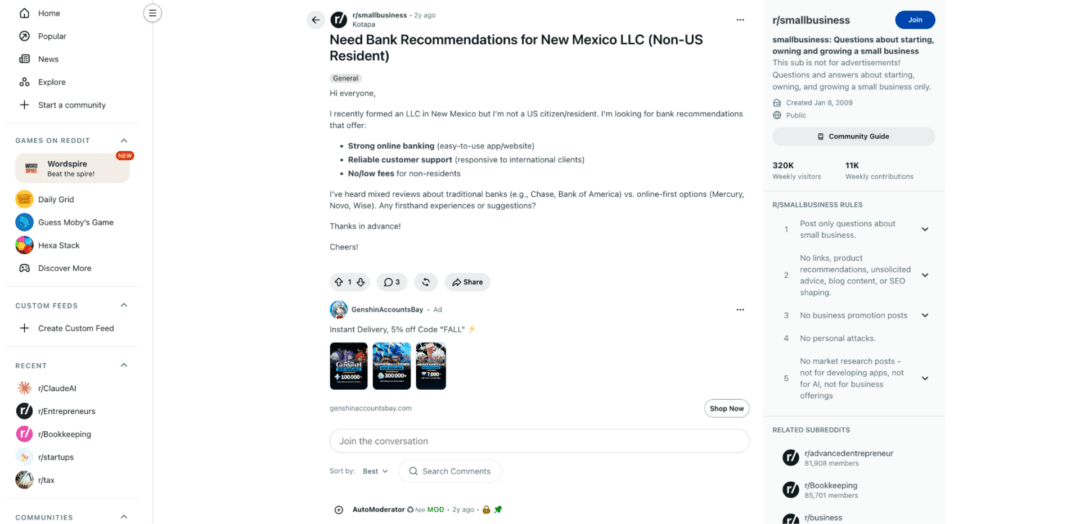
Yes, absolutely. Modern business banks and fintech platforms like Mercury, Relay, or Wise routinely accept New Mexico LLCs.
However, many non-US founders run into issues during the application process because of address requirements and business clarity, not because of the state of New Mexico itself.
What Banks Look For
Fintechs like Mercury evaluate whether your company is legally registered, what it sells, who owns it, and where the founders operate. They do not rank or penalize specific states.
1. Mandatory Documents
To get approved, you must upload:
- State Formation Document: Your officially approved Articles of Organization from the New Mexico Secretary of State.
- IRS-Issued EIN Document: An official IRS document confirming your Employer Identification Number, specifically Form CP 575, Letter 147C, or an IRS-returned Form SS-4. (A pending application or plain unreturned SS-4 will trigger an immediate rejection).
- Government Photo ID: A valid, unexpired passport for every individual who owns 25% or more of the company.
2. The Physical Address Gotcha
This is the single most common reason applications get flagged or denied:
- What Is NOT Accepted: Banks will reject registered agent addresses, P.O. boxes, virtual mailboxes, and UPS Store addresses when listed as your principal place of business.
- What IS Accepted: You must provide a genuine physical operating location. For international founders, using your actual residential address abroad as your principal place of business is completely acceptable.
3. Operational & Beneficial Ownership Transparency
Beyond basic paperwork, the bank’s compliance team needs to verify who is actually running the business:
- Business Description: Clear details on what your company does, who your customers are, and how money moves in and out. (Having an active company website and domain-matching email speeds up approval).
- Beneficial Ownership (25%+ Rule): Full legal details for anyone who directly or indirectly owns 25% or more of the company, plus whoever controls day-to-day operations.
- Founder Location: Transparent details on where the founders live and physically manage the business from day-to-day.
How to Choose in 30 Seconds: Wyoming LLC vs New Mexico LLC
Find the type of business you’re running:
- Choose New Mexico if you run a solo online business, freelance practice, or small agency and cost is your priority.
- Choose New Mexico if you want the lowest possible upkeep and will track federal deadlines yourself or through a service.
- Choose Wyoming if the LLC holds assets, IP, or investments, or you have real personal creditor exposure.
- Choose Wyoming if you’re building a crypto, DAO, or Web3 project.
If you’re a non-US founder: Both work for banking and Stripe. Decide on cost versus protection, not on rumors.
In the Wyoming vs New Mexico LLC comparison, New Mexico wins on cost and Wyoming wins on legal certainty.
Do Not Choose Either State Based Only On
“Zero recurring fees.” New Mexico charges no annual state report fee, but you still pay for your mandatory Registered Agent service, US tax prep, and IRS filings every year.
“Total absolute anonymity.” Both states keep owner names off public records, but public privacy is not full secrecy, the IRS, US banks, and payment processors will always require your true identity.
An unusually cheap checkout price. Always check Year 2 renewal costs. Cheap formation packages routinely offset low initial setup fees by charging high recurring rates for registered agents and compliance add-ons.
Assuming one state unlocks Stripe or Mercury. Neither platform prefers Wyoming over New Mexico. Bank approvals depend entirely on accurate paperwork, valid address verification, and matching EIN details.
Thinking formation completes your compliance. State formation is merely step one. Annual requirements, like mandatory IRS Form 5472 filings and keeping an active Registered Agent continue every year regardless of your state.
What About Delaware?
You might also be wondering where Delaware fits into all this. It makes sense mainly for venture-backed startups, and usually as a C-Corp rather than an LLC.
If that’s your path, read Wyoming vs Delaware LLC before you file.
Questions from Our 1:1 Founder Consultations About Wyoming vs. New Mexico LLC
Is a Wyoming or New Mexico LLC better?
It depends on your priority: New Mexico offers the lowest lifetime cost for solo online founders, while Wyoming provides stronger statutory legal protection for entities holding valuable assets, IP, or cash reserves.
Which is cheaper to maintain over time?
New Mexico. It requires $0 in annual state fees (compared to Wyoming’s $60/year minimum). Both still require a third-party registered agent.
Does New Mexico require an annual or initial report?
No. New Mexico requires neither an initial nor an annual state report. Any agent billing you for an “initial report” is charging an unnecessary fee.
Do New Mexico LLCs pay a franchise tax?
Not by default. New Mexico’s $50 franchise tax applies only to C-Corporations or LLCs taxed as corporations.
Is a New Mexico LLC completely anonymous?
Only on public records. State filings omit owner names, but your identity must be disclosed to the IRS, banks, payment processors, and your registered agent.
How do I prove my New Mexico LLC is in good standing?
You can order an official Certificate of Good Standing online from the Secretary of State for $25.
Which state offers stronger single-member asset protection?
Wyoming. Its statute explicitly makes charging orders the exclusive remedy and bars foreclosure. New Mexico’s statute stays silent on exclusivity and sole-member protections.
Can non-US residents form an LLC in either state?
Yes. Neither state requires US citizenship or residency, you only need an in-state registered agent.
Do Stripe, PayPal, and Mercury accept New Mexico LLCs?
Yes. Approval depends on verified identity and matching IRS EIN records, not your state of formation.
Do non-residents owe New Mexico state income or gross receipts tax?
Generally no. Foreign owners selling online with no local physical presence, staff, or New Mexico operations typically owe $0 in state income or gross receipts tax under federal source-of-income rules.
Can I move my LLC from New Mexico to Wyoming later?
Yes. Both states support continuance/domestication filings ($100 state fee each side). Bank and payment processor details will need to be re-verified after the move.
Finishing the Setup: Compliance Is Where the Real Work Starts
Choosing between Wyoming and New Mexico settles your state of formation, but setting up the company is just step one. Long-term compliance is where founders actually lose time and money.
Once your Articles of Organization are approved, the ongoing requirements are virtually identical in both states:
- Registered Agent Maintenance: Keeping an active in-state agent on retainer so your LLC remains in good standing.
- EIN & Banking Alignment: Ensuring your IRS tax ID details match your bank, Mercury, and Stripe accounts character-for-character.
- US Bank Account Setup: Maintaining a dedicated business account to keep personal and entity finances completely separate.
- Annual IRS Filings: Submitting Form 5472 and pro forma Form 1120 every year if you are a foreign owner of a single-member LLC.
- State Annual Reports (Wyoming Only): Filing your annual report by the first day of your anniversary month ($60 minimum fee).
doola Will Handle Your LLC Formation & Ongoing Compliance

doola manages the entire lifecycle so you can focus on building your business instead of tracking government deadlines:
- End-to-End Formation: We file your Articles of Organization directly in Wyoming, New Mexico, or any other US state.
- Registered Agent & EIN Included: Every formation package includes a dedicated in-state registered agent and official IRS EIN processing.
- US Bank Account Access: Get help applying for a US business account through our partner banking portal.
- Total Tax & Compliance Automation: Federal IRS filings, state report tracking, and compliance deadlines are managed in one dashboard via Tax & Compliance and Business-in-a-Box™.
- Built for Global Founders: Tailored specifically for both US residents and international entrepreneurs, with no US SSN required.