

When comparing Shopify vs Etsy, e-commerce sellers are not simply choosing between two places to list their products online.
They are choosing between two different business models.
Etsy is a marketplace. It gives sellers access to an existing buyer base, marketplace discovery, and a standardized selling environment.
Shopify is an e-commerce platform for building an independent store. It gives sellers control over their storefront, branding, customer experience, and business systems.
That difference matters because it affects far more than setup. It influences how you acquire customers, how much control you have over pricing and brand presentation, how repeat purchases happen, and how the business scales over time.
So, it’s not just Shopify vs Etsy. It is whether you want to plug into existing demand or build an asset you actually own.
This matters even more in 2026, when customer acquisition is more expensive, marketplace competition is harsher, and serious operators care a lot more about first-party customer relationships than they did a few years ago.
If you are trying to decide between the two, this guide will help you pick the best platform based on cost structure, setup friction, traffic model, branding control, SEO upside, and long-term growth.
Let’s quickly get to it.
Shopify vs Etsy: Quick Comparison
Feature
Shopify (Your Own Store)
Etsy (Marketplace)
Best For
Scaling brands & repeat customers
Niche, handmade, & first-time sales
Upfront Cost
$39/mo (Basic) or $29/mo (Annual)
$0/mo ($15 setup fee for new shops)
Transaction Fees
0% (with Shopify Payments)
6.5% of total order (inc. shipping)
Listing Fees
None (Unlimited products)
$0.20 per item (expires every 4 months)
Payment Proc.
2.9% + $0.30 (US Basic)
3% + $0.25 (US)
Traffic Source
You (SEO, Social, Ads, Email)
Etsy (Internal search & “Offsite Ads”)
Data Ownership
Full (You own your email list)
Limited (Etsy owns the customer data)
Design Freedom
Total (800+ themes, custom CSS)
Restricted (Standard Etsy layout)
The 2026 “Value Triggers”
- The “Break-Even” Revenue: Mathematical data shows that once your shop consistently clears $1,500 – $2,000 in monthly sales, Shopify becomes cheaper. At this volume, Etsy’s 6.5% transaction fee plus listing renewals usually costs more than Shopify’s $39 fixed monthly fee.
- The Marketplace Risk: Etsy’s “Offsite Ads” are often mandatory for shops earning over $10k/year. This adds an additional 12% fee to sales Etsy attributes to their advertising, which can instantly evaporate the margins of low-priced goods.
- The Search Reality: On Etsy, you are one click away from a competitor’s “Similar Item” being recommended at the bottom of your own page. On Shopify, the only products the customer sees are yours.
- Decision Hack: If you’re just testing a hobby, start on Etsy. If you have a business plan and a marketing strategy (Instagram, TikTok, or Email), go Shopify from Day 1 to avoid the headache of migrating your data later.
What Is Shopify?
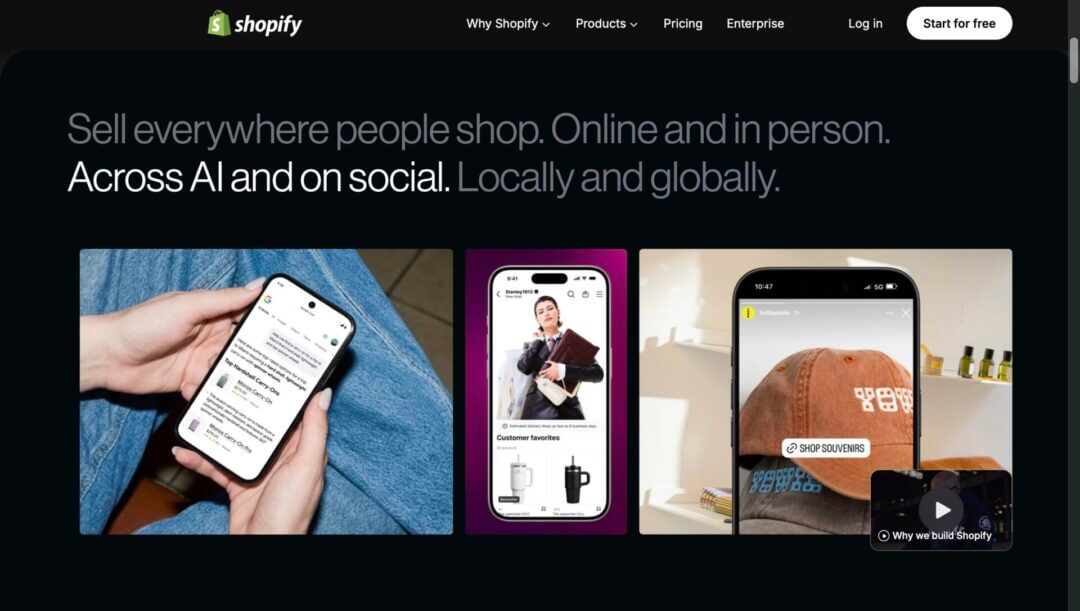
Shopify is a comprehensive e-commerce platform that acts as the “operating system” for your independent business. Unlike a marketplace, it gives you a dedicated domain name and a standalone website.
In 2026, it is no longer just a site builder; it is a multi-channel hub that syncs your inventory across TikTok, Instagram, Amazon, and even physical Point-of-Sale (POS) locations.
Key Features
- Shopify Store Setup: A streamlined onboarding process that uses “Online Store 2.0” technology, allowing you to build a high-converting site using modular blocks rather than complex code.
- Shopify Payments: An integrated checkout system that supports everything from credit cards to “Buy Now, Pay Later” (BNPL) and crypto, without requiring third-party plugins.
- App Ecosystem: A massive library of tools for SEO, automated shipping, and AI-driven customer service.
- Global Scaling: Built-in tools for “Markets” that automatically localize currencies, languages, and duties for international buyers.
Best For
- Ambitious Scaling: Businesses that want to grow from their first sale to $1M+ without switching platforms.
- Brand Builders: Entrepreneurs who want total control over their customer’s experience, from the landing page to the post-purchase thank-you email.
- Multichannel Sellers: Anyone selling through a mix of social media, brick-and-mortar, and a standalone website.
- Data-Driven Owners: Those who want to own their customer data and email lists to drive repeat sales, something not possible on marketplace-only platforms.
🔖 Learn more: Shopify Requirements for US and Non-US Sellers
What Is Etsy?
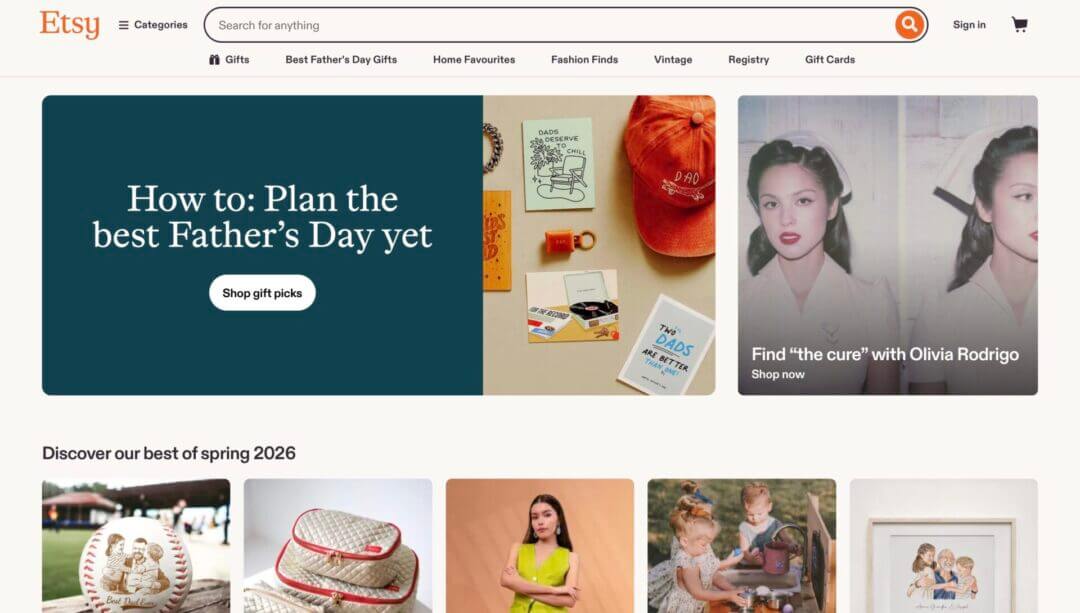
Etsy is a global marketplace that has spent over two decades carving out a specific niche in the e-commerce world. It isn’t just another site to buy stuff; it’s a dedicated ecosystem for three distinct categories: Handmade goods, Vintage items (at least 20 years old), and Craft supplies.
The platform has evolved into a sophisticated “plug-and-play” solution. When you start selling on Etsy marketplace, you aren’t just getting a storefront, you’re buying into a massive, pre-built audience of over 450 million monthly visitors.
Key Features
- Built-in Traffic & Discovery: The biggest draw of the Etsy marketplace is its internal search engine. Unlike a standalone site where you have to hunt for every visitor, Etsy’s algorithm actively connects your products with high-intent buyers already searching for unique, personalized items.
- AI-Driven Search (2026 Update): Etsy has overhauled its search to prioritize “natural language.” The algorithm now understands the context behind a search (like “minimalist anniversary gift for him”) rather than just matching repetitive keywords, rewarding sellers who write clear, human-focused descriptions.
- The Star Seller Badge: This is Etsy’s “seal of approval.” By maintaining a 95% response rate and 95% on-time shipping, you earn a badge that signals instant trust to shoppers, often leading to higher conversion rates in a crowded market.
- Stable Listing URLs: A recent technical update ensures that your listing links remain permanent even if you edit them. This makes selling on Etsy much more effective for long-term SEO, as Google can now index your products more reliably without broken links.
- Integrated Marketing Tools: From “Offsite Ads” (where Etsy pays to advertise your products on Google and Instagram) to internal “Etsy Ads,” the platform gives you a tiered way to scale your visibility based on your budget.
Best For
- Solopreneurs and Hobbyists: If you want to go from “idea” to “first sale” in a single afternoon without worrying about web design or hosting, Etsy should be your choice.
- Niche Artisans: Makers who produce highly specific, specialized items that benefit from a community that values “unique” over “mass-produced.”
- Proof-of-Concept: Entrepreneurs who want to test if a product will actually sell before investing the time and money into a full Shopify store setup.
- Low-Volume, High-Margin Sellers: Because of the $0.20 listing fee and 6.5% transaction fee, Etsy is perfect for those who sell fewer, higher-priced items where they don’t mind a “pay-as-you-go” cost structure.
🔖 Learn more: How to Sell on Etsy in 6 Steps
Shopify vs Etsy: Ease of Use and Setup
If you’re looking for the path of least resistance, Etsy is the clear winner for getting an item live fast.
The setup is essentially a series of forms; you upload a photo, write a description, set a price, and you are officially “in business.”
Because Etsy is a standardized marketplace, you aren’t responsible for designing the architecture of the shop, you are simply moving into a pre-built website.
This makes Shopify vs Etsy for beginners a lopsided debate if the only metric is speed.
Etsy handles the hosting, the SSL certificates, and the mobile optimization by default, meaning a novice can bypass the steep learning curve of web design entirely. However, that speed comes at the cost of ownership.
Shopify demands a greater time investment upfront to build and customize your own dedicated e-commerce website. This effort, however, provides you with complete ownership and control, allowing you to create a unique, branded, and fully customizable customer experience.
While Shopify’s modern drag-and-drop editor is incredibly intuitive, you are still the one making the creative calls. This extra effort is precisely what builds a stronger foundation.
The best choice depends on your goal: Select Etsy if your priority is speed and product validation; choose Shopify if your goal is to establish a long-term, scalable, and fully owned brand.
Shopify vs Etsy: Fees
When people compare Shopify vs Etsy fees, they usually make one mistake: they look only at the starting cost, not at what happens to profit as the business grows.
In 2026, the fee structures for both platforms have diverged significantly, moving toward a “pay-as-you-go” marketplace model versus a “fixed-cost” infrastructure model.
The Marketplace Tax: Decoding Etsy’s Costs
Etsy is viable because of its low barrier to entry, but as you scale, those “small” percentages can begin to bite.
Every item you list costs $0.20 (expiring every four months), which is negligible for a few products but adds up for large catalogs.
The real weight, however, is the 6.5% transaction fee applied to the total order value, including the shipping you charge the customer.
When you add the standard 3% + $0.25 payment processing fee (for US sellers), you’re already losing nearly 10% of every sale.
The “silent margin killer” on Etsy is the mandatory Offsite Ads program. If you cross $10,000 in annual revenue, Etsy automatically advertises your products across the web. If a sale comes from one of those clicks, they take an additional 12% fee (15% for smaller shops).
In a worst-case scenario, between transaction, processing, and offsite ad fees, Etsy can consume over 20-25% of a single sale’s revenue.
The Infrastructure Investment: Shopify’s Fixed Fees
Shopify charges a monthly subscription fee, like paying rent for your store’s platform, regardless of how much you sell. The Basic plan is $39/month (or $29 if you pay for a year).
The good news is that if you use Shopify’s own payment system (Shopify Payments), they don’t charge a separate transaction fee. You only pay the standard credit card processing rate, which starts at 2.9% plus 30 cents per transaction.
While there are no fees to list products, be aware of extra costs for add-on apps.
Most serious sellers spend an additional $20 to $100 monthly on specialized apps for things like better search engine optimization (SEO), customer loyalty programs, or suggesting related products (upsells).
The Break-Even Realities
To understand how Shopify vs Etsy fees affect your business, think about how much you sell each month:
- Selling a little (less than $1,300/month): Etsy is cheaper. If you only make about $500 in sales, your total fees on Etsy would be around $52, but Shopify would cost you almost $100 (due to its monthly fee plus processing costs).
- The tipping point (around $1,350/month): This is the break-even point. Once you sell more than this, Etsy’s 6.5% sales fee (the “success tax”) starts to cost more than Shopify’s fixed monthly subscription (around $39).
- Selling a lot ($10,000+/month): Shopify is the clear winner here. For $10,000 in sales, Etsy might take over $1,000 in fees. With Shopify, your total costs, even with extra paid tools, would likely be closer to $400–$500.
The main difference: Etsy has variable costs, which is great when sales are slow because you don’t pay much. Shopify has fixed costs, which rewards you as your business grows because the fixed fee stays the same.
If you plan to keep your business small, stay on Etsy; if you want to grow into a major brand, Shopify’s subscription model will save you money.
Shopify vs Etsy: Traffic and Customer Acquisition
The fundamental difference between these two platforms lies in who holds the keys to the audience.
Here is a simplified explanation of the traffic and customer acquisition difference between Shopify and Etsy:
Etsy (The Digital Department Store):
- Traffic: Etsy already has a massive audience, it’s like a crowded department store. Buyers come directly to Etsy looking for unique products.
- Customer Acquisition: You don’t have to find customers; Etsy’s search engine and tools do the work of showing your product to interested shoppers. You can get your first sale fast without paying for external ads.
- The Trade-off: The customers belong to Etsy. You can’t easily market to them later, and you are always dependent on Etsy’s rules and algorithms. This is “borrowed” traffic.
Shopify (Your Own Standalone Store):
- Traffic: Shopify gives you a powerful website, but it starts with zero visitors. It’s an empty store you built on a quiet street.
- Customer Acquisition: You are 100% responsible for bringing in every customer through advertising (Google Ads, Facebook, etc.) and other methods (SEO, social media).
- The Trade-off: While getting traffic is harder and costs more upfront, you own the customer data (email, phone number). This allows you to drive repeat sales cheaply through email or text, improving your long-term profits. This is “owned” traffic.
The key takeaway:
Ultimately, the choice between Etsy traffic vs Shopify traffic is a trade-off between immediate traction and long-term scalability.
Etsy is the superior laboratory for testing product-market fit because it eliminates the friction of finding an audience. However, as a business matures, the reliance on a third-party algorithm becomes a liability.
Shopify allows you to move away from the model where you constantly rely on “pay-per-click” or “percentage-per-sale” fees.
Instead, it enables you to build a valuable, self-sustaining business asset where your own brand, not the marketplace platform, becomes the main driver of your growth.
Shopify vs Etsy: Branding and Customization
Branding and customization are not small differences between these two platforms. They directly affect how customers perceive your business and whether they remember your brand or just the platform where they bought the product.
On Etsy, your store exists within a standard marketplace format. The layout, product display, and overall shopping experience follow Etsy’s structure, so there is only limited room to make your store feel distinct.
You can add your logo, banner, shop announcement, and product photography, but the overall environment still feels like Etsy. Customers are often comparing your listing with similar products on the same page, which makes differentiation harder.
In many cases, the buyer remembers that they purchased something on Etsy, but not necessarily which brand they purchased it from.
Shopify gives you much more control over how your business is presented. You can customize your homepage, product pages, navigation, colors, fonts, collections, checkout experience, and brand messaging.
That matters because strong branding does more than make a store look attractive. It helps create trust, supports premium pricing, and gives customers a reason to come back to your website instead of searching for similar products again.
To sum it up, Etsy helps you sell within an existing marketplace, while Shopify helps you build a branded business that customers can recognize, remember, and return to directly.
Shopify vs Etsy: SEO and Discoverability
When you compare Etsy vs Shopify SEO, the difference is structural, not just technical.
Both platforms help you get discovered, but they do it in completely different ways, and that directly affects how much control you have over your traffic.
On Etsy, SEO happens inside the marketplace.
Etsy’s own search system works in two stages: first, it matches listings to a buyer’s query using elements like titles, tags, categories, and attributes. Next, it ranks those listings based on performance signals like clicks, conversions, reviews, and overall shop quality .
In 2026, this system is even more behavior-driven. Listings that earn engagement and sales get pushed higher, which means your visibility depends not just on keywords but on how well your product performs once seen .
This makes Etsy SEO relatively faster to work with. You don’t need domain authority or backlinks. If your listing matches buyer intent and performs well, it can start getting visibility within the marketplace quickly.
But the limitation is clear: your traffic is tied to Etsy’s ecosystem. You are optimizing for Etsy’s algorithm, not building independent search presence.
Shopify works very differently.
There is no built-in marketplace search pushing your products. Instead, SEO is focused on ranking your own website on search engines like Google.
Shopify gives you control over key elements like meta titles, URLs, structured data, and content through blogs and landing pages, which allows you to build long-term organic visibility .
But unlike Etsy, this takes time. Search engines evaluate authority, relevance, and content depth before sending consistent traffic.
The core difference comes down to control. Etsy helps you get discovered faster within a closed system. Shopify allows you to build discoverability that exists outside any platform. One is optimized for immediate visibility, the other for long-term traffic ownership.
Shopify vs Etsy: Payment Options and Checkout Experience
The difference here comes down to how much control you want over payments and what kind of checkout experience you’re willing to accept.
Etsy is designed for simplicity. Shopify is designed for flexibility.
How payments work on Etsy
Etsy uses a system called Etsy Payments, which is mandatory for most sellers. It supports major payment methods like credit/debit cards, PayPal (in many regions), Apple Pay, Google Pay, and Etsy gift cards.
Here are some core features of Etsy Payments:
- Etsy manages the entire checkout flow
- Buyers stay within the Etsy platform from discovery to payment
- Currency conversion and local payment methods are handled by Etsy
- Funds are deposited into your account based on Etsy’s payout schedule
This makes checkout very smooth for buyers, especially because many of them already trust Etsy and have used it before.
But there are limitations. For example:
- You cannot customize the checkout experience
- You cannot add upsells, bundles, or post-purchase offers
- Customer data access is limited compared to independent stores
- You are dependent on Etsy’s payment policies and timelines
In short, Etsy optimizes for convenience, but removes control.
How Payments Work On Shopify
Shopify gives you significantly more flexibility. Its native system, Shopify Payments, supports major cards, Apple Pay, Google Pay, Shop Pay, and in many regions, local payment methods.
For example:
- You can use Shopify Payments or integrate third-party gateways (Stripe, PayPal, Razorpay, etc.)
- You can sell in multiple currencies and enable localized checkout experiences
- Checkout can be optimized with features like discount codes, bundles, subscriptions, and upsells
- Shop Pay (Shopify’s accelerated checkout) is widely used and designed to improve conversion rates
Shopify gives you much more control over the payment experience, which becomes important as your store grows.
You can tailor checkout more closely to your brand, introduce post-purchase upsells and cross-sells to increase order value, and connect tools for subscriptions, bundles, or one-click add-ons.
More importantly, the entire journey, from product discovery to final payment happens within your own store environment, which gives you greater control over conversion, customer experience, and retention.
The key takeaway: Etsy prioritizes ease and trust within its marketplace. Shopify prioritizes control, flexibility, and revenue optimization as your business grows.
Shopify vs Etsy: Scalability and Business Growth
The gap between Etsy and Shopify becomes much clearer once your business starts growing. In the early stage, Etsy can help you get traction faster.
But once you begin thinking about margins, repeat customers, brand control, and expansion, the platform starts to feel more limiting.
Why Etsy works in the early stage
Etsy can be effective when you are still validating demand. It gives you:
- Access to built-in marketplace traffic
- A lower barrier to entry
- A faster route to first sales
That makes it useful for testing products, especially in categories where Etsy already has strong buyer intent.
Where Etsy starts to become limiting
As sales volume increases, Etsy’s structure becomes harder to grow with.
The main limitations are:
- Fees rise as revenue rises, which puts pressure on margins
- Your products sit next to competing listings, making price comparison easy
- Branding remains limited
- You do not fully own the customer relationship
This means growth can happen, but it happens inside Etsy’s system, not fully on your terms.
Why businesses move to Shopify
Shopify is better suited for businesses that want to scale with more control.
It gives you the ability to:
- Keep platform costs more predictable as revenue grows
- Build email marketing and retention flows
- Segment customers and drive repeat purchases
- Expand across your own site, social channels, and other sales channels
- Create a stronger brand that customers remember directly
The core difference:
Etsy helps you get discovered. Shopify helps you build systems. That is why major businesses often start on Etsy but eventually move to Shopify, or make Shopify their primary store.
Etsy can support early traction, but Shopify gives you the structure needed for sustainable, long-term growth.
Shopify vs Etsy: Pros and Cons
Before you decide, you need to look at these platforms from a business lens, not a feature list. The difference between these platforms can affect margins, control, and how far you can actually grow.
One is a high-yield infrastructure; the other is a high-traffic marketplace.
So, let’s understand a few core pros and cons of both the platforms.
| Factor | Shopify (Owned Infrastructure) | Etsy (Global Marketplace) |
| Business Model | Independent store (you own the platform experience) | Marketplace (you operate within Etsy’s ecosystem) |
| Primary Traffic | Outbound: You generate traffic (ads, SEO, social) | Inbound: Etsy’s search engine delivers active buyers to you. Built-in marketplace traffic. |
| Cost Structure | Fixed Heavy: High monthly sub ($39) but low per-sale tax. | Variable Heavy: $0 monthly sub but high ~10–25% per-sale tax. |
| Customer Data | Full Ownership: You own the email/SMS list for life. | Rented: Etsy owns the customer; remarketing is restricted. |
| Branding | Limitless. Custom UX/UI, checkout, and packaging. Full control over design and experience. | Limited, standardized storefront |
| Scalability | Infinite. High, supports multi-channel growth. | Capped. Fees scale linearly with your success (6.5% + ads). Limited by marketplace structure. |
| Risk Factor | Low platform dependency. | High dependency on Etsy policies/algorithm. One algorithm change can kill your traffic. |
Shopify Pros
Shopify gives you control where it actually matters.
You control pricing, customer experience, and how your brand is perceived. As your revenue increases, your costs don’t scale in the same way, which protects margins.
More importantly, you can build systems around your business, email marketing, retention, upsells, and repeat purchase flows. This is what turns a store into a business.
Shopify Cons
The biggest drawback is that nothing is handed to you. You have to generate your own traffic, which means investing time or money into marketing.
There is also an upfront commitment with monthly fees and initial setup effort. If you’re not ready to think about branding and acquisition, Shopify can feel slow at the start.
Etsy Pros
Etsy removes friction in the early stage. You get access to a large, intent-driven audience without spending on ads.
Setup is fast, and you can start selling almost immediately. For testing products or running a side hustle, this makes it one of the easiest entry points into e-commerce.
Etsy Cons
The limitations show up as you grow. Fees increase with every sale, which eats into margins. Your products are displayed next to competitors, making differentiation harder.
Branding is limited, and you don’t fully control the customer relationship. There is also platform risk, changes in Etsy’s algorithm or policies can directly impact your sales.
Shopify vs Etsy: Which One Should You Choose?
This decision becomes much clearer when you tie it to your stage of business.
Choose Etsy if:
You are at the validation stage. You want to test whether your product sells without investing heavily upfront. You don’t want to worry about traffic yet, and your priority is getting initial sales quickly.
Etsy works well if your product fits into categories where buyers are already searching, like handmade, personalized, or giftable items.
Choose Shopify if:
You are thinking beyond early sales. You want to build a brand, improve margins, and create a business that customers come back to directly.
You’re willing to invest in marketing and want control over how your business grows. Shopify is the better choice if you’re planning to scale, expand product lines, or build long-term value.
| 💡 doola’s Advice
The smartest approach is not choosing one over the other blindly. Start with Etsy to validate demand and understand what sells. Once you have traction, move to Shopify and make it your primary store. Use Etsy as a discovery channel, but build your brand and customer base on Shopify. |
How to Transition from Etsy to Shopify
Moving from a marketplace to an independent storefront is a significant operational shift that requires a calculated, multi-phase approach.
The most successful brands do not “leave” Etsy; they transition it from their primary storefront to a top-of-funnel discovery channel while building their long-term equity on Shopify.
When To Transition
The move to Shopify typically makes sense when the business shows consistent traction and operational clarity.
Common indicators include:
- Monthly revenue consistently above $1,000–$5,000
- A measurable share of repeat customers
- Increasing fee impact on margins due to Etsy’s transaction and advertising costs
- A need for stronger brand control and direct customer relationships
At this stage, continuing solely on Etsy can limit growth efficiency.
How To Migrate Operations
The transition should begin with setting up Shopify as a parallel channel, not a replacement.
A seamless transition ensures that your sales momentum remains uninterrupted. Here are the key steps:
- Data Transfer: Use the native CSV export tool in Etsy Shop Manager to download product listings, including titles, descriptions, and prices. For larger catalogs, 2026-standard migration apps like Matrixify or LitExtension can automate the transfer of product variants, images, and order history.
- Operational Parity: Before going live, ensure your Shopify shipping zones, tax settings, and payment gateways (Shopify Payments) mirror or improve upon your Etsy setup.
- Parallel Running: Do not shut down your Etsy shop. Maintain it as a secondary sales channel to capture marketplace search traffic while your Shopify SEO gains traction.
| Keep in mind:
✔️ Recreate your product catalog on Shopify (manually or via CSV import tools) ✔️ Set up payment gateways such as Shopify Payments or third-party providers ✔️ Configure shipping rules, taxes, and domain ✔️ Test the full purchase flow before directing any traffic It is important to keep the Etsy store active during this phase to avoid revenue disruption. Orders, inventory, and fulfillment processes should remain consistent across both platforms until Shopify stabilizes. |
How To Migrate Customers (Policy-Compliant)
Etsy restricts the use of customer data for unsolicited off-platform marketing. This means you cannot directly export customer information and promote your Shopify store without consent.
Instead, the customer transition should be gradual and compliant. Here are core things to keep in mind during the customer transition:
- Package Inserts: Include a high-quality physical card in every Etsy order. Offer a “First-Purchase Discount” or a “Loyalty Reward” exclusive to your Shopify URL.
- The “Around the Web” Section: Use the official link fields in your Etsy Shop Profile to point toward your Shopify store and social media channels.
- Banner Branding: Use your Etsy shop banner to display your independent domain name clearly, fostering brand recall without violating direct-linking policies in private messages.
Building an Owned Audience
The ultimate goal of the transition is the accumulation of first-party data. Unlike Etsy, Shopify allows you to build a customer database that you own entirely.
To reduce long-term dependency on Etsy, here’s what you need to do:
- Email & SMS Capture: Implement a “welcome pop-up” on your Shopify store offering an immediate incentive (e.g., a free digital guide or 10% off) in exchange for an email address.
- Retention Marketing: Use automated email flows to reach out to customers on their birthdays or after 30 days of inactivity. This reduces your dependency on expensive ads and marketplace algorithms, turning one-time buyers into a self-sustaining revenue stream.
| Keep in mind:
The transition from Etsy to Shopify should be gradual and structured. Etsy can continue to function as a discovery channel, while Shopify becomes the primary platform for brand building, customer retention, and long-term growth. |
Start Your E-Commerce Business The Right Way With doola
Once you move beyond the initial Shopify vs Etsy confusion and decision, the next priority is building your business on the right legal and operational foundation.
Getting sales is one part of growth. Structuring the business properly is what helps you sustain and scale it.
To operate seriously, you need more than a storefront. You need the basics in place to support payments, compliance, and long-term expansion.
Here are the three core components of a long-lasting business:
- Legal Business Structure: Forming an LLC or Corporation protects your personal assets from business-related liabilities and lawsuits.
- Tax Compliance: Accurate federal and state filings are mandatory to avoid significant IRS penalties and maintain your company’s “good standing.”
- Business Banking: Dedicated accounts are necessary to track margins accurately and integrate with professional payment processors.
This is where doola fits in. We provide an integrated Business-in-a-Box™ solution designed specifically for modern business owners, including international entrepreneurs.
Our platform is built to help entrepreneurs like you set up and manage some of these intricate backend requirements without needing to jump across multiple systems independently.
By centralizing the administrative requirements, doola helps you:
- Form a U.S. LLC remotely, even if you are not based in the United States
- Stay compliant with ongoing tax and filing requirements
- Get support with setting up business bank accounts and integrated bookkeeping that syncs with platforms like Shopify
Start your e-commerce business the right way with doola today.
FAQs
Is Shopify better than Etsy for beginners?
It depends on your goal. Etsy is better for absolute beginners who want to start selling immediately with zero marketing experience, as it provides built-in customers.
Shopify is better for beginners who are serious about building a standalone brand and are willing to learn how to drive their own traffic via social media or ads.
Can I use Shopify and Etsy together?
Yes, you can use Shopify and Etsy together and many successful sellers do.
You can use Etsy as a discovery channel to find new customers and Shopify as your primary storefront where you keep higher margins. There are several apps available in 2026 that sync your inventory across both platforms automatically.
Which platform is cheaper: Shopify or Etsy?
Etsy is cheaper for low-volume sellers because it has no monthly subscription fee. However, Shopify becomes cheaper once you cross approximately $1,350 in monthly sales. At that point, Etsy’s 6.5% transaction fees usually exceed Shopify’s flat $39 monthly cost.
Is Etsy good for long-term business growth?
Etsy is excellent for consistent sales, but it has a “growth ceiling” due to its percentage-based fees and limited branding.
For unlimited scaling and building a business you can eventually sell, Shopify is the superior long-term choice because you own the customer data and the platform
Do I need an LLC to sell on Shopify or Etsy?
You are not legally required to have an LLC to start. You can sell as a Sole Proprietor.
However, as your sales grow, forming an LLC is highly recommended to protect your personal assets from business liabilities and to take advantage of professional tax benefits.
Can I migrate my Etsy store to Shopify?
Yes. You can export your product data into a CSV file from Etsy and import it directly into Shopify.
For a more comprehensive transition (including reviews and customer history), professional migration tools like Matrixify are commonly used in 2026.
Which platform is better for print-on-demand businesses?
Shopify is generally better for POD because it offers deeper integrations with suppliers and allows for the high-profit margins needed to offset ad costs.
While you can sell POD on Etsy, the marketplace is highly saturated, making it harder to stand out without a unique niche.

![Shopify vs Etsy: Which Platform Is Better for Your Online Business in [year]?](https://www.doola.com/wp-content/uploads/2026/04/bottom-cta-new.png "Shopify vs Etsy: Which Platform Is Better for Your Online Business in [year]?")
