

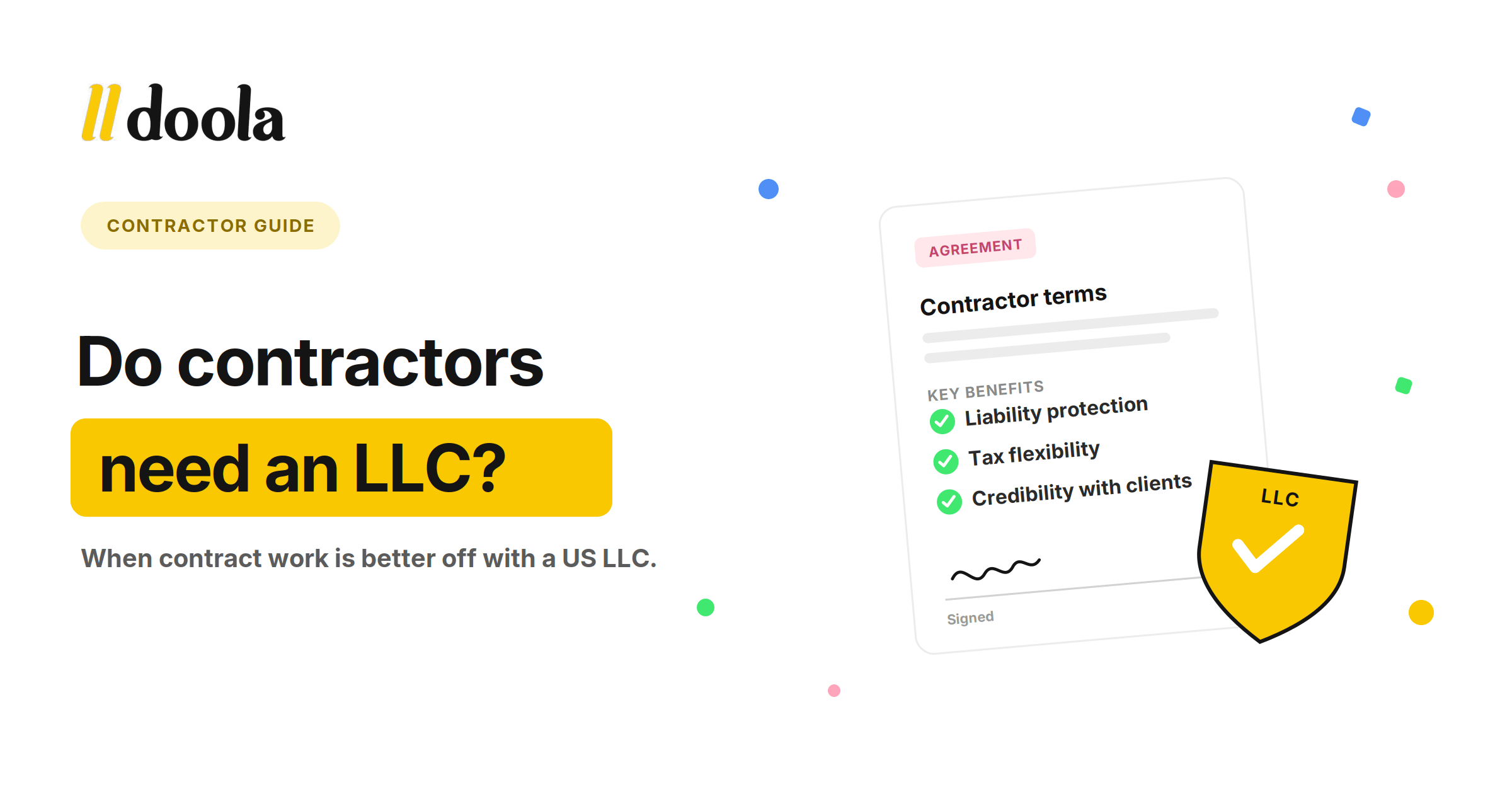
The question isn’t whether you can operate this way. It’s whether you should.
Here’s what an independent contractor LLC actually adds: a legal wall between your personal finances and your business activity, cleaner separation of income and expenses, and formal business status that enterprise clients increasingly require before they’ll issue a purchase order.
If your contracts are under $10K and your clients are individuals, the LLC can wait. If you’re pitching enterprise procurement teams or holding IP for clients, it can’t. This article gives you the framework to figure that out.
Do You Legally Need an LLC to Do Contract Work?
![LLC for Contract Work: Do Independent Contractors Need a US LLC in [year]?](https://www.doola.com/wp-content/uploads/2026/07/image-2.png "LLC for Contract Work: Do Independent Contractors Need a US LLC in [year]?")
No, you do not need an LLC to work as an independent contractor. As a sole proprietor, you can sign contracts, invoice clients, collect 1099 income, and pay self-employment taxes under your own name without forming any business entity. What an LLC adds is liability separation, cleaner financial infrastructure, and the business-entity status enterprise clients increasingly require.
As a sole proprietor, you can legally:
- Sign contracts with clients and subcontractors under your own name
- Invoice clients and collect payment as an individual
- Deduct ordinary and necessary business expenses on Schedule C
- File and pay self-employment taxes using your Social Security number on a W-9
The real question isn’t whether you can operate without an LLC for contract work. It’s whether the exposure you’re carrying as a sole proprietor matches the risk profile of the work you’re actually doing.
What You’re Actually Risking as a Sole Proprietor Contractor
As a sole proprietor, there is no legal separation between you and your business. Every contract you sign, every deliverable you ship, every dispute that escalates, your personal finances are at stake.
The Scope Dispute
You deliver a web project on time and to spec, as far as you’re concerned. The client disagrees, claims the deliverable doesn’t match what was promised, and threatens legal action. As a sole proprietor, the lawsuit names you personally.
The Acquisition Mid-Project
You are six weeks into a twelve-week engagement when the client gets acquired. The new parent company disputes the original contract terms, argues the scope was never properly defined, and then refuses to pay the outstanding balance.
As a sole proprietor, you’re litigating that dispute personally. An LLC creates a legal boundary between you and the business, shifting the exposure from your personal finances to the entity itself and changing the stakes for everyone involved.
The IP Claim
As a designer, you deliver a brand identity project using a stock image they believed was properly licensed. The licensing terms were ambiguous. The original rights holder surfaces, files an infringement claim, and names you.
Without an LLC, there’s no separate entity to absorb the liability. The claim follows you personally.
In each of these scenarios, forming an LLC and operating it correctly changes your exposure substantially. Again, an LLC is not lawsuit-proof. Courts can and do pierce the corporate veil when an owner commingles personal and business funds, ignores the entity’s legal formalities, or uses the LLC as a personal piggy bank.
But when you maintain a dedicated business bank account, keep client revenue and personal finances separate, and operate the LLC as a genuine business entity, you raise the bar considerably for anyone trying to reach your personal assets.
Do Enterprise Clients Require Contractors to Have an LLC?
Not universally, but above a certain contract size, the requirement becomes common enough that going into a procurement process as a sole proprietor creates friction that costs you deals.
Three specific triggers make enterprise clients want a formal business entity on file:
Certificates of Insurance (COI)
![LLC for Contract Work: Do Independent Contractors Need a US LLC in [year]?](https://www.doola.com/wp-content/uploads/2026/07/image.png "LLC for Contract Work: Do Independent Contractors Need a US LLC in [year]?")
Many enterprise clients require contractors to carry general liability or errors and omissions insurance before work begins, and the COI must name a registered business entity, not an individual.
If you don’t have an LLC, the policy either can’t be issued the way procurement requires or requires workarounds that slow the process.
EIN on W-9 Submissions
![LLC for Contract Work: Do Independent Contractors Need a US LLC in [year]?](https://www.doola.com/wp-content/uploads/2026/07/image-5.png "LLC for Contract Work: Do Independent Contractors Need a US LLC in [year]?")
When you submit a W-9 to a client or their accounts payable team, you can provide either your Social Security number or an Employer Identification Number. Procurement teams at larger companies prefer the EIN because it doesn’t require them to handle your SSN and reduces their administrative liability. An LLC gets you an EIN.
If you’re unclear on the difference between a W-9 and a 1099, here’s our breakdown of W-9 vs 1099 contractor forms.
Vendor Onboarding Systems
Enterprise companies run contractors through formal vendor onboarding before issuing purchase orders.
Many of these systems have a required field for business entity type. If you’re onboarding as an individual, the system either rejects the submission or flags it for manual review, both of which slow you down and create opportunities for the deal to stall.
The practical threshold: At around $50K or above per contract (this is a general heuristic, not a universal rule), enterprise clients commonly require formal business entity status. Below that, you’ll encounter it occasionally but not universally. If your contracting work is trending toward larger clients, longer engagements, or recognized companies with procurement departments, an LLC becomes less optional over time.
The Tax Case for an LLC: What It Does (& Doesn’t) Save You
Here’s everything you need to know:
Layer 1: Formation Alone Doesn’t Save Taxes
By default, pass-through taxation for a contractor with a single-member LLC looks identical to sole proprietor treatment. That means your income flows directly to your personal return, and you pay self-employment tax on net profit exactly as you would as a sole proprietor. Forming an LLC changes your liability exposure. It does not, by itself, reduce your tax bill by a single dollar.
Now that distinction matters, because plenty of contractors form a US LLC in 2026 expecting a tax benefit and are confused when their first-year tax return looks identical to the year before.
Layer 2: The S-Corp Election Is Where The Math Changes
Your LLC can elect to be taxed as an S-corporation. That changes how your income is treated.
Here’s an example: if your LLC generates $100,000 in net profit and you elect S-corp status, you will pay yourself a salary (say, $60,000) and take the remaining $40,000 as a distribution.
Self-employment tax applies to the $60,000 salary portion. It does not apply to the $40,000 distribution. At the current SE tax rate of 15.3%, that’s roughly around $6,000 in SE tax savings. This is a simplified illustration.
Work with a CPA to set the right salary and confirm the election makes sense at your income level.
Layer 3: The QBI Deduction
Pass-through entities, including single-member LLCs, may qualify for the 20% Section 199A qualified business income deduction. This deduction phases out at higher income levels and has additional limitations for certain service businesses.
Ideally a tax professional should confirm your eligibility. What matters here is that it’s available to sole proprietors too, not just LLC owners, and so it can’t be a reason to form an LLC on its own.
For a deeper look at what you can deduct as a contractor regardless of entity type, check out our guides:
Sole Proprietor vs. LLC for Contractors: A Direct Comparison
For contractors weighing this decision, here is how sole proprietor vs. LLC structures compare.
| Sole Proprietor | Single-Member LLC | |
|---|---|---|
| Personal liability exposure | Unlimited. Client disputes, IP claims, and contract failures can reach personal assets directly. | Limited in most cases. The LLC absorbs liability when properly maintained. |
| Tax treatment | Self-employment tax on 100% of net profit. Schedule C on personal return. | Identical by default. S-corp election available at higher income levels to reduce SE tax on distributions. |
| Enterprise client eligibility | Works at smaller contract sizes. Creates friction above ~$50K with companies requiring an EIN, COI, or formal vendor entity. | Clears enterprise vendor onboarding requirements. EIN replaces SSN on W-9. |
| Banking and financial separation | No structural requirement, and personal and business funds can commingle. | A separate business bank account is required to maintain clean separation between client revenue and expenses. |
| Formation cost and compliance | None, and no ongoing state requirements. | One-time filing fee ($50 to $500 depending on state). Annual report or franchise tax in most states. Registered agent required. |
| SSN vs. EIN | SSN submitted on W-9 to every client. | EIN used for client payments, banking, and tax filings. SSN not shared with clients. |
For contractors above $30,000 in annual 1099 income (this is a general heuristic, not a universal rule), the tradeoff profile favors the LLC in most situations. And below that, your compliance costs start to compete with the actual benefits.
When NOT to Form an LLC as a Contractor
There are four situations where staying a sole proprietor is the smarter call than forming an LLC:
1. Under $20,000 Annually From Contract Work
Annual LLC compliance costs (state filing fees, registered agent fees, and in some states annual franchise taxes) can run $200-$800 or more per year. At low income levels, those costs eat a meaningful percentage of your net.
If you’re doing occasional freelance work at this scale, the math doesn’t support the overhead.
What to do instead: Open a dedicated personal checking account just for contract income, track expenses in a free tool like Wave, and revisit the LLC decision when your annual 1099 income crosses $25,000.
2. Working Through An Agency / Employer Of Record On A W-2 Basis
![LLC for Contract Work: Do Independent Contractors Need a US LLC in [year]?](https://www.doola.com/wp-content/uploads/2026/07/image-1.png "LLC for Contract Work: Do Independent Contractors Need a US LLC in [year]?")
If the agency is issuing you a W-2, you’re not a 1099 contractor for that work. The liability and tax structure is already different. Forming an LLC for W-2 work provides essentially no benefit.
What to do instead: Review your W-2 classification and confirm your agency or EOR is covering standard employer protections. If you also take on independent 1099 work outside the agency, evaluate the LLC for that income stream separately.
3. Contract Work is a Side Project and Your Primary Income is Salary
![LLC for Contract Work: Do Independent Contractors Need a US LLC in [year]?](https://www.doola.com/wp-content/uploads/2026/07/image-4.png "LLC for Contract Work: Do Independent Contractors Need a US LLC in [year]?")
If you have $8,000 in freelance income on top of a full-time job, the LLC compliance overhead is hard to justify. Your primary income is already protected by your employer structure. Consider the LLC when contracting becomes a meaningful part of your income picture.
What to do instead: File a Schedule C with your personal return to report the side income, set aside 25-30% for self-employment taxes, and set a threshold, say $20,000 in annual freelance income, as your trigger to revisit formation.
4. You’re In California or Any High-Fee State At Lower Income Levels
California charges an $800 annual minimum franchise tax on LLCs, regardless of revenue. If you’re earning $25,000 a year in contract work and you’re California-based, you’re paying $800 annually just to maintain the entity before any other compliance costs.
For instance, New York imposes a publication requirement. You must publish your LLC formation notice in two local newspapers for six weeks.
Depending on the county, that alone can cost $500 to over $1,500 (Manhattan runs toward the high end).
Massachusetts charges a $500 filing fee. Verify the current fees in your state before you file.
What to do instead: Run the actual numbers for your state before deciding. Add up the filing fee, registered agent cost, annual report fee, and any franchise tax. Compare that total to your projected net contract income. If it exceeds 3-4% of what you expect to earn this year, hold off and reassess when your revenue grows.
How to Form an LLC for Contract Work: The Actual Steps
Forming a US LLC is a simple, one-time process. Most contractors complete it in under a week:
Step 1: Choose Your Formation State
If you’re a US-based contractor, form in your home state. Forming in Delaware or Wyoming when you operate in California, for example, means you’ll pay fees and maintain a registered agent in both states, which doubles your compliance overhead.
For non-US residents or digital nomads without a home state, Wyoming and Delaware are the standard choices for their low fees, minimal compliance requirements, and friendly LLC statutes.
Neither state requires you to be a US citizen or permanent resident to form an LLC, and you can complete the entire process remotely without ever setting foot in the US.
If you don’t have a Social Security number, you can still get an EIN. doola handles the IRS filing on your behalf, which is the step that typically blocks non-US founders trying to navigate it alone.
Once your LLC and EIN are in place, you can open a US business bank account, sign contracts with US clients, and get paid in dollars, all from outside the country.
Step 2: Name Your LLC
Run a name availability check through your state’s Secretary of State website. Your LLC name must include a required designator: “LLC,” “L.L.C.,” or “Limited Liability Company.”
Verify the exact requirements for your state.
Step 3: File Articles of Organization
This is the document that officially creates your LLC.
Filing fees vary widely by state, ranging from around $40 in states like Kentucky to $500 in Massachusetts. California, Massachusetts, and New York are among the more expensive states for LLC formation, so it’s worth checking the latest fee schedule before you file.
![LLC for Contract Work: Do Independent Contractors Need a US LLC in [year]?](https://www.doola.com/wp-content/uploads/2026/07/image-3.png "LLC for Contract Work: Do Independent Contractors Need a US LLC in [year]?")
Step 4: Get Your EIN from the IRS
An Employer Identification Number (EIN) is your LLC’s federal tax ID. You’ll use it to open a business bank account and for business tax filings.
If you’re a U.S. person, you’ll also use it when completing Form W-9. However, if your single-member LLC is owned by a non-U.S. resident, you generally shouldn’t submit a W-9.
Since a single-member LLC is disregarded for federal tax purposes, the foreign owner typically needs to provide Form W-8BEN instead. This is a common point of confusion for non-U.S. founders.
Applying for an EIN online through the IRS takes about ten minutes, the EIN is usually issued immediately, and it’s free.
Step 5: Draft an Operating Agreement
![LLC for Contract Work: Do Independent Contractors Need a US LLC in [year]?](https://www.doola.com/wp-content/uploads/2026/07/image-6.jpg "LLC for Contract Work: Do Independent Contractors Need a US LLC in [year]?")
Some states require a written operating agreement for LLCs; most don’t. Either way, having one is best practice. It documents how the LLC operates, how profits are distributed, and what happens if the business winds down.
For a single-member LLC, it’s a simple document, but having it on file demonstrates that you’re running a legitimate entity.
Step 6: Open A Dedicated Business Bank Account
This step is operationally non-negotiable. Your liability protection depends, in part, on the separation between your personal finances and the LLC’s finances.
If you’re running client payments into a personal account, a plaintiff’s attorney will argue the LLC doesn’t actually function as a separate entity.
Open a dedicated business bank account before invoicing your first client under the LLC name. And doola Bookkeeping is built to keep that separation clean from day 1.
Step 7: Update Client Contracts and W-9s
Once your LLC is formed and EIN is issued, update your contract templates to reflect the LLC name as the contracting entity. Submit a new W-9 to any existing clients (W8-BEN in case of foreign resident owner), replacing your SSN with your EIN and showing the LLC as the payee.
If you’re thinking about eventually bringing on help under your LLC, see how the structure works when an LLC hires independent contractors.
doola handles steps 1 through 5, from state selection to EIN.
Start your LLC formation today →
Should You Form an LLC Before Signing Your First Contract?
Ideally, yes. But the urgency depends on the contract.
Form first if:
- The contract is over $10,000
- The work involves IP ownership, deliverable quality disputes, or any ambiguity about what “done” means
- The client is a recognized company with a procurement process or legal team reviewing vendor agreements
- The client is asking for a W-9 with a business entity and EIN
The risk is bounded (though real) if:
- The project is under $5,000
- You have a direct relationship with the client, not a procurement department
- The work is low-dispute-risk: defined output, clear scope, client you’ve worked with before
If your work is trending toward larger contracts, recognized clients, or enterprise procurement processes, the formation decision shouldn’t wait for the perfect moment.
If your client base includes international companies or you’re doing cross-border contract work, learn more about how to pay international contractors to gain additional context on what your entity structure means for those payment flows.
Form your LLC with doola and have your business entity in place before the next major contract.
Turn Your Contract Work Into a Real Business

You don’t legally need an LLC for contract work. But once your projects get bigger, your clients become more sophisticated, and your income starts to grow, “legal enough” stops being the standard.
An LLC gives you something a sole proprietorship can’t: separation between your business and personal finances.
Yes, there are filing requirements and ongoing compliance obligations. But for most contractors earning consistent income, especially those making more than $30,000 annually, the protection, credibility, and flexibility far outweigh the administrative overhead.
And you don’t have to figure it all out yourself.
doola helps contractors form their LLC, get an EIN, stay compliant, and keep their finances organized, all from one place. From formation paperwork and registered agent services to annual report filing, compliance reminders, and bookkeeping, doola handles the back office so you can focus on growth.

![LLC for Contract Work: Do Independent Contractors Need a US LLC in [year]?](https://www.doola.com/wp-content/uploads/2026/04/bottom-cta-new.png "LLC for Contract Work: Do Independent Contractors Need a US LLC in [year]?")
