
How to Register a US Business from Canada

Overview
Registering a US business from Canada is no longer a niche strategy reserved for multinational corporations.
Today, solo founders, SaaS builders, e-commerce operators, and global startups routinely establish US entities to access customers, payment infrastructure, and capital markets.
This doola Doc provides a clear, end‑to‑end framework for how to register a US business from Canada. We’ll cover everything from legally registering, operating, and maintaining a US business: without relocating, without a Social Security Number (SSN), and without unnecessary complexity.
Who Is This For?
This doola Doc is intended for Canada-based founders and business owners seeking to establish a compliant US business presence without relocating to the United States.
It is specifically structured to address the operational, banking, and regulatory considerations that apply when forming and maintaining a US entity as a non-resident.
The primary audiences include:
| Founder Profile | Why They Need This Guide |
| Canadian citizens or residents forming a US business remotely | Guidance on cross-border formation, compliance, and US operational setup |
| Solo founders, startups, consultants, and e-commerce operators | Practical considerations for scalable structuring and streamlined maintenance |
| Non-US persons without an SSN or ITIN | Entity and banking pathways available to founders lacking US personal tax IDs |
By focusing on the specific realities faced by Canadian founders, this doola Doc provides a structured framework for navigating US business formation with clarity, compliance readiness, and long-term operational viability.
What This Guide Covers
| ✔️ US entity formation (LLC and C‑Corporation)
✔️ EIN application without an SSN ✔️ Registered agent and US address setup ✔️ Opening a US business bank account from Canada ✔️ High‑level tax and compliance considerations specific to Canadian founders |
What This Guide Does Not Cover
- Immigration, visa, or work authorization guidance
- State‑specific licensing beyond federal‑level requirements
- Advanced tax structuring, transfer pricing, or treaty arbitrage strategies
Step 1: Choosing the Correct US Business Structure
Selecting the right entity is the single most important decision in a cross‑border setup. The wrong structure can introduce unnecessary tax exposure, compliance friction, and limitations on future growth.
LLC vs C‑Corporation: What Should You Choose?
| Criteria | LLC | C‑Corporation |
| Ownership | Flexible, member‑based | Share‑based |
| Default tax treatment | Pass‑through | Corporate taxation |
| VC‑friendly | No | Yes |
| Best suited for | Solo founders, SMBs | Venture‑backed startups |
Tax Implications for Canadian Founders
For Canadian residents, US LLCs introduce unique considerations:
- Pass‑through taxation risk: LLC income may be taxable in both the US and Canada if not structured correctly
- Treaty limitations: Certain treaty benefits are unavailable to pass‑through entities
- Compliance complexity: Additional reporting obligations may apply in Canada
In contrast, a US C‑Corporation is often treated as a separate taxable entity, which can simplify treaty treatment and reduce personal tax exposure for Canadian founders, particularly in growth and fundraising scenarios.
Recommendation Scenarios: Structural Considerations by Use Case
While entity selection should always be evaluated in light of treaty exposure, operational footprint, and long-term growth objectives, the following high-level scenarios provide practical guidance for Canadian founders:
- E-commerce, Amazon FBA, consulting: An LLC is often suitable for founders seeking operational simplicity and pass-through flexibility, provided the structure is supported by treaty-aware tax planning to reduce the risk of double taxation and cross-border reporting gaps.
- SaaS with global customers: Depending on the founder’s growth trajectory, an LLC may work well in the early stages for streamlined administration, while a C-Corporation may become more appropriate if the business anticipates scaling rapidly, issuing equity, or expanding institutional complexity.
- Venture-backed startups: A Delaware C-Corporation is generally the preferred structure for companies pursuing US venture capital, as it aligns with investor expectations, supports equity issuance, and offers clearer treatment under corporate tax and governance frameworks.
These scenarios are not prescriptive, but they reflect the most common structural pathways observed among Canada-based founders entering the US market.
Step 2: Selecting a US State for Registration
A US business entity does not need to be formed in the state where its customers are located or where transactions occur.
Instead, founders typically evaluate jurisdictions based on legal predictability, administrative costs, ongoing compliance obligations, and regulatory friendliness toward non-resident owners.
The selection of a state for registration shapes not only corporate governance obligations but also annual maintenance costs and general administrative burden.
Preferred States for Non‑US Founders
Certain US states have emerged as common choices for Canada-based founders due to their diverse blends of legal infrastructure, cost efficiency, and founder-friendly policies:
1. Delaware: Renowned for a mature body of corporate law and an investor-centric judicial framework suitable for entities anticipating venture engagement.
2. Wyoming: Offers comparatively low annual compliance costs, strong privacy protections, and no state corporate or personal income tax.
3. Texas: Large domestic market, no personal income tax, and no routine annual report filing; instead, a state gross-receipts (margin) tax may apply under specified thresholds.
4. Florida: Cost-competitive annual compliance profile with growing economic activity across services and e-commerce sectors.
These states represent diverse strategic profiles: from legal sophistication (Delaware) to operational cost efficiency (Wyoming) and market scale (Texas, Florida).
Comparative Analysis of Key States
To assist in objective evaluation, the following table consolidates formation and recurring state fees, along with a qualitative privacy assessment.
| State | Primary Strategic Fit | Annual/Recurring Fees | Owner Privacy (Qualitative) |
| Delaware | Startups, VC financing | ~$300 annual franchise tax (LLC) | Medium (members not disclosed) |
| Wyoming | Solo founders, cost efficiency | ~$60 annual report fee | High (anonymous ownership supported) |
| Texas | Operating businesses | No fixed annual report fee; franchise margin tax may apply above revenue thresholds | Medium (standard disclosures) |
| Florida | E-commerce, services | ~$138.75 annual report fee | Medium (standard public disclosures) |
Note: Recurring fees listed are state government filing or franchise obligations and do not include registered agent fees, which vary by provider.
🔖 Related Reading: How Much Does an LLC Cost in Every State (2026 Guide)
Nexus Considerations
State selection should not be viewed solely through the lens of initial formation cost and privacy.
Founders must also consider economic nexus rules, which can trigger additional filing and tax obligations if the business engages in substantive activity within a given state.
Common triggers include:
- Physical presence: Offices, employees, or contractors located within a state.
- Warehousing or inventory: Particularly relevant for e-commerce businesses utilizing fulfillment services (e.g., third-party logistics or Amazon FBA).
- Significant in-state operations: Substantial contracts, sales volumes, or delivery commitments within the state.
When a nexus is established, the business may need to register as a “foreign entity” in that state and comply with additional tax and reporting requirements beyond the state of formation.
Step 3: Appointing a Registered Agent
All US business entities are legally required to appoint and continuously maintain a registered agent in their state of formation (and in any state where they are registered as a foreign entity). This requirement applies universally, including to entities owned entirely by non-US persons.
For Canada-based founders operating remotely, the registered agent serves as the formal legal interface between the business and US state authorities.
Failure to maintain an active registered agent can result in missed legal notices, administrative penalties, loss of good standing, or involuntary dissolution.
What a Registered Agent Does
A registered agent performs a narrowly defined but legally critical function within the US compliance framework. Core responsibilities include:
1. Receiving legal notices and service of process: The registered agent accepts lawsuits, subpoenas, and other official legal documents on behalf of the entity, ensuring that the business is properly notified of legal actions.
2. Handling state compliance correspondence: State-issued notices related to annual reports, franchise taxes, and administrative actions are delivered to the registered agent, who forwards them to the business.
3. Providing a valid US physical address: The registered agent must maintain a physical street address within the state of formation. PO boxes, virtual-only addresses, and non-physical locations are not permitted for this purpose.
The registered agent’s address becomes part of the public record and functions as the entity’s official point of contact for legal and regulatory matters.
Requirements for Canadian Founders
Canada-based founders are not eligible to act as their own registered agent and must appoint a qualified third party. Minimum statutory requirements include:
✅ US-based individual or company: The agent must be legally authorized to operate in the relevant state and available during normal business hours.
✅ Physical street address in the state of formation: The address must be continuously maintained and cannot be substituted with mailing services or non-commercial locations.
✅ Annual renewal: Registered agent services are typically provided on an annual basis and must be renewed to ensure uninterrupted compliance coverage.
These requirements are uniform across states, though administrative enforcement varies by jurisdiction.
How to Choose a Registered Agent
Choosing a registered agent is a compliance decision rather than a convenience purchase. The quality and reliability of the agent directly affect the entity’s legal responsiveness and administrative continuity.
Key selection criteria include:
- Transparent annual pricing: Fees should be clearly disclosed upfront, with no hidden renewal increases or bundled services that are not operationally necessary.
- Compliance reminders and notifications: Proactive alerts for upcoming filings and deadlines reduce the risk of missed obligations and administrative penalties.
- Clear and timely document delivery: Legal and government correspondence should be scanned, timestamped, and delivered promptly through secure channels.
Canadian and other non-US founders should exercise caution when selecting providers that aggressively bundle ancillary services or obscure renewal terms, as these practices can increase long-term costs without improving compliance outcomes.
Step 4: Registering the Business Entity
The next step is the formal registration of the entity with the relevant state authority. This process establishes the business as a legally recognized US organization and creates the foundation upon which banking access, tax registration, contractual operations, and ongoing compliance obligations are built.
For Canada-based founders registering remotely, this stage is critical, as formation details will be referenced across federal filings, financial institutions, and third-party platforms.
Information Required
1. Legal business name: The official name of the entity must be unique within the state and compliant with naming rules, including the appropriate designation (e.g., LLC or Inc.).
2. Registered agent details: The entity must appoint a registered agent with a physical address in the state of formation to receive legal notices and official correspondence.
3. Member or director structure: States may require disclosure of ownership or governance roles, such as LLC members, managers, or corporate directors, depending on the entity type and jurisdiction.
4. Organizer information: The organizer is the individual or service provider submitting the formation filing and is recorded as part of the entity’s initial documentation.
Filing Process
Entity registration is completed through the state government’s designated filing system and typically involves submission of core formation documents.
1. File through the state’s official portal: Most states allow online filing, enabling remote founders to complete registration without physical presence.
2. Articles of Organization (LLC) or Incorporation (C‑Corp): These governing documents formally establish the entity, define its legal existence, and outline key structural details recognized by the state.
3. Standard or expedited processing available depending on state: Processing timelines vary, with many jurisdictions offering expedited options for an additional fee, often relevant for founders seeking faster banking or operational activation.
| State (Common for Canadian founders) | Standard Processing Timeline (Typical) | Expedited Option Available? | When Additional Fees May Matter for Founders |
| Delaware | ~2–4 weeks | Yes (1–3 business days) | Often used when founders need faster entity documents for venture fundraising or immediate bank onboarding. |
| Wyoming | ~1–2 weeks | Limited (case-dependent) | Useful when speed is required for fintech bank applications or marketplace setup. |
| Florida | ~1–2 weeks | Yes (varies by filing type) | Expedited filing may help founders begin operations quickly in ecommerce or service businesses. |
| Texas | ~2–3 weeks | Yes (typically 2–5 days) | Relevant when operational activation depends on having all your approved formation documents in hand. |
Overall, the filing process is administrative in nature but carries long-term legal and compliance significance.
Output Documents
Upon approval, the state issues official formation records that serve as proof of the entity’s legal existence.
- Certificate of Formation or Incorporation: This certificate confirms that the business has been formally registered and is authorized to operate under state law.
- Filed articles: A stamped or state-accepted copy of the Articles of Organization or Incorporation becomes part of the entity’s permanent legal record.
- State acknowledgment: Many states provide confirmation notices or online verification that the entity is active and in good standing at inception.
These documents form the legal foundation of the business and are required for subsequent steps such as obtaining an EIN, opening a US business bank account, entering commercial contracts, and maintaining ongoing compliance.
Step 5: Obtaining an EIN (Without an SSN or ITIN)
The EIN serves as the primary federal tax identifier for the business and is required for most operational and compliance activities in the United States.
Importantly, Canadian founders can obtain an EIN even without a US Social Security Number (SSN) or Individual Taxpayer Identification Number (ITIN), provided the application is completed correctly and in accordance with IRS guidelines.
What an EIN Is Used For
An EIN functions as the business equivalent of a tax identification number and is required across multiple core infrastructure and regulatory touchpoints, including:
- Opening US bank accounts: Financial institutions require an EIN to establish a business account under a US entity, particularly for foreign-owned companies.
- Filing US tax returns: All US entities must file federal tax documentation under an EIN, regardless of whether tax is ultimately owed.
- Working with payment processors: Payment providers frequently require an EIN to activate merchant services, verify the business, and support regulatory reporting obligations.
In practice, an EIN is foundational to operating a compliant and functional US business from Canada.
EIN Application Options for Canadians
Canadian founders without SSNs or ITINs cannot apply through the standard online IRS portal.
Instead, the IRS provides alternative submission methods that remain fully valid for foreign applicants.
📝 IRS Form SS-4 (fax or mail): Founders may submit Form SS-4 directly to the IRS via fax or postal mail. This is the most common pathway for non-US applicants, though processing times vary.
📝 IRS international phone application: The IRS also allows eligible foreign applicants to apply by phone through its international EIN line. This method can significantly reduce turnaround time when documentation is prepared accurately.
Selecting the appropriate application route depends on urgency, documentation readiness, and operational timelines.
Key EIN Application Rules
Canada-based founders should be aware of several critical rules that govern EIN issuance for foreign-owned entities:
1. The responsible party may be a foreign individual: The IRS permits the responsible party listed on the EIN application to be a non-US citizen or resident, including Canadian founders.
2. No SSN or ITIN is required: An EIN can be issued without a US personal tax identifier, provided the application is submitted through the correct foreign applicant process.
3. Accuracy is essential: EIN applications are highly sensitive to inconsistencies in entity name, formation state, or responsible party details. Errors often lead to processing delays, rejection, or the need for resubmission.
Given that the EIN becomes the permanent federal identifier for the entity, precision at this stage is operationally critical.
Expected Timelines
Processing timelines vary depending on the submission method selected:
| Application Method | Typical Processing Time |
| Phone application | Same day (when approved live) |
| Fax submission (Form SS-4) | Approximately 5–10 business days |
| Mail submission (Form SS-4) | Approximately 4–6 weeks |
For founders operating on accelerated banking or launch timelines, the phone or fax pathways are generally preferred.
Step 6: Obtaining a US Business Address
A US business address is a functional and compliance-related requirement that supports banking, payments, regulatory filings, and commercial credibility.
For Canada-based founders operating remotely, the necessity of a US address is not universal but context-specific, driven by the policies of financial institutions, payment processors, and online marketplaces.
When a US Address Is Required
The requirement for a US business address is most often driven by third-party compliance standards rather than statutory formation rules.
For Canada-based founders operating remotely, the need for a US address typically emerges at the point where the business interfaces with regulated institutions such as banks, payment providers, or commerce platforms.
In these contexts, the address serves as a verification and risk-management mechanism, helping counterparties establish jurisdictional clarity and operational legitimacy.
✔️ Certain Banks
Traditional US banks and other conservative financial institutions frequently require a US business address as part of their Customer Identification Program (CIP) and broader onboarding controls.
This requirement most commonly arises during initial account opening or in situations where enhanced due diligence is triggered due to foreign ownership or cross-border transaction expectations.
The purpose is not necessarily to confirm physical operations, but rather to establish a reliable US-based point of reference that reduces perceived compliance and jurisdictional risk.
Large legacy banks such as Chase and Bank of America are more likely to apply this standard, whereas many fintech-oriented institutions maintain more flexible address policies for non-resident founders.
✔️ Payment Processors
Payment processors may also require a US business address in order to activate or maintain merchant processing capabilities under a US entity.
Here, the US business address is required during onboarding or prior to enabling full payment functionality, particularly where card networks, chargeback frameworks, or regulatory reporting obligations apply.
From the processor’s perspective, a US address supports fraud mitigation, dispute resolution processes, and alignment with domestic compliance expectations.
Certain US-based merchant account providers and card processors apply these standards more strictly than globally oriented platforms, making address readiness an important operational consideration for Canadian founders seeking uninterrupted payment access.
✔️ Online Marketplaces
Online marketplaces may request a US business address as part of seller verification procedures or to align a storefront with a US-registered entity.
The US business address is required before a founder can list products, scale distribution, or access certain marketplace programs under a US business profile. It functions as a jurisdictional anchor that supports tax documentation, customer protection enforcement, and platform-level compliance oversight.
Major e-commerce marketplaces operating US storefronts frequently apply these requirements to ensure seller accountability within the US regulatory environment.
Across all cases, the US address should be understood as a compliance and verification instrument rather than evidence of physical operations.
Address Options
Canada-based founders can satisfy US address requirements through several compliant mechanisms, depending on use case and provider acceptance.
They should evaluate address solutions based on whether the address will be used for banking verification, operational correspondence, marketplace onboarding, or regulatory documentation.
✔️ Virtual Business Addresses
Virtual business addresses are commercially zoned locations that provide professional business addressing, often accompanied by mail handling services and, in some cases, dedicated suite numbers.
These solutions are commonly used by remote founders who require a credible US presence without maintaining physical office space.
When explicitly permitted by the institution, virtual addresses can support banking onboarding, payment processor verification, and marketplace account setup.
Many virtual office providers also offer mail scanning and digital forwarding capabilities, which can improve administrative efficiency for founders operating from Canada.
✔️ Mail Forwarding Services
Mail forwarding services provide a US-based address where business correspondence can be received and subsequently forwarded internationally. This option is often suitable for founders whose primary need is document delivery, government notices, or general mail continuity.
However, acceptance varies significantly across banks and payment processors, some of which may not recognize forwarding-only addresses as sufficient for compliance purposes.
For this reason, founders should ensure that the selected provider operates within compliance-aware standards and is aligned with the requirements of the specific institution or platform involved.
✔️ Co-working Spaces
Co-working spaces offer physical commercial locations where address usage is typically included as part of a membership or service package.
Because these addresses are tied to real, operational office environments, they are frequently viewed more favorably by traditional banks and enterprise vendors, particularly those that require stronger indicators of physical legitimacy.
National coworking providers often combine address usage with mail receipt and optional workspace access, making this a practical solution for founders seeking maximum institutional acceptance.
| ⚡ doola Insight for Founders:
It is important to distinguish these address options from registered agent addresses. Registered agent locations are generally restricted to legal service of process and official government correspondence. They are not intended for routine business operations, customer-facing communications, banking onboarding, or payment processor verification. Misusing a registered agent address for broader business purposes can create compliance inconsistencies and may lead to onboarding delays or account restrictions. |
Compliance Risks
Improper selection or usage of a US business address can introduce compliance vulnerabilities.
The table below outlines common risks, their potential business impact, and mitigation strategies.
| Risk | Business Impact | Solution |
| Address mismatches across filings | Account delays, rejections, or compliance flags | Ensure consistent address usage across all documents |
| Improper use of residential addresses | Increased scrutiny or outright rejection by institutions | Always use commercially zoned, provider-approved addresses |
| Non-compliant virtual address providers | Account suspension or loss of services | Vet providers for bank and processor acceptance standards |
For Canada-based founders, a US business address should be selected with a clear understanding of its intended purpose and acceptance criteria.
An address that satisfies one provider may be insufficient, or prohibited, for another.
Aligning address strategy with banking, payments, and marketplace requirements at the outset reduces friction, avoids rework, and strengthens the overall compliance posture of the US business entity.
Step 7: Opening a US Business Bank Account from Canada
A dedicated US bank account enables USD collections, access to US payment rails, improved credibility with customers and partners, and separation of personal and business finances.
However, US banking remains a highly regulated environment, and eligibility, documentation, and approval standards differ meaningfully between institutions, particularly for non-US residents.
Understanding these requirements in advance reduces friction, minimizes rejection risk, and accelerates operational readiness.
Eligibility Requirements
While specific requirements vary by bank, most US financial institutions apply a common baseline framework for foreign-owned entities.
Canadian founders should expect to provide the following:
1. Employer Identification Number (EIN): An EIN issued by the IRS is mandatory for opening a US business bank account. It serves as the primary tax identifier for the entity and is non-negotiable across all banks.
2. Formation documents: Banks require official evidence of entity formation, such as Articles of Organization or Incorporation, along with supporting documents that confirm ownership and authorized signatories.
3. Valid passport: A government-issued passport is required to verify the identity of non-US owners and controlling persons as part of standard Know Your Customer (KYC) procedures.
4. US business address (sometimes required): A US business address may be required depending on the bank’s internal compliance policies. Typically required by traditional US banks and some conservative financial institutions. Often not required by remote-friendly US fintech banks, provided the entity has a valid registered agent address and meets all other compliance criteria.
While these eligibility criteria establish the foundational compliance threshold, the practical experience of opening a US account depends heavily on the institution’s internal review standards.
That’s why founders should evaluate banking options based on both accessibility and long-term operational fit.
Bank Options
Canada-based (and non-resident founders in general) choose between remote-friendly fintech banks and traditional US banks, each offering distinct trade-offs between accessibility and institutional breadth.
US Fintech Banks
US fintech banks often represent the most accessible pathway to establishing US banking infrastructure without requiring travel or in-person branch visits.
These institutions are built to support digital-first businesses and typically provide streamlined onboarding, faster approvals, and modern integrations with accounting, payroll, and payment platforms.
However, fintech banks also operate under strict compliance frameworks and may apply heightened scrutiny to certain industries, ownership structures, or transaction profiles.
The following table outlines several commonly used remote-friendly options, along with practical limitations that founders should evaluate prior to selection.
| Bank | Key Characteristics | Common Limitations / Considerations |
| Mercury | Widely used by startups and non-US founders; fully remote onboarding | May restrict certain high-risk industries; requires clear business documentation and activity disclosure |
| Relay | Strong multi-user controls, expense segmentation, and cash flow visibility | Not designed for complex venture structures; fewer credit and lending products than traditional banks |
| Brex | Optimized for venture-backed or high-growth companies | Often requires strong revenue signals or institutional backing; not ideal for early-stage solo founders |
📌 Note: Fintech banks offer significant advantages in speed, usability, and remote accessibility, making them particularly attractive for Canada-based founders establishing US operations. At the same time, approval outcomes are closely tied to business clarity, compliance readiness, and risk classification.
Founders should align bank selection with both immediate onboarding feasibility and longer-term operational needs.
Traditional US Banks
Traditional US banks provide long-term institutional stability, broad financial service offerings, and access to lending products that may become relevant as a business scales.
However, for Canada-based founders, these banks are often less accessible at the onboarding stage due to strict identity verification requirements and the frequent expectation of an in-person branch visit.
Even when entity documentation is complete, legacy banks tend to apply more conservative compliance standards for foreign-owned businesses.
The following table summarizes common traditional banking options, along with practical limitations that non-resident founders should anticipate.
| Bank | Key Characteristics | Common Limitations / Considerations |
| Chase | Broad national footprint; strong reputation and enterprise services | Typically requires in-person branch visit; conservative risk review for foreign-owned entities |
| Bank of America | Extensive banking products, lending options, and international reach | In-person identity verification is standard; onboarding timelines may be longer for non-resident founders |
| Wells Fargo | Established commercial banking relationships and legacy infrastructure | Physical presence often required; stricter documentation and compliance checks for cross-border owners |
While traditional banks can offer meaningful advantages over time, particularly for businesses seeking credit facilities or long-term banking depth, their onboarding processes are generally less accommodating for Canada-based founders operating remotely.
As a result, many non-US founders begin with fintech banking solutions and transition to legacy institutions later as operational complexity and domestic presence increase.
Typical Setup Flow: Step-by-Step Guide
Although timelines vary by institution, opening a US business bank account as a Canadian founder generally follows a structured, repeatable sequence.
Understanding what happens at each stage, and what banks expect from you, can significantly reduce delays and improve approval outcomes.
Step 1: Online Application
As a first step, you need to submit preliminary business and ownership details through the bank’s application portal, including entity information and intended account usage.
At this stage, founders should be prepared to provide:
- Legal entity name and state of formation
- EIN (or confirmation that it has been applied for, depending on the bank)
- Business type and operating activity (e.g., SaaS, ecommerce, consulting)
- Ownership details, including all beneficial owners
- Intended account usage, such as receiving customer payments or paying vendors
Enter your company details as a first step, as shown in the screenshot below:

Next, you’ll be prompted to input and then confirm your Employer ID Number (EIN) as shown:
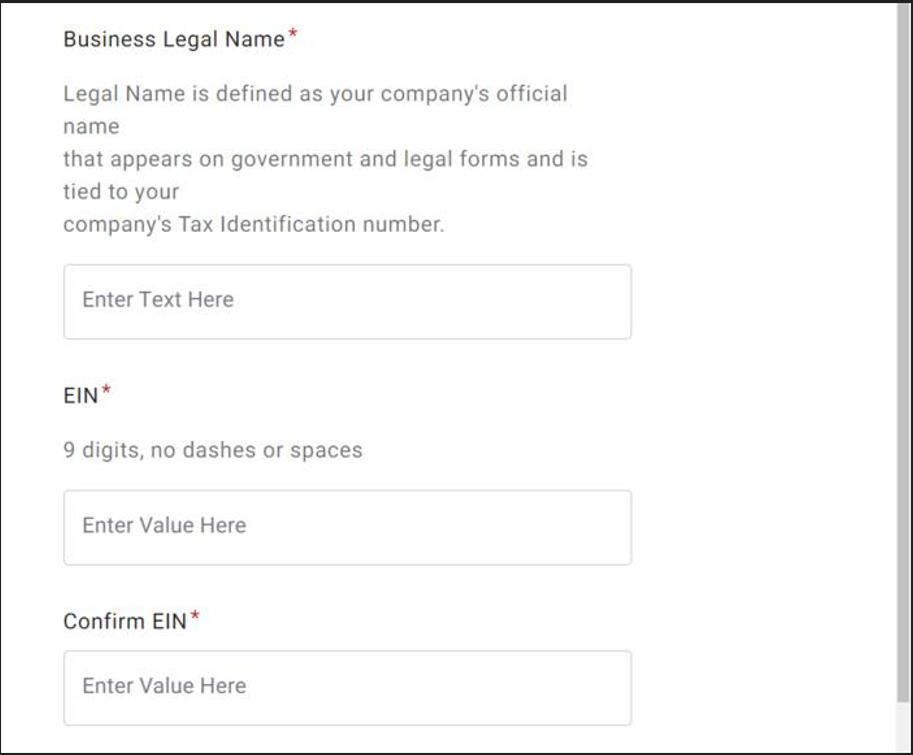
Note that banks are assessing legitimacy from the start. Clear, consistent descriptions of your business model help prevent follow-up requests later.
Step 2: KYC and Identity Verification
Once the application is submitted, the bank initiates Know Your Customer (KYC) checks, which are mandatory under US anti-money laundering regulations.
You will be asked to share the following business information as shown in the screenshot below:

Founders will typically need to submit:
- A valid passport for each controlling person
- Formation documents (Articles of Organization/Incorporation)
- Proof of authority (operating agreement or corporate resolutions, if requested)
- Business address documentation, depending on bank policy
Ensure all names, entity details, and addresses match exactly across documents. Even minor inconsistencies can trigger delays.
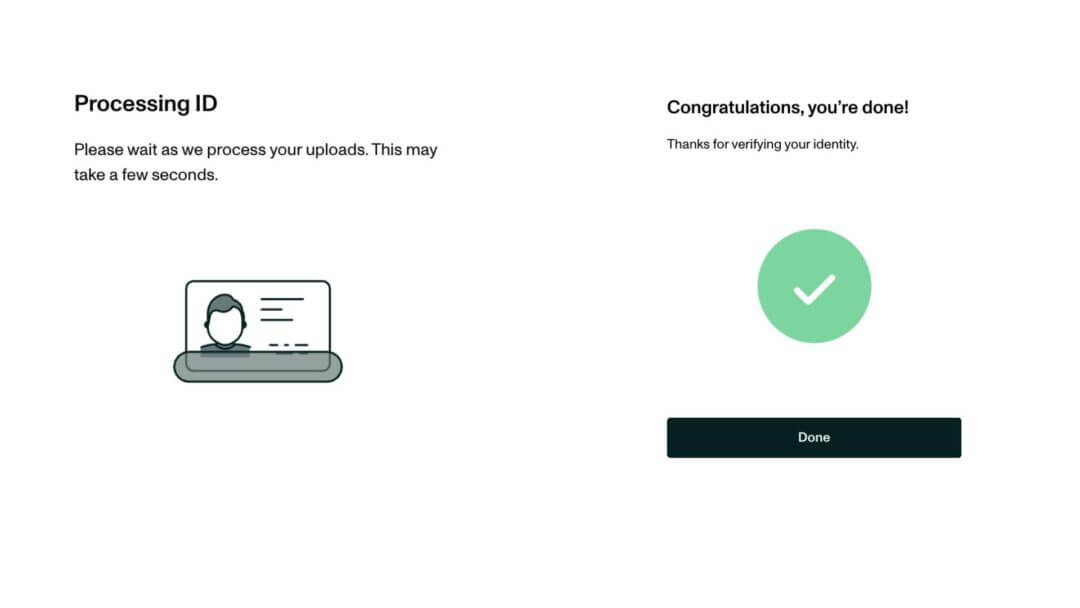
Once all the documents are submitted and verified, you will receive a “confirmation” as shown:
| ⚡ Note for Founders:
Even when operating through a US entity, Canada-based founders may face dual GST/HST implications if revenue is tied to Canadian consumption, either through direct taxable supplies in Canada or via self-assessed tax on ‘imported’ services. |
Step 3: Compliance Review
This is the most critical stage for foreign-owned businesses. The bank conducts an internal compliance review to evaluate overall risk and confirm the business aligns with its onboarding standards.
The review typically examines:
- Business model and expected transaction activity
- Jurisdictional exposure (Canada-based ownership, international customers, etc.)
- Ownership structure and control rights
- Industry category, especially if considered higher-risk (e.g., crypto, regulated products)
- Anticipated payment flows and counterparties
Make sure to have organized documentation, a clear operational explanation, and realistic transaction expectations to expedite approval.
Step 4: Account Approval and Activation
If the bank is satisfied with both identity verification and compliance review, the account is formally approved and activated.
At this stage, founders gain access to:
- US routing and account numbers
- Ability to receive ACH and wire payments
- Debit cards or expense tools (depending on the institution)
- Integrations with accounting platforms and payment processors
Once active, founders should immediately establish clean financial operations, separating business and personal activity and maintaining proper bookkeeping from day one.
Common Rejection Reasons

US banks may decline applications from Canadian founders for reasons that are often preventable with proper preparation. Common issues include:
🚫 Name inconsistencies: Discrepancies between formation documents, EIN records, and application details can trigger automatic rejection.
🚫 Address mismatches: Conflicting addresses across documents, such as registered agent, mailing, and business addresses, raise compliance red flags.
🚫 High-risk or unclear business activity: Businesses operating in regulated, high-risk, or poorly explained sectors may fail internal risk assessments, even if legally compliant.
Founders should treat these considerations as upfront infrastructure, not afterthoughts. When entity setup, documentation, and bank compliance standards are aligned early, approval is smoother and future growth is far easier to support.
US Federal & State Tax Obligations
Establishing a US business entity as a Canada-based founder introduces a dual-jurisdiction tax framework that must be navigated with precision.
While a US entity provides access to global markets, payment infrastructure, and customers, it also triggers federal and state-level tax responsibilities in the United States, many of which apply regardless of whether the founder is physically present in the US.
These obligations are further shaped by foreign ownership rules and the provisions of the US-Canada Tax Treaty, making early structural decisions especially consequential for Canadian founders.
Federal Tax Basics
At the federal level, US tax compliance is mandatory for all registered entities, including those that are wholly owned by non-US persons.
For Canada-based founders, federal tax obligations are primarily driven by entity type, ownership structure, and the nature of US-source income, rather than residency or citizenship.
Key federal considerations include:
- Annual filing requirements for all entities: Every US-registered business must file an annual federal return, even in years with no revenue or activity. Filing obligations exist independently of whether tax is ultimately owed.
- Additional reporting for foreign-owned businesses: Foreign-owned US entities are subject to enhanced disclosure requirements, including information reporting related to ownership, related-party transactions, and cross-border payments. These filings are compliance-driven and non-optional.
- Severe penalties for non-compliance: Failure to file required federal forms, particularly those applicable to foreign-owned entities, can result in substantial penalties, often assessed per form and per year, irrespective of profitability.
From a Canadian founder’s perspective, federal compliance should be viewed as a baseline operating requirement rather than a downstream consideration.
State Taxes
In addition to federal obligations, US businesses may also be subject to state-level taxes, which vary significantly by jurisdiction.
Unlike federal taxes, state tax exposure is determined by operational presence, economic activity, and statutory nexus rules rather than entity formation alone.
Common state-level considerations include:
- Franchise or annual state taxes: Some states impose fixed annual fees or franchise taxes for the privilege of maintaining a registered entity, regardless of income or activity levels.
- Sales tax obligations based on nexus: Sales tax liability is determined by whether the business has established “nexus” in a particular state. Nexus may arise through physical presence, employees, inventory, or economic thresholds such as revenue or transaction volume.
Because nexus rules differ by state and continue to evolve, Canadian founders operating across multiple US states must assess state tax exposure on an ongoing basis rather than as a one-time exercise.
Quick Comparison: US vs. Canada Sales Tax at a Glance
| Feature | United States | Canada |
| Federal Sales Tax | ❌ None | ✅ 5% GST |
| Tax Authority | State- and local-level (e.g., California CDTFA, Texas Comptroller) | Centralized CRA + some provincial (e.g., Revenu Québec) |
| Number of Tax Jurisdictions | 13,000+ (state + city + county + special districts) | ~13 (10 provinces, 3 territories) |
| Economic Nexus Threshold | Varies by state (e.g., $100K in CA, $500K in NY) | Uniform $30,000 CAD for GST/HST; QST is province-specific |
| Tax Calculation Complexity | Highly different rates, rules, and exemptions by ZIP code | Moderate – depends on province, but more unified |
| Invoice + Checkout UX | Inconsistent, often confusing for buyers | More consistent across provinces (except Quebec) |
| Registration Portals | Dozens of state-level websites | CRA (federal), Revenu Québec (Quebec), others as needed |
| Common Filing Pain Point | Managing multiple filing deadlines and platforms | Managing CRA + Revenu Québec separately |
| Digital Goods Rules | Vary wildly by state (some tax, some don’t) | Generally taxed federally and provincially (QST applies) |
These structural contrasts may appear technical on paper, but they have immediate implications across banking, compliance, and customer operations.
US-Canada Tax Treaty Overview
The US-Canada Tax Treaty plays a central role in shaping the tax outcomes for Canadian founders operating US businesses.
The treaty is designed to coordinate taxing rights between the two countries, reduce instances of double taxation, and provide clarity on when business activity in one country becomes taxable in the other.
Key treaty considerations include:
- Definition of permanent establishment (PE): The treaty establishes thresholds for when business activity constitutes a taxable presence, influencing whether profits are subject to US taxation beyond compliance filings.
- Mitigation of double taxation: Treaty provisions enable tax credits and exemptions that prevent the same income from being fully taxed in both jurisdictions, subject to proper structuring and reporting.
- Structure-dependent benefits: The applicability and effectiveness of treaty protections depend heavily on entity classification, ownership structure, revenue flows, and operational footprint.
While the treaty provides meaningful protections, it does not eliminate compliance requirements and does not apply automatically without proper documentation and filings.
| 📌 Note for founders:
As your revenue increases or business operations become more complex, the margin for error in cross-border tax compliance narrows significantly. At this stage, consider engaging CPAs with specific expertise in US–Canada tax matters as a risk-management imperative. |
Ongoing Compliance & Maintenance
Once a US business entity has been formed, ongoing compliance and administrative maintenance become continuous operational obligations rather than one-time formalities.
For Canada-based founders, maintaining good standing is particularly critical, as lapses in compliance can lead not only to penalties and loss of legal protections in the United States, but also to downstream complications with banking, tax filings, and cross-border reporting.
Effective compliance management requires both adherence to statutory requirements and disciplined internal record-keeping practices.
Annual Requirements
US business entities are subject to recurring annual obligations at both the state and federal levels. These requirements exist irrespective of revenue generation or physical presence in the United States.
Core annual obligations typically include:
- Registered agent renewal: All US entities must continuously maintain an active registered agent in their state of formation or registration. Annual renewal ensures uninterrupted receipt of legal notices, service of process, and official correspondence from state authorities.
- Annual state reports: Most states require periodic filings, commonly annual or biennial, to confirm entity details such as ownership, management, and business address. Failure to file these reports on time can result in late fees, administrative dissolution, or revocation of good standing.
- Franchise or annual state taxes: Certain states impose mandatory annual taxes or fees as a condition of maintaining an active entity, regardless of income or operational activity. These obligations are statutory and non-discretionary.
Timely completion of these requirements is essential to preserve the legal validity of the entity and avoid reinstatement costs or operational disruptions.
Record‑Keeping Best Practices
Beyond statutory filings, disciplined record-keeping is a foundational component of long-term compliance.
For foreign-owned US entities, proper documentation is especially important due to heightened reporting requirements and the potential for cross-border audits or information requests.
Key record-keeping areas include:
- Operating agreements and bylaws: Foundational governance documents should be formally executed, kept current, and readily accessible. These documents establish ownership structure, decision-making authority, and internal controls.
- Banking and accounting records: Complete and accurate financial records, including bank statements, transaction histories, and reconciliations, are essential for both compliance and financial transparency. Consistent accounting practices also support future financing, audits, and due diligence processes.
- Tax filings and official correspondence: Copies of all federal, state, and local tax filings, along with notices received from tax authorities, should be retained in an organized and auditable manner. These records form the basis for responding to inquiries and substantiating treaty positions or tax credits.
Robust documentation practices reduce compliance risk and provide continuity as the business scales or advisors change.
Compliance Calendar
Given the multiplicity of filing obligations across jurisdictions, maintaining a centralized compliance calendar is a practical control mechanism for foreign founders managing US entities remotely.
A structured calendar clarifies responsibilities and reduces the risk of missed deadlines.
| What to File | When to File | Who Is Responsible |
| Annual state report | Annually or biennially (state-specific) | Founder, corporate administrator, or service provider |
| Registered agent renewal | Annually | Founder or registered agent service |
| Franchise or annual state tax | Annually (state-specific) | Founder or tax advisor |
| Federal tax return and disclosures | Annually (IRS deadlines apply) | CPA or tax professional |
| Internal record updates | Ongoing | Founder or internal finance function |
A consistently maintained compliance calendar serves as an internal governance tool and reinforces accountability across all parties involved.
Example Walkthroughs
The following illustrative scenarios demonstrate how ongoing compliance and maintenance requirements manifest in practice for Canada-based founders operating US business entities.
Rather than prescribing a single optimal structure, these examples highlight how entity type, state selection, and growth intent influence compliance scope, timelines, and administrative complexity.
These are designed to provide practical context for founders evaluating operational trade-offs under different business models.
Example 1: Canadian E-Commerce Founder | LLC
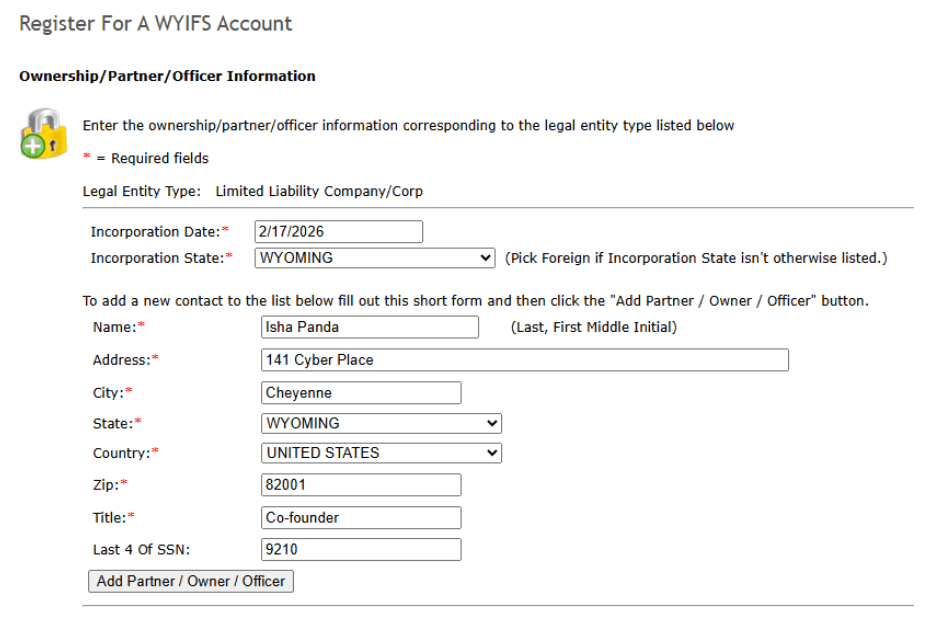
A Canada-based e-commerce founder, for instance, establishes a US LLC in Wyoming to support cross-border sales and access US payment infrastructure.
To start off, they can register for online filing and provide key business information (address, ownership, etc) as shown above. They select Wyoming primarily due to its low annual state fees, minimal ongoing reporting obligations, and founder-friendly privacy framework.
The business operates without a physical US presence, relying on third-party logistics and digital sales channels.
The entity is formed, an EIN is obtained, and a registered agent is appointed in Wyoming. A remote-friendly US fintech bank is selected, enabling account opening without in-person attendance and reducing onboarding friction for a non-resident founder.
Compliance obligations are limited to annual state filings, registered agent renewal, federal tax filings, and consistent record-keeping to support cross-border reporting.
Because the operational footprint is intentionally lean and centralized, the end-to-end setup, from formation through banking activation, can typically be completed within approximately 10-14 days, assuming documentation is prepared accurately and compliance reviews proceed without escalation.
Once approved, the state issues a Certificate of Organization which serves as your LLC’s official proof of formation.

Ongoing maintenance remains predictable and cost-efficient, making this structure well-suited for founders prioritizing speed to market and administrative simplicity.
Example 2: Canadian SaaS Startup | Delaware C‑Corp
Say for instance, a Canada-based software startup pursuing venture funding adopts a Delaware C-Corporation structure to align with investor expectations and institutional governance standards.
They choose Delaware due to its established corporate legal framework, specialized business courts, and broad acceptance among US and international investors.
The company has multiple founders, necessitating formal equity issuance, capitalization table management, and clearly defined governance documentation.
In addition to baseline federal and state compliance, the entity must maintain detailed corporate records, including board resolutions, shareholder consents, and equity documentation.
Ongoing obligations, in this case, extend beyond statutory filings to include investor reporting, financial transparency, and audit-ready record-keeping.
Compliance complexity increases as the company scales, particularly as revenue grows, employees are added, or multi-state operations are introduced.
The administrative burden, in this scenario, is higher than that of a single-founder LLC, but the structure provides strategic advantages in fundraising, equity incentives, and long-term scalability.
Final Setup Checklist
Checklist Item
Status / Notes
✔️ Business structure selected
Entity type aligned with ownership, growth strategy, and funding objectives
✔️ State chosen
Jurisdiction selected based on legal framework, costs, and operational footprint
✔️ Non-US persons without an SSN or ITIN
Entity and banking pathways available to founders lacking US personal tax IDs
✔️ Registered agent appointed
US-based agent with physical address in the state of formation
✔️ Entity registered
Formation completed and confirmed by the state
✔️ EIN received
IRS-issued Employer Identification Number obtained
✔️ US address secured
Address selected based on banking, payments, and marketplace requirements
✔️ Bank account opened
US business bank account approved and activated
✔️ Tax compliance obligations understood
Federal, state, and cross-border tax responsibilities clearly defined and documented
Conclusion: Register a US Business from Canada With doola
Registering and operating a US business from Canada is ultimately a strategic undertaking that demands precision, foresight, and regulatory awareness.
As outlined throughout this doola Doc, successful cross-border formation is the result of informed, intentional decisions across entity selection, jurisdiction choice, documentation precision, banking strategy, and tax alignment.
While the US market offers unmatched access to customers, capital, and financial infrastructure, those benefits are only fully realized when the underlying legal and operational framework is engineered correctly from the outset.
Canadian founders who treat compliance as foundational infrastructure, not a downstream obligation, position their businesses for credibility, durability, and scalable growth.
The frameworks presented here are designed to remove ambiguity, reduce execution risk, and enable founders to enter the US market with confidence and long-term operational clarity.
Use the insights and structures detailed in this guide as a practical foundation to take the next step and establish your US business with confidence.


Table of Contents
OverviewWho Is This For?What This Guide CoversWhat This Guide Does Not CoverStep 1: Choosing the Correct US Business StructureStep 2: Selecting a US State for RegistrationStep 3: Appointing a Registered AgentStep 4: Registering the Business EntityStep 5: Obtaining an EIN (Without an SSN or ITIN)Step 6: Obtaining a US Business AddressStep 7: Opening a US Business Bank Account from CanadaUS Federal & State Tax ObligationsOngoing Compliance & MaintenanceExample WalkthroughsFinal Setup ChecklistConclusion: Register a US Business from Canada With doolaHow Businesses Stay Compliant.