

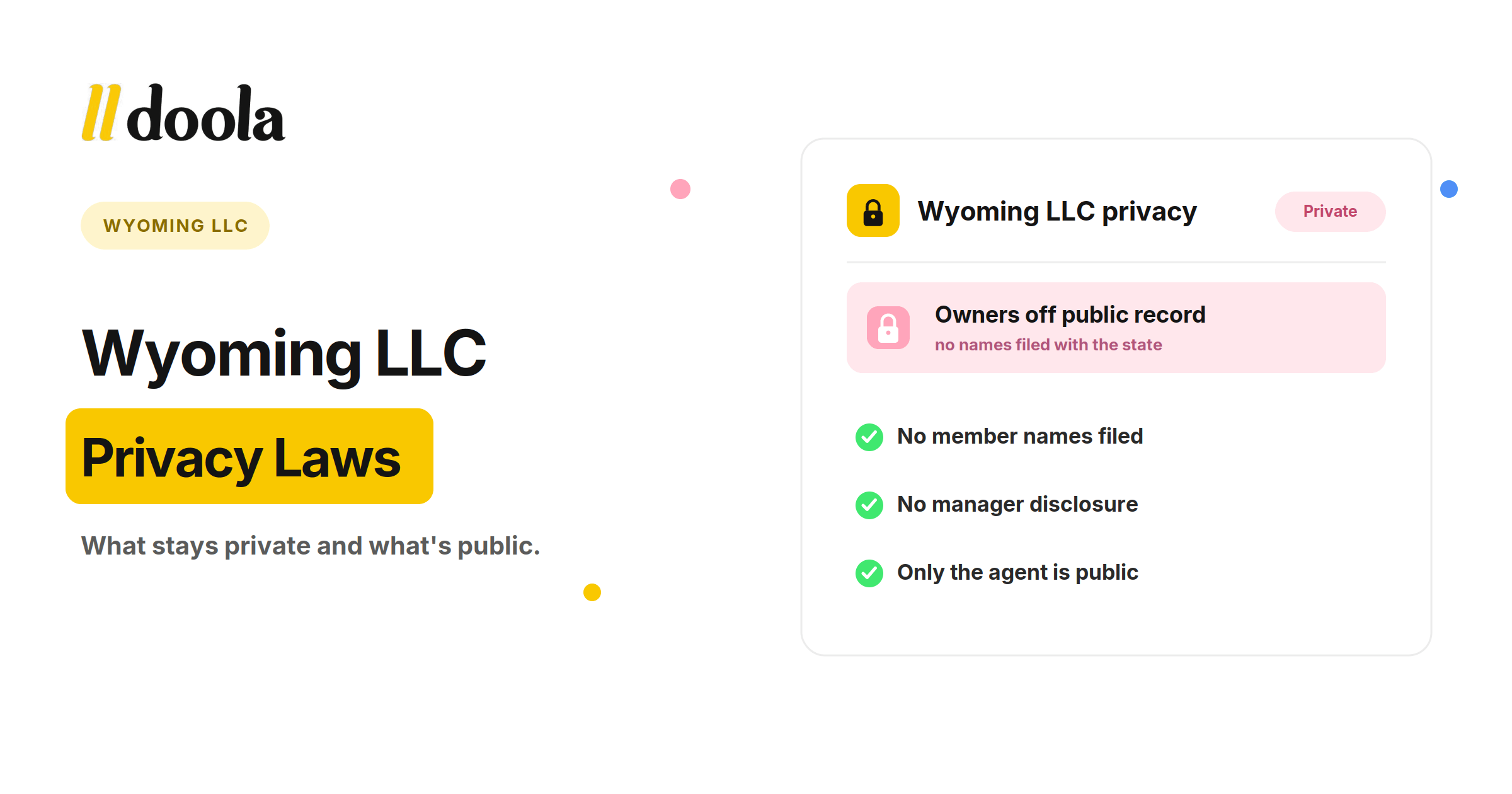
This guide to Wyoming LLC privacy laws explains what information remains private, what becomes public, where privacy can collapse, and how to protect your personal details after formation.
TL;DR: Which Privacy Setup Fits You?
Your privacy configuration should match your actual risk profile. Here is how to structure your new LLC:
- Standard Privacy (Keep home address off public search & records): Use a commercial Registered Agent + Third-Party Organizer + Dedicated Virtual Business Address. This baseline setup keeps your personal residence off routine Secretary of State lookups and public scrapers in any state.
- High Privacy / Enhanced Protection: Use the baseline setup above. For additional privacy or high-risk situations, consider forming a Wyoming holding LLC above your local operating LLC to add an extra layer between your public identity and the business.
- Basic/Low Risk (When address privacy isn’t a priority): A standard Registered Agent and Virtual Address setup still prevents your home address from entering public state registries. You do not need the added complexity or cost of a multi-LLC structure.
Read on for specific state disclosure rules, common leaks (payment gateways, WHOIS), and how to set up complete address privacy from day 1.
In 2019, David and Ina Steiner ran a small trade blog called EcommerceBytes right out of their living room in Massachusetts. They covered online marketplaces, and they didn’t hold back when reporting on executive missteps.
Someone corporate didn’t take that well.
What followed sounds like a psychological thriller. Fake Craigslist ads were posted online, listing the couple’s home address and inviting complete strangers to show up for impromptu garage sales, late-night hookups, and party meetups. Soon after, packages began arriving: live spiders, boxes of cockroaches, a funeral wreath, and a bloody pig mask.
For a long time, neither the Steiners nor local law enforcement knew who was behind the harassment campaign. When federal prosecutors finally untangled the trail, the source wasn’t a disgruntled reader or a random web troll.
It was eBay’s own corporate security team.
eBay eventually agreed to a $3 million criminal settlement over the campaign, not a normal regulatory fine, but an explicit admission of guilt stemming directly from employee access to a couple’s residential address.
Most founders will never face anything remotely close to that nightmare. But the underlying vulnerability is identical:
The moment your physical address sits in a public database, anyone with an internet connection can find you.
Doesn’t matter if you’re running an Etsy shop out of a spare room or a two-person SaaS company. If your name and address are searchable, they’re searchable by everyone, not just the customers you’re hoping to find you.
That is where Wyoming LLC privacy laws become relevant.
Here is what most incorporation services won’t mention: keeping your name off the state formation filing solves less than half the problem. The rest of your data footprint usually leaks through everyday operational touchpoints you haven’t thought to protect yet.
What This Guide Covers for US and Non-US Founders
- Wyoming’s Legal Boundaries: Exactly what information the Secretary of State keeps hidden and what remains public record.
- Hidden Exposure Points: The most common ways founders accidentally leak their home address post-incorporation.
- Practical Steps: How to keep your personal location completely off public-facing business documents.
Is an Anonymous Wyoming LLC Actually Private? | Myths vs. Facts
Marketing claims surrounding “anonymous LLCs” often create dangerous misunderstandings about what state-level privacy protections actually cover.
Here are the most common Wyoming LLC privacy myths, and what is actually true.
The Paper Trail Matrix: What’s Public vs. What’s Vaulted
When establishing and managing an anonymous Wyoming LLC, safeguarding your privacy requires a clear understanding of where each data point is processed and stored.
Mechanics of Wyoming Privacy Protections
The statutory foundation of Wyoming LLC privacy laws relies on three essential legal mechanisms:
1. Absence of Ownership Filing Requirements
Wyoming Statute § 17-29-201 governs Articles of Organization. The state does not require you to list member or manager names and addresses on public filings. Unlike California or Nevada, Wyoming leaves ownership fields off formation documents and annual reports entirely.
2. Public Shield via Commercial Registered Agent
Wyoming Statute § 17-28-101 obligates every business entity to maintain an in-state physical address for service of process.
Engaging a commercial registered agent places their address on the state registry, creating a protective buffer between public record scrapers and your personal residence.
3. Third-Party Organizer Execution
The person who signs your Articles of Organization stays on public record forever. If you sign the document yourself, your name becomes permanent public data.
Using a third-party formation service lets an authorized representative sign as the organizer, keeping your name off state filings.
The 4 Big Leaks: How Founders Often Blow Their Own Privacy
Setting up an anonymous Wyoming LLC at the state level takes care of initial formation filings. But privacy leaks rarely happen on day one at the Secretary of State’s office. They happen during day-to-day operations through routine vendor setups, merchant sign-ups, and out-of-state filings.
Here are the four most common operational missteps founders make:
Leak 1: Self-Filing as Organizer or Registered Agent
When filing Articles of Organization online, state portals prompt you for an Organizer (the entity or person submitting the form) and a Registered Agent (the entity receiving legal notices). To save a $50 to $100 service fee, founders type in their own name and home address.
Wyoming permanently archives the original Articles of Organization as a public PDF. Amending your filing later does not wipe the record. Hiring a registered agent service after the fact will not hide your past details either.
The initial PDF remains permanently stored in public state databases. Within 24 to 48 hours, data scrapers index that original document, making your personal information searchable online forever.
Real-World Scenarios: How Founders Dox Themselves Unknowingly
- A protocol developer creates a Wyoming LLC to accept software grants. To save time, they sign as the organizer using their home address. Six months later, a disgruntled token holder searches the public state database, pulls the original PDF, and posts the founder’s residential address on X.
- A streamer with 300,000 subscribers forms an LLC independently. They list themselves as the Registered Agent. Corporate aggregator websites immediately link their full legal name and home address to the channel’s business name, allowing persistent followers to send unwanted physical packages directly to their front door.
How to Fix It
Never put your personal name on state submission forms. Appoint a Commercial Registered Agent prior to filing, and instruct a Third-Party Formation Organizer to sign and submit the Articles of Organization on your behalf.
Leak 2: Entering a Residential Address in Principal or Mailing Address Fields
Wyoming law does not require member or manager names on filings, but it does require a physical Principal Office Address (where operations occur) and a Mailing Address (where state notices are sent).
During online formation, founders type in their personal residential address because they do not yet have a commercial lease.
Unlike member lists, Principal and Mailing addresses are active searchable data fields on the Secretary of State’s public web lookup. Automated web bots scrape these database entries daily.
When data brokers link your home address to your business, it appears in public search engine results whenever anyone searches your company name.
Real-World Scenarios: How Founders Dox Themselves Unknowingly
- An online seller creates an LLC for a private-label skincare brand. They enter their apartment as the Principal Office Address. A customer experiencing an allergic reaction searches the business entity online, finds the residential address in state filings, and shows up at the apartment complex demanding a refund.
- An investor sets up a new entity to test a stealth business concept. By entering their primary residence as the mailing address, public corporate databases immediately link their high-profile personal name to the new venture, blowing their stealth launch strategy before product development finishes.
How to Fix It
Secure a commercial Virtual Business Address with physical mail-scanning capabilities before filing any state paperwork. Enter this commercial address into all Principal Office and Mailing Address fields across every state form.
Leak 3: Foreign-Qualifying in High-Disclosure States
A founder living outside Wyoming (for example, in California, New York, or Florida) forms a Wyoming LLC.
As the business grows, they need to sign local office leases, hire local employees, or register for local state taxes. They file a Foreign Qualification to legally conduct business in their home state.
State registration laws apply locally. While Wyoming protects ownership details, states like California mandate an initial Statement of Information (Form LLC-12) within 90 days of foreign registration.
This form explicitly requires listing the full names and physical business or residential addresses of all active managers or members. Failing to structure this correctly strips away the front-end public privacy provided by Wyoming.
Real-World Scenarios: How Founders Dox Themselves Unknowingly
- A Texas-based investor forms a Wyoming LLC to acquire out-of-state rental properties secretly. When they foreign-qualify the entity to acquire local Texas property, county land filings and state registrations mandate listing the managing member. Their personal name becomes attached to the public property deed, defeating the original purpose of using Wyoming.
- An international SaaS founder forms a Wyoming LLC from abroad. Later, they move to California on a visa and open a physical office in San Francisco. When completing California’s Statement of Information, they list themselves as the sole managing member. Their personal California residential address enters the California public business registry.
How to Fix It
Before foreign-qualifying in a state that requires more owner information, consider whether a Double LLC structure makes sense.
Here’s the setup:
- Your Wyoming LLC owns 100% of the local operating LLC.
- The local LLC runs the business in your home state.
- Where the state allows an entity to be listed as the member, the filing can show the Wyoming LLC’s name and business address instead of your personal name and home address.
That can preserve another layer of public-record privacy when you have to register outside Wyoming.
But it is not a universal workaround. State disclosure rules still apply, and you now have two LLCs to maintain, which means extra filing fees, annual costs, banking, and bookkeeping.
Leak 4: Exposing Personal Details in Day-to-Day Operations
Even with a flawless state-level setup, founders inadvertently publish personal details across operational vendor channels, developer accounts, merchant tools, and domain registrations.
Third-party platforms operate under specific regulatory and operational frameworks, including:
- Consumer protection laws
- Card network compliance rules
- Platform transparency policies
If you register vendor accounts using personal credit cards or personal home addresses during sign-up, those tools default to displaying those details across several public and customer-facing channels like customer-facing invoices, WHOIS lookup directories and online store footers.
Real-World Scenarios: How Founders Dox Themselves Unknowingly
- An independent developer launches a subscription app using their Wyoming LLC. When setting up their Google Play Console Merchant Account, Google mandates displaying a public physical developer address for consumer transparency. The developer enters their home address during setup. Within hours, their home address appears at the bottom of their app’s public store listing.
- A founder sets up Stripe to process credit card payments. During Stripe onboarding, they enter their personal residence as the “Customer Support Address”. Every automated email receipt sent to customers includes their home address printed in the footer.
- An international founder registers a .com domain for their SaaS platform using a personal credit card. They forget to enable WHOIS privacy protection. ICANN domain databases immediately publish their foreign personal address and phone number online, where it is indexed by global domain scrapers.
How to Fix It
Perform a total operational data audit across four main touchpoints:
- Payment Processors (Stripe/PayPal): Navigate to Settings → Public Details and manually set the public customer support address to your commercial virtual address.
- Domain Registrars: Enable WHOIS Privacy Protection (ID Shield) on all domain names before completing purchase checkout.
- App Store Profiles: Register developer portals as an Organization (not an Individual) using your Wyoming LLC EIN and commercial virtual address.
- Physical Returns: Use a dedicated mail-forwarding or virtual address facility on product packaging and shipping labels rather than your home address.
What Wyoming LLC Privacy Costs Over 5 Years
Running an anonymous Wyoming LLC necessitates a virtual business address and a commercial registered agent. Sourcing these services independently adds administrative tracking overhead and leads to vendor bloat.
Here is a breakdown of the maintenance costs associated with a DIY Wyoming privacy setup:
DIY Privacy Maintenance Costs
Setting up a DIY privacy stack means researching, vetting, and onboarding 3 to 4 separate vendors, a commercial registered agent, a virtual address provider, an EIN filing service, and a compliance tracker.
DIY vs. doola: What Are You Actually Paying For?
At first glance, the difference doesn’t appear too big: a typical DIY stack costs around $325+ per year, compared with $297 for doola Starter.
Over five years, that works out to roughly $1,625+ vs. $1,485, excluding state fees. But the bigger difference is in how much you have to manage yourself.
With the DIY route, you may need separate providers for your registered agent and virtual address, while also handling the formation filing, EIN application, operating agreement, and renewals on your own.
doola handles the formation, EIN application, registered agent, virtual address, and key setup documents in one place, thereby reducing admin overhead and lowering the five-year total cost.
Time vs. Expense
If you’re doing this yourself, the LLC filing is usually the easy part. The EIN is where the timing starts to vary.
From what doola’s formation team is seeing, the LLC itself is usually filed within 24 hours. For U.S. founders with an SSN, the EIN often comes through the same day or within 1 business day.
For non-U.S. founders without an SSN, it takes longer because the SS-4 goes to the IRS by fax. When the IRS backlog is lighter, that can be around 10–14 business days. Right now, doola is seeing more like 18–30 days.
If you DIY, you’re dealing with the same IRS wait. The difference is that you’re also the one sending the application, checking on it, fixing any mistakes, and following up if it gets stuck.
With doola, that part is handled for you. The IRS still sets the pace, but you’re not left chasing the process yourself.
Want to skip the paperwork and follow-ups? Start your LLC with doola and let us handle your formation, EIN application, registered agent, and business setup in one place.
What to Check Before You Form a Wyoming LLC?
Before relying on Wyoming LLC privacy laws, make sure Wyoming actually fits how and where you run your business.
If you operate from another state, that state may require you to register the Wyoming LLC there too. Once that happens, the local state’s disclosure rules can come into play and reduce the privacy you gained in Wyoming.
What to Check First
- Where you actually operate: If you have an office, storefront, warehouse, employees, or other physical presence outside Wyoming, you may need to register there as a foreign LLC.
- What your home state makes public: Foreign qualification can expose information Wyoming keeps private. For example, some states require manager or member details on public filings.
- Whether a second LLC is worth it: Some founders use a Wyoming holding LLC above a local operating LLC for more separation. That can help in some cases, but it also means extra filing fees, annual costs, and admin.
- What still has to be disclosed privately: Wyoming privacy does not hide you from banks, payment processors, or other regulated institutions. You still need to provide real ownership details during KYC checks.
- Your federal tax filings: The IRS still requires a responsible party for an EIN, and foreign-owned single-member LLCs may also have additional reporting requirements, including Form 5472.
Additionally, understand what Wyoming LLC privacy laws cannot do.
What Wyoming LLC Privacy Can vs. Cannot Do
How to Form a Wyoming LLC Without Unnecessarily Exposing Your Information
Follow this step-by-step sequence to form an anonymous Wyoming LLC and ensure your personal information remains completely off the public record:
1. Check Name Availability:
Search the Wyoming Secretary of State database to confirm your desired company name is distinct and available under W.S. § 17-29-108.
2. Appoint Commercial Registered Agent
Lock in your registered agent service before generating state forms so their physical address occupies the public registered agent field.
3. Set Up Virtual Business Address:
Route all principal street and mailing address fields to a commercial virtual business address prior to submitting paperwork.
4. Hire Third-Party Organizer:
Ensure the Articles of Organization are signed and submitted by an authorized representative of your filing service so your personal signature never enters state archives.
5. Secure EIN Privately:
File Form SS-4 with the IRS designating your responsible party. Here’s what you need to know:
- Your EIN record is not public: IRS EIN information is confidential tax data, not something that appears in a public business search.
- U.S. founders with an SSN usually move faster: The EIN often comes through the same day or within one business day after formation.
- Non-U.S. founders usually wait longer: Without an SSN, the application generally goes through the IRS by fax, so processing can take much longer.
Non-US founders file by fax, and should plan for 10 to 30+ business days depending on IRS backlog. The IRS’s currently quoted window is 30 days; recent actual turnaround has often run faster, closer to two to three weeks, but 30 days is the safer number to plan around.
6. Draft Internal Operating Agreement:
Detail member ownership percentages and internal management rules. Store this document privately in your corporate records; it is never filed with the state.
7. Open Business Bank Account:
Submit identity verification details directly to your financial institution during confidential KYC onboarding.
How to Keep Your Wyoming LLC Private After Formation
Wyoming can keep your ownership details off standard state filings, but that does not mean every business record stays private.
Some information can still appear publicly, including:
- Articles of Organization
- Annual report details
- Principal office or mailing address
- Organizer information
- Amendments filed later with the Secretary of State
And the state registry is only one place to watch. Your home address can also surface through your website, a local business license, domain registration, invoices, app-store profiles and other public-facing business accounts
That’s why the privacy setup has to continue after formation. Keep using your registered agent and separate business address, and avoid adding personal details to public-facing records unless they are legally required.
Here’s what to watch as your LLC operates and grows.
Renew Your Registered Agent
Wyoming LLCs must continuously maintain a registered agent with a physical address in the state.
If the agent resigns or the service lapses, you need to appoint a replacement.
Wyoming generally gives the LLC 60 days after notice to fix the issue. If you do not, the Secretary of State can begin the process of administratively forfeiting the LLC’s authority or articles.
Treat the registered agent renewal date as an IMPORTANT compliance deadline. Keep your payment method current and make sure your agent can still reach you.
The agent also keeps certain internal information about the people connected to the LLC, including managers or members and a communications contact. That information is not automatically shown on the public business record, but the agent still needs accurate details on file.
Maintain Your Business or Virtual Address
If you’re using a virtual or commercial address, keep it active.
You may already be using that address for state filings, bank records, vendor accounts, and business mail. If you let it lapse, the easy fallback is often your home address, which can undo the privacy setup you started with.
Whenever you update an account, check which address is being used before you submit the change.
One thing to keep separate: a virtual address is not your registered agent. The virtual address is for business mail. Your registered agent still needs a physical Wyoming address for legal notices.
File Your Annual Report Carefully
A Wyoming LLC must file an annual report each year. The report is due on the first day of the LLC’s anniversary month, and the annual license tax is generally $60 or 0.0002 of the company’s Wyoming assets, whichever is greater.
Before you submit it:
- Check the address fields: Make sure the principal office and contact details are still correct.
- Don’t default to your home address: If a valid business address can legally be used, avoid adding your residential address just because it is convenient.
- Don’t miss the deadline: If the report remains unfiled for 60 days after the due date, Wyoming can administratively dissolve the LLC.
The same caution applies whenever one of your business addresses changes during the year.
Be Careful When Updating Addresses
Your virtual mailbox may move, your registered agent may change offices, or your business may relocate. When that happens:
- Update the right record: An old address can send important mail or notices to the wrong place.
- Avoid using your home address as a quick fix: If it lands on a public filing, directory, or customer-facing account, it may still be copied elsewhere even after you change it.
- Use the right address for the right purpose: Your registered office, principal office, mailing address, bank address, and operating address do not all have to be the same.
Before submitting any address change, check where that address will appear and whether it will be public.
Keep Ownership Documents Out of Public Channels
Your operating agreement, membership ledger, membership certificates, ownership transfers, resolutions, and amendments should be stored securely with the company’s internal records.
These documents can contain exactly the information you are trying to keep off public-facing records, including member names, ownership percentages, addresses, signatures, and financial arrangements. Avoid placing them in publicly shared cloud folders or attaching them unnecessarily to customer-facing documents.
Privacy does not mean hiding ownership from authorities, banks, courts, or other parties that are legally entitled to request it. It means avoiding unnecessary public disclosure.
Audit Your Operational Touchpoints
The Secretary of State is only one place where your information can appear.
Check the services you use after formation, including your website, domain registration, payment processor, invoicing software, app-store profiles, e-commerce accounts, business directories, email signatures, and customer-facing terms.
For example, a founder could carefully keep a home address off Wyoming’s public formation record and then accidentally publish it six months later in a website footer or invoice template.
Use your legitimate business contact details wherever the service allows it. But do not provide false information or substitute a virtual address where a bank, payment processor, tax authority, or regulated platform specifically requires your actual residential or physical address for identity verification.
Run a Privacy Check Once or Twice a Year
Search your LLC name, your own name, phone number, and business address online. Review your Wyoming business record, website, major business accounts, and public profiles to see what information is actually visible.
Privacy is easier to maintain when you catch a disclosure early.
Once a residential address has been copied by business directories, data brokers, search engines, or archived webpages, removing it can become much harder.
Confidentiality Exception: Where Identity Disclosure IS Required
Maintaining public privacy does NOT mean hiding your identity from regulated authorities. To remain fully compliant, prepare to disclose true beneficial ownership details in these strictly confidential, non-public channels:
- Banking & Financial Institutions (KYC): Banks are required under federal Anti-Money Laundering (AML) laws to verify beneficial owners holding 25% or more equity. This information is held confidentially by the bank and is never uploaded to state databases.
- Internal Revenue Service (IRS): Requesting an EIN requires naming a “Responsible Party” (listing an SSN, ITIN, or Passport number). IRS records are protected under federal tax confidentiality laws (26 U.S.C. § 6103) and are never shared publicly.
- Foreign-Owned LLC Tax Filings (Form 5472): Non-US founders operating foreign-owned single-member LLCs must submit IRS Form 5472 and Form 1120 annually. While submitted privately to the IRS, failing to file carries a mandatory $25,000 statutory penalty per missing return under 26 U.S.C. § 6038A.
What Founders Ask Our Formation Experts About Wyoming LLC Privacy?
When founders consult our formation experts regarding Wyoming LLC privacy laws, their concerns typically extend well past a basic “Will my name be publicly visible?”
Below are the most common practical inquiries we receive, reflecting the key issues frequently debated by entrepreneurs on Reddit.
- If Wyoming Doesn’t Require My Name as a Member, Can I Still Expose Myself by Filing the LLC on My Own?
Yes. This is an easy detail to miss.
Wyoming’s formation form does not require member names, but it does require the organizer to sign and print their name. If you file the LLC yourself, your name can still appear on the formation document, just as the organizer rather than the owner. Wyoming also allows filed documents to be retrieved through its business-record system.
That is why privacy-conscious founders need to look at the entire filing, not just the member field.
- Do I Need a Registered Agent Address, a Virtual Address, or Both?
Possibly both, because they solve different problems.
Wyoming requires your registered agent to maintain a physical Wyoming address where legal documents can be accepted. The LLC formation form separately asks for a mailing address and principal office address.
This distinction causes a lot of confusion on Reddit, especially when founders discover that a registered agent’s address is not automatically suitable for banking, payment processors, or everyday business mail.
Key Takeaway: Don’t assume one address can be used for every purpose.
- If I Own Several Wyoming LLCs, Can Someone Connect Them Even If My Name Isn’t Listed?
Potentially, but not simply because they use the same registered agent.
Commercial registered agents can represent hundreds or thousands of companies, so sharing one proves nothing about ownership. But repeated public details, such as the same unusual mailing address, principal office, organizer, or other filing information, can make businesses easier to associate with one another.
For founders building several entities, privacy is therefore not just about removing your name. It is also worth thinking about how much information your filings have in common.
- I Put the Wrong Address on My First Filing. If I Change It Now, Is the Old One Gone?
Don’t assume so.
Wyoming lets businesses update their current principal and mailing addresses, but it also allows users to access an entity’s filing history and view available PDFs of previous filings and amendments.
So, fixing your address today does not necessarily erase a residential address that appeared on an earlier document.
This is one reason our formation experts emphasize getting the privacy setup right before the first filing. Keeping personal information out of the record is much easier than trying to clean it up later.
Where Wyoming LLC Privacy Stops
As highlighted earlier, Wyoming LLC privacy laws do not provide total anonymity. Their main purpose is to limit what appears in public state records, not to hide an LLC owner from every institution or legal process.
Once a bank, tax authority, court, or other authorized party has a legal reason to ask who owns the LLC, a different set of rules applies. That is why it helps to look at where Wyoming privacy stops, starting with federal ownership reporting.
Does the Corporate Transparency Act Apply?
This is one area where older articles can be misleading.
As of August 11, 2026, domestic U.S. companies, including Wyoming LLCs, are exempt from FinCEN’s BOI reporting requirements under the current Corporate Transparency Act rule.
That means a domestic Wyoming LLC no longer has to file its beneficial owners with FinCEN under the CTA. But that does not mean the LLC’s ownership can never be discovered.
Foreign entities registered to do business in the U.S. are treated differently and may still have BOI reporting obligations. Where reporting applies, FinCEN keeps that information in a restricted database rather than a public business-search system.
A lawsuit is where the limits of Wyoming privacy become much clearer. Through subpoenas and discovery, courts can require access to ownership information that would never appear in a public business search.
What Happens If You Get Sued?
A Wyoming LLC may keep your name off the public state record, but a lawsuit can still uncover who owns the company. Here’s what you should know:
- Public Privacy: Wyoming can keep member ownership details out of routine public formation records and business searches.
- Legal Disclosure: During litigation, relevant ownership records held by registered agents, banks, or other parties may be obtainable through subpoenas, discovery requests, or court orders.
- The Reality: Wyoming privacy limits routine public exposure. It does not shield ownership information from lawful legal process.
In short, Wyoming privacy Laws can stop a stranger from finding your ownership through a simple public search. But, it does not stop a court from requiring that information when there is a valid legal reason to produce it.
This is that core area where discussion should move from privacy to asset protection: once a creditor knows you own the LLC, the next question is what they are legally allowed to reach.
Privacy vs. Asset Protection
Think of privacy and asset protection as two different layers.
Privacy = Camouflage: It reduces how prominently your personal identity is connected with the LLC in publicly accessible records.
Asset Protection = Armor: It concerns which assets a creditor may legally reach after establishing a valid claim or obtaining a judgment.
Wyoming law generally treats an LLC as legally separate from its members. Company debts do not automatically become a member’s personal debts merely because that person owns or manages the LLC.
However, Wyoming law allows courts to consider several specific factors when determining whether a member should be held personally liable:
- Fraud or misrepresentation in business dealings
- Inadequate capitalization relative to business risks
- Failures to adhere to required formalities, where applicable
- Serious commingling of personal and company finances
Personal debts work differently than company debts. If a creditor sues you personally, Wyoming law protects your LLC.
Under state law, a court can only grant a charging order against your interest in the business. Creditors cannot seize company assets or take control of the business, even if you are the sole owner. A charging order is their only legal path to collect.
So, an anonymous Wyoming LLC is not automatically an asset-protected LLC simply because the owner’s name is absent from a public filing.
Privacy controls public visibility. Asset protection determines legal exposure. You can have one without necessarily having the other.
And one of Wyoming’s most important asset-protection rules is its charging-order protection.
How Wyoming’s Charging Order Protection Works
Under Wyoming Statute § 17-29-503, if an LLC member incurs personal debt, a court creditor’s statutory remedy against that member’s interest in the LLC is limited to a charging order.
A charging order gives the creditor a lien on cash distributions made from the LLC to that member, but does not allow the creditor to seize LLC assets, force liquidation, or participate in company management.
Wyoming explicitly extends this exclusive single-member charging order protection to sole-member LLCs, preventing courts from seizing company assets to settle personal judgments.
What If You Run the Business Outside Wyoming?
Our clients frequently ask how out-of-state operations affect Wyoming’s privacy protections. While Wyoming maintains strict privacy standards for its own public registry, operating in another state subjects your business to that state’s local disclosure regulations.
Take California as an example: If your Wyoming LLC engages in local business activities, you are required to register as a foreign LLC. Standard activities that trigger this requirement include:
- Leasing physical commercial or office space
- Managing local staff or employees
- Running a physical storefront or local facility
This foreign registration triggers California’s requirement to file a Statement of Information (due within 90 days of registration and every two years thereafter), which explicitly requires naming at least one member or manager and providing an address.
Ultimately, while Wyoming keeps your information private locally, registering as a foreign entity in another state can result in a separate public record with different disclosure mandates.
Can a Wyoming Holding LLC Add Another Privacy Layer?
That is one reason some founders use a two-LLC structure or Double LLC structure.
Instead of owning the local operating LLC personally, a Wyoming holding LLC owns it. Where the local filing allows an entity to be listed as the member or manager, the Wyoming LLC may appear there instead of your personal name.
But this is not a privacy shortcut that works everywhere. The local state still controls what has to be disclosed, and you now have two LLCs to maintain, which means more filing fees, annual costs, bookkeeping, and compliance.
For most founders, the extra layer only makes sense when the added privacy is worth the extra work
Using a Wyoming LLC to Hold Real Estate
Similar logic applies to property. If an LLC buys a property, the deed will generally show the LLC as the owner rather than listing you personally. That can reduce how directly your name appears in county property records.
But the property itself ties the LLC to another state. Depending on that state’s rules and what the LLC does with the property, you may also face local registration, tax, licensing, or disclosure requirements.
And the ownership is not hidden from everyone. Lenders, title companies, tax authorities, and courts can still require the real owner’s information when there is a legitimate reason to do so.
Whether you are running a business or holding property outside Wyoming, the rule is the same: check the disclosure rules where the business actually operates or owns assets, not just the rules in Wyoming.
Special Wyoming Privacy Laws Considerations for Non-US Founders
If you live outside the U.S., Wyoming can still be a good privacy-friendly option. But there are a few extra things to keep in mind.
- You can form without a U.S. home address: You can use a business or virtual address where allowed, so your overseas residential address does not have to appear on public-facing business records.
- Banks will still ask who you are: When opening a bank account, expect to provide your passport and proof of address. That information is used for identity checks and is not normally shown on Wyoming’s public business search.
- Tax filing matters: If you own a foreign-owned single-member LLC, you may need to file Form 5472 with a pro forma Form 1120. Missing that filing can lead to a $25,000 penalty. See the IRS rules.
Wyoming vs. Delaware vs. Nevada vs. New Mexico for LLC Privacy
Here’s how Wyoming compares with Delaware, Nevada, and New Mexico on the factors that matter most for LLC privacy.
These grades evaluate four key criteria that matter most to both US and Non-US founders:
- Public Disclosure: What information enters the public record.
- Annual Updates: Whether ownership details must be re-filed every year.
- Maintenance Costs: The ongoing state fees required to stay compliant.
- Asset Protection: How strongly state law shields a single-member LLC from personal creditors.
Disclaimer: The grade reflects doola’s assessment based on public-record disclosure, ongoing filing requirements, state costs, single-member charging-order protection, and insights from 1:1 founder consultations. It is not an official state rating.
Best LLC States for Non-US Founders: Privacy, Cost, and Protection
Wyoming — A+
The balanced privacy option. Wyoming does not require member or manager names on its standard Articles of Organization, and its annual report asks for the principal-office address and Wyoming assets rather than an ownership list.
Formation costs $100, and the annual fee starts at $60. Wyoming also expressly makes the charging order the exclusive remedy even when the debtor is the LLC’s sole member.
For a remote non-US founder, that gives you a useful combination: no public member list, low ongoing state cost, and clear single-member creditor-protection language. One caveat: the organizer’s name is still printed on the formation document if you file it yourself.
Delaware — A-
Strong privacy, much higher annual cost. Delaware’s Certificate of Formation requires the LLC name and registered-agent details, not member names, and Delaware LLCs do not file an annual ownership report.
Its official 2026 fee schedule still lists $110 to form an LLC, while the annual LLC tax is now $400. Delaware law also says charging-order protection applies whether the LLC has one member or several.
For a founder choosing a state mainly for privacy, Delaware gets you similar public-record privacy to Wyoming, but at a much higher yearly state cost. Its other advantages may matter if you have separate legal, financing, or investor reasons for choosing Delaware.
New Mexico — A
Cheapest to maintain. New Mexico does not require member names in the statutory Articles of Organization requirements, and its LLC rules do not impose an annual LLC report. Formation is $50, with no recurring Secretary of State annual-report fee.
The trade-off is the charging-order statute. New Mexico allows a creditor to obtain a charging order against a member’s interest, but the statute does not expressly say that this is the exclusive remedy for a single-member LLC, as Wyoming, Delaware, and Nevada do.
Nevada — C-
Good creditor protection, weak public-record privacy. Nevada is very different from the other three.
Its Articles of Organization require the names and addresses of the initial managers or, for a member-managed LLC, the initial members. It then requires an Initial List and Annual List naming managers or managing members and listing their addresses.
It is also the most expensive here: $75 formation + $150 Initial List + $200 business license = $425 upfront, followed by $150 Annual List + $200 business-license renewal = $350 per year.
Nevada does have explicit single-member charging-order protection, but if your main goal is keeping management information out of public filings, that protection does not solve the disclosure problem.
doola’s POV
Wyoming offers the strongest overall balance. New Mexico wins on cost. Delaware gives similar filing privacy at a much higher annual price. Nevada requires too much public management disclosure to compete on privacy alone.
Build Your Private Wyoming LLC With doola

Most founders don’t lose their privacy when they file their LLC. They lose it months later down the road when routine business admin gets messy.
doola helps keep your Wyoming LLC private by handling the pieces founders tend to overlook:
- Registered agent service: doola serves as your registered agent and provides a Wyoming address for your official filings, so your personal name and home address stay off the state’s public register.
- Virtual business address: A dedicated business address keeps your personal address out of vendor accounts, public forms, and invoices.
- Annual report filing: On the Tax and Compliance and Business-in-a-Box™ plans, doola files your Wyoming annual report, helping your LLC stay in good standing year after year.
- Documents in one place: Your formation documents and filings are stored in your doola dashboard, so everything is easy to find when you need it.
FAQs
Can someone find out if I own a Wyoming LLC?
Not through public state registries or online business lookup tools. To uncover ownership, an individual would need a court order, a civil subpoena associated with active litigation, or official law enforcement authority.
Is an anonymous Wyoming LLC completely invisible?
No. You remain visible to banks, tax authorities (IRS), courts with subpoena power, and your registered agent. It provides public privacy, not absolute legal immunity.
Can my home address stay off public records permanently?
Yes, if you route all public fields (principal street address, mailing address, payment processors, WHOIS domain registries) through a commercial virtual business address from day 1.
Does my bank share my identity details publicly?
No. Financial Know Your Customer (KYC) records are strictly confidential and governed by federal financial privacy laws. Banks do not share ownership data with public registries.
Do domestic Wyoming LLCs file BOI reports under current rules?
Domestic U.S. LLCs owned by U.S. persons are exempt from public FinCEN reporting under current administrative rules. Even where reporting applies to foreign entities, FinCEN BOI data is non-public.
What happens to my privacy if I register my Wyoming LLC in another state?
If you foreign-qualify your Wyoming LLC in a state like California or Florida, that state’s public disclosure laws apply. If your home state mandates member or manager disclosures on annual filings, your privacy will be compromised unless you use a Double LLC structure.
What is the difference between privacy and asset protection?
Privacy keeps your personal name off public databases so people do not know what you own (camouflage). Asset protection prevents judgment creditors from seizing business assets if you are sued (armor).