

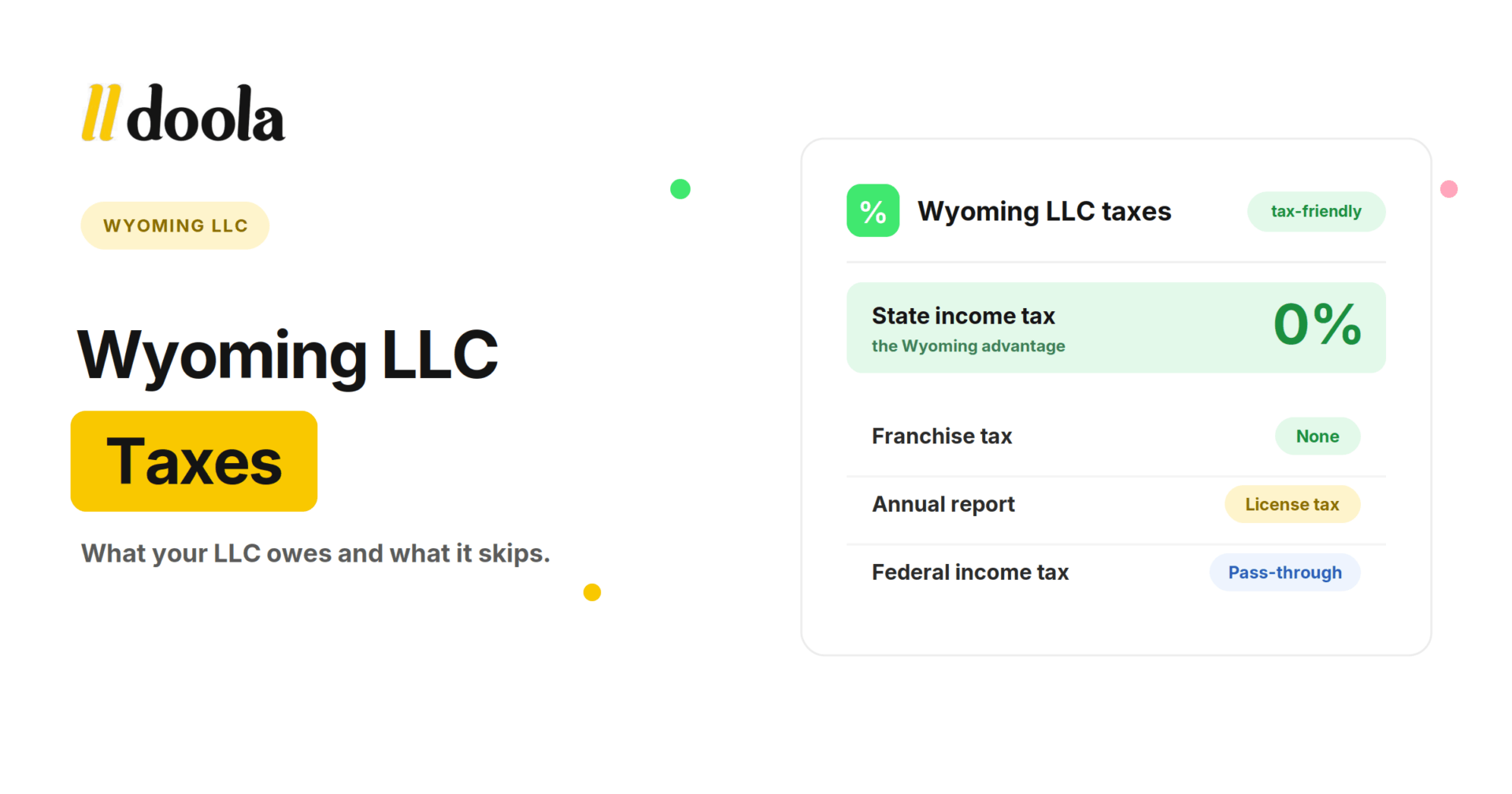
If you’re a non-U.S. founder trying to understand Wyoming LLC taxes, here’s the first thing to get straight:
Wyoming’s 0% state income tax does not mean your U.S. tax obligations are automatically $0.
You may still have IRS filings to deal with, and your home country may tax YOUR income too. In this guide, we’ll show you where tax can actually come from, which filings can still apply even when no tax is due, and the Wyoming fees non-U.S. founders are most likely to run into.
Wyoming has no personal state income tax and no corporate state income tax. That is the easy part. The harder part, and where most founders run into trouble, is understanding what that actually means for your bank account.
If you live in the U.S., forming an LLC in Wyoming does not automatically wipe away your home state taxes. You may still owe federal tax, and your home state may still tax your income.
If you live outside the U.S., owning a Wyoming LLC does not automatically mean you owe U.S. income tax on everything the business earns. But you may still have IRS forms to file, even when your U.S. tax bill is $0. Your home country may tax the income too.
When people say, “Wyoming has 0% income tax,” they are only telling you one part of the story.
The easiest way to navigate Wyoming LLC taxes is to stop looking at them as one big bill. State rules, federal rules, home country taxes, and annual compliance filings all operate in completely separate lanes.
In this guide, we’ll separate them throughout, so you can see who can tax you, what you may have to file, and which rules actually apply to your business.
What This Guide Covers:
- The 4 Tax Buckets: How state fees, federal rules, and home-country taxes apply to non-residents.
- Entity Tax Structure: How single-member, multi-member, C-Corp, and S-Corp rules work.
- Zero-Revenue Compliance: The exact forms to file when your business makes $0.
- Wyoming Specifics: Annual report fees ($60 minimum), sales tax rules, and state maintenance.
- State Comparisons: Wyoming vs. Delaware vs. Nevada for non-U.S. owners.
TL;DR: Wyoming LLC Taxes for Foreign Founders
If you are a non-U.S. resident looking to run a global business through a Wyoming LLC, your tax footprint boils down to three quick facts:
- State Taxes ($0): Wyoming charges 0% state corporate tax and 0% personal income tax. You only pay a minimum $60 annual license tax/report fee to keep your business in good standing.
- U.S. Federal Taxes ($0 Income Tax, Mandatory Filings): If you operate outside the U.S. with no local physical footprint, office, or employees, you owe $0 in U.S. federal income tax. However, you must file Form 5472 and Form 1120 annually; missing them triggers an automatic $25,000 IRS penalty, even on $0 in revenue.
- Home Country Taxes (Varies): Your Wyoming LLC income flows through to you personally, meaning you report your profits according to your local country’s tax laws.
The 4 Buckets of Wyoming LLC Taxes
There is no single tax rate that applies to every Wyoming LLC. Instead, what you end up paying depends on your IRS entity structure, where your revenue comes from, and where you physically sit while running the business.
Rather than looking for one universal tax rate, think of your tax footprint in buckets. Let’s look at how these compare side-by-side:
If you live outside the U.S. and run the business from abroad, Bucket 4 may not apply to you. That is why your tax position can look very different from that of someone who actually lives and works in Wyoming.
Bucket 1: What Wyoming DOES NOT Tax
This is where Wyoming genuinely stands out as one of the most business-friendly states in the country.
Currently, the state does not impose any of the following:
- Personal State Income Tax: You pay 0% in state income tax on profits passed through to you individually.
- Corporate Income Tax: There is no traditional state corporate tax on corporate entities.
- Separate LLC Franchise Tax: Unlike states like California or Delaware, Wyoming does not charge a standalone franchise tax.
For founders who physically live and operate their business within Wyoming, these tax exemptions create meaningful savings. However, if you reside elsewhere, your home state will typically still tax your income, which can reduce or eliminate these state-level savings.
Bucket 2: What You STILL OWE Wyoming
Even though Wyoming is tax-friendly, maintaining an active LLC is not completely free.
Every Wyoming LLC must file an Annual Report with the Wyoming Secretary of State and pay an Annual Report License Tax, due on the first day of the LLC’s anniversary month. This fee is calculated as the greater of:
- $60 (the base minimum), or
- $0.0002 per dollar ($200 per $1 million) of gross assets located and employed within Wyoming.
For standard online businesses or remote companies with little physical asset presence in the state, the minimum $60 annual fee is all that applies. This report is required even if the business had no income or activity during the year.
Filing can be done online in most cases through the Secretary of State’s Annual Report Wizard, though LLCs owing more than $500 in license tax must file by mail. Missing the deadline triggers a delinquency notice, and the LLC has roughly 60 days to file before the state administratively dissolves it.
A registered agent with a physical Wyoming address must also be maintained at all times to stay in good standing.
If your LLC sells taxable goods or services within Wyoming, you’ll also need to register for a Sales and Use Tax License through the Wyoming Department of Revenue, covered in detail later in this guide.
Bucket 3: What You OWE the Federal Government as a Non-U.S. Founder
This section applies to founders who are non-resident aliens for U.S. tax purposes.
Forming an LLC in Wyoming does not automatically make all of your business income taxable in the U.S. Federal tax depends on where the income comes from, whether you are doing business in the U.S., and how the LLC is taxed.
- Single-member LLC: The IRS treats it as a disregarded entity by default. For a non-U.S. owner, this does not mean all LLC profit automatically goes on Schedule C. If you have income that is taxable in the U.S., you may need to file Form 1040-NR.
- Multi-member LLC: The IRS usually treats it as a partnership. The LLC files Form 1065. If U.S. business income is allocated to a foreign partner, the partnership may also have to withhold U.S. tax.
- Self-employment tax: Nonresident aliens are generally not subject to U.S. self-employment tax. The usual 15.3% self-employment tax rule does not apply to most founders in this group.
- S-corp election: A nonresident alien cannot be an S-corp shareholder. So the common advice to switch to an S-corp once profits reach a certain level does not apply while you remain a nonresident alien.
- C-corp election: An LLC can choose to be taxed as a corporation. In that case, the company generally files Form 1120 and pays the 21% federal corporate income tax on taxable income. Dividends paid to a foreign owner may also face U.S. withholding tax.
- Form 5472: A foreign-owned single-member LLC may have to file Form 5472 with a pro forma Form 1120 if it has a reportable transaction with its owner or another related party. This can include money you put into the LLC or take out of it. Even an LLC with $0 revenue can still have a filing requirement. Missing a required Form 5472 can trigger a $25,000 penalty.
- Payroll taxes: These usually become relevant when the LLC hires employees in the U.S. If you run the business alone from outside the U.S., forming the LLC in Wyoming does not by itself create U.S. payroll tax.
All in all, you may also owe tax in the country where you live. That is separate from your Wyoming and U.S. federal obligations.
Wyoming LLC Tax Benefits: What’s Real, and What’s Just Marketing
What’s Real?
- No Wyoming income tax: Wyoming has no personal or corporate state income tax.
- No franchise tax: Wyoming does not charge a separate franchise tax.
- Low annual state cost: The annual license tax starts at $60. It can be higher if the LLC has more than $300,000 in assets located and used in Wyoming.
What’s Marketing Hype?
- “Zero Total Taxes” for U.S. Founders: False. Wyoming has no state income tax, but U.S. founders may still owe federal income tax and self-employment tax. They may also owe tax in the state where they live or run the business.
- “Zero Total Taxes” for Non-U.S. Founders: Not guaranteed. A non-resident founder may owe no U.S. federal income tax in some cases, but U.S. tax can apply if the business has taxable U.S. income or is engaged in a U.S. trade or business. Tax may also be due in the founder’s home country.
- “Form in Wyoming and Avoid Tax Where You Live”: False. Forming in Wyoming does not override the tax rules where you live or where the business operates.
Bottom line: Wyoming can lower what you pay to Wyoming. It does not decide your full tax bill. That depends on where you live, where you work, where the income comes from, and how your LLC is taxed.
Does Wyoming Have a State Income Tax? Yes, No, and It’s Complicated
Wyoming has 0% personal state income tax and 0% corporate state income tax. That is true whether the LLC owner lives in Wyoming, another U.S. state, or outside the U.S.
Where you live and run the business can still change what you owe elsewhere. For example:
- If you live in another U.S. state: That state may tax your income or require you to register the business there. Forming the LLC in Wyoming does not cancel those rules.
- If you live outside the U.S.: Simply forming a Wyoming LLC does not make all of your business income subject to U.S. state income tax. If you are a nonresident alien, federal tax is a separate question. The IRS generally looks at whether you have U.S.-source income or income connected with a U.S. trade or business.
- If you provide services from outside the U.S.: The IRS generally sources personal-service income based on where the work is performed. Services performed outside the U.S. are generally foreign-source income.
No physical presence does not always mean no state tax duty. Sales tax can be triggered by economic nexus. Wyoming, for example, can require a remote seller with no physical presence in the state to collect sales tax once its Wyoming sales cross the state threshold.
Bottom line: Wyoming will not charge income tax on your LLC profits. For a U.S. founder, another state may still have a claim based on where you live or work. For a non-U.S. founder running the business from abroad, the bigger questions are usually federal tax, U.S.-source income, and whether the business creates a nexus in any other state.
Does Forming a Wyoming LLC Mean You Skip Your Home State’s Income Tax?
No. Where you live and perform the work determines what you owe locally, not where your LLC is registered. Forming a U.S. LLC gives you access to the U.S. financial system, but it is not a tax-haven loophole that bypasses your home country’s tax laws.
Real-World Example (For Non-U.S. Founders): You live in London, UK, running a global SaaS startup through a Wyoming LLC.
Here’s how the tax responsibility gets split between Wyoming, New York, and the federal government:
- Wyoming takes: $0 in state income tax (you only pay the mandatory $60 annual report fee to keep the company active).
- The IRS takes: $0 in federal income tax, assuming you have no U.S. physical office, no U.S. employees, and no trade or business physically operating inside the U.S. However, you still owe mandatory annual IRS information returns (Form 5472 + Form 1120).
- HMRC (UK Tax Authority) takes: Full personal income tax or corporation tax on profits withdrawn or managed from the UK, based on local UK tax residency rules.
Result: Your Wyoming LLC gives you asset protection, a low-cost U.S. business presence, and access to U.S. banking/Stripe. But it does not erase your tax reporting duties to your home country’s government.
Wyoming Franchise Tax: The Tax That Doesn’t Exist (But Kind of Does)
Wyoming has no franchise tax and no corporate state income tax.
It does, however, require every LLC to file an annual report and pay an Annual Report License Tax.
How it works:
- When it’s due: The first day of your LLC’s anniversary month. If you formed on March 15, your next annual report is due March 1.
- What you pay: $60 minimum, or $0.0002 for every dollar of assets located and used in Wyoming, whichever is higher.
- When the fee goes above $60: Once your Wyoming assets exceed $300,000. For example, $500,000 of Wyoming assets would produce a $100 license tax.
- For many online and non-U.S. founders: If the LLC has little or no property or other assets in Wyoming, the $60 minimum will usually apply.
You file the annual report and pay the license tax together with the Wyoming Secretary of State.
For the full calculation and filing process, see doola’s Wyoming LLC cost guide. It breaks down the asset calculation, filing deadline, and annual cost in more detail.
Franchise Tax vs. Annual License Tax: What’s the Difference?
Understanding why online sources get confused comes down to how different states charge for entity privileges:
- Traditional Franchise Tax (e.g., California, Delaware): A state fee paid simply for the privilege of doing business or existing as an LLC in that state, often starting at $300 to $800+ per year regardless of state assets.
- Wyoming’s License Tax: A state fee tied directly to your annual report filing. It scales strictly based on the physical assets your business holds inside Wyoming boundaries.
Calling Wyoming “franchise-tax-free” is technically accurate under state law, but using that label without mentioning the mandatory $60 annual report fee can be misleading to new founders.
Wyoming Tax Benefits That Don’t Get Mentioned Enough
While most online guides focus exclusively on the headline “0% state income tax,” the real operational value of Wyoming LLC taxes comes from structural legal and administrative protections that rarely get mentioned:
- Zero Asset-Information Disclosure: Wyoming does not force LLCs to report bank account balances or personal asset holdings on public tax registries, preserving complete financial privacy.
- No Capital Stock Tax or Intangible Taxes: Unlike states that levy hidden annual levies on business capital stock, patents, trademarks, or digital assets, Wyoming charges $0 on intangible business holdings.
- Charging Order Protection for Single-Member LLCs: Wyoming extends strong charging order legal protections to single-member LLCs, meaning judgment creditors cannot easily seize company assets or force a liquidation of your business.
- No Information Sharing Agreement Defaults: Wyoming maintains tight privacy laws regarding corporate entity data, shielding owners from public registries compared to aggressive tax collection states.
Evaluating the Complete Wyoming LLC Tax Setup
Wyoming delivers maximum value when you evaluate it as a complete business environment rather than a silver-bullet tax shortcut. Beyond state tax savings, Wyoming provides strong corporate privacy protections (member names do not appear on public record) and robust asset protection laws.
Rather than assuming a one-size-fits-all “tax-free” setup, assess how your operational location, ownership structure, and annual compliance needs align.
For a comprehensive analysis of entity benefits, privacy structures, and setup rules, read doola’s complete guide to Wyoming LLC pros and cons.
How Your Tax Structure Changes What You File for a Wyoming LLC
When setting up a business, many founders focus heavily on entity registration. However, how your tax structure changes what you file depends far more on your IRS classification than the fact that your business was formed in Wyoming.
While Wyoming handles your annual entity maintenance, your federal tax filing requirements are determined entirely by your tax election.
1. Single-Member LLC (The Default Path for Solo Founders)
By default, the IRS treats a single-member domestic LLC as a disregarded entity.
For Wyoming LLC tax purposes, the IRS does not separate you from your business entity. All active business income and allowed expenses pass directly through to your individual federal return, where they are reported on Schedule C (Form 1040).
Because net earnings from a disregarded entity are considered active self-employment income, they are generally subject to federal self-employment tax in addition to standard income tax.
2. Multi-Member LLC (The Default Path for Co-Founders)
If an LLC has two or more owners, the IRS automatically classifies it as a partnership unless you explicitly elect another tax treatment.
Under partnership rules:
- The business itself does not pay federal income tax.
- The LLC files an informational return using Form 1065.
- Each member receives a Schedule K-1, which details their specific share of net profits or losses to report on their individual personal tax returns.
3. S-Corporation Election (The Growth & Payroll Model)
An eligible single-member or multi-member LLC can file Form 2553 to elect S-Corporation tax treatment.
Under an S-Corp election, the business files an annual return on Form 1120-S. This classification changes your operational rules:
- Reasonable Compensation: Active shareholder-employees must be paid a reasonable W-2 salary subject to standard payroll taxes.
- Owner Distributions: Any remaining business profit can be taken as owner distributions, which are not subject to self-employment tax.
This separation of income into W-2 wages and distributions is why S-Corp elections become an effective tax planning tool once business profits reach a higher threshold.
Note: Non-US founders cannot do an S-corp election.
4. C-Corporation Election (The Entity-Level Tax Model)
An LLC can also choose to be taxed as a traditional corporation by filing Form 8832.
When taxed as a C-Corporation, the LLC becomes a completely separate tax-paying entity. It files Form 1120 and pays the flat federal corporate income tax rate of 21% on its profits.
While this model exposes profits to potential double taxation (once at the corporate level and again when distributed to owners as dividends), it is often selected by founders who intend to reinvest earnings back into the company or raise institutional investment.
The Zero-Revenue Trap: Why $0 in Sales Can Still Trigger a $25,000 IRS Fine
The Zero-Revenue Trap is one of the most famous compliance issues for foreign entrepreneurs. It happens because standard common sense directly contradicts U.S. tax regulations.
Most founders assume that earning $0 in revenue automatically translates to $0 in tax obligations and zero IRS reporting.
Under U.S. tax law, however, the IRS tracks ownership and capital movements, not just sales revenue.
For a non-U.S. resident owning a single-member LLC, transferring personal cash into your business bank account to pay formation fees, buy software, or fund startup operations is legally classified as a reportable transaction under IRS Section 6038A.
Because this reporting requirement involves an informational filing rather than an income tax calculation, missing the deadline results in an automatic baseline penalty of $25,000 per missing year.
Form 5472 Filing Requirements by Scenario
The table below breaks down how various business actions dictate your IRS compliance and penalty risk:
For a complete step-by-step breakdown of non-resident Wyoming tax rules, foreign compliance schedules, and entity filings, read doola’s guide to Wyoming LLC taxation for non-US residents.
Wyoming LLC Tax Filing Requirements: What’s Due, and When
Here’s the filing calendar:
- Wyoming Annual Report: Due the first day of your LLC’s anniversary month. $60 minimum. Applies regardless of activity.
- Federal filings: Set by your entity structure (see above). Generally due by the standard federal deadlines.
- Sales tax filings: Cadence depends on your sales volume. Usually monthly, quarterly, or annual once you’re registered.
Six Questions Our Tax Team Hears Over and Over in 1:1 Tax Consultations
- “My LLC is dormant. No bank account, no activity. Do I still need to file Form 5472?”
Generally, no. The filing requirement is triggered by a transaction between the owner and the entity, not by the LLC’s existence alone. A truly dormant LLC, with no account opened and no money moved in either direction, falls outside the reporting requirement.
The catch is that founders often assume dormancy applies when it doesn’t; if an EIN application fee or a registered agent invoice was ever paid from personal funds, that’s a transaction.
- “Does moving my own money into the business count as a ‘reportable transaction’?”
Yes. Depositing personal funds to cover formation costs, software subscriptions, or startup expenses counts as a related-party transaction under Section 6038A, and it’s the single most common way founders trip into the Form 5472 requirement without realizing it.
- “I haven’t opened a business bank account yet. Am I already non-compliant?”
Not opening an account isn’t itself a compliance issue. What matters is whether any money has changed hands between the owner and the LLC through any channel, including a personal card covering a formation fee.
- “I do my own bookkeeping in a spreadsheet. Do I still need an accountant for tax filings?”
Clean books help, but they don’t replace the filing itself. Form 5472 and the pro-forma Form 1120 have specific formatting and disclosure requirements the IRS checks closely, and an incomplete form is treated the same as not filing at all.
- “My payment processor wants proof I’m in good standing. What does that actually mean?”
It usually means the state annual report is current and the registered agent is active, not that federal filings are current.
The two are separate systems. A processor may accept a state good-standing certificate without ever asking about Form 5472, which is part of why the federal penalty catches so many founders off guard.
- “I missed a filing deadline. What happens now?”
The $25,000 penalty applies per year of failure, but the IRS does allow a reasonable-cause exception if the failure isn’t due to willful neglect. That’s a case-by-case determination, and it’s worth getting professional input before assuming the penalty is locked in.
Wyoming Sales Tax: When Does It Apply to Wyoming LLC Taxes?
A common misunderstanding regarding Wyoming LLC taxes is that registering an LLC automatically forces you to add 4% sales tax to every customer invoice.
The baseline state sales tax rate is 4% (plus up to 2% in local county taxes). However, whether your business is required to collect and remit sales tax depends on what you sell, where your customer receives the product, and where your business has established a legal tax nexus.
Wyoming vs. Delaware vs. Nevada: Comparing State Taxes & Ongoing Fees
All three states charge 0% personal state income tax. Here is how to pick the right one for your actual goals:
- Pick Wyoming if: You want the absolute lowest annual maintenance cost ($60/year) for a bootstrapped, online, or global business.
- Pick Delaware if: You are hunting U.S. venture capital. Investors demand Delaware legal structures, even though it costs $300/year to maintain.
- Pick Nevada if: You want maximum corporate privacy and don’t mind paying $400+ per year in state business fees.
The One Core Question to Ask Before Incorporating
Before comparing state charts, weighing Wyoming LLC taxes against Delaware or Nevada rates, ask yourself this primary question:
Where am I physically sitting while running this business everyday?
Start with your daily workspace. If forming out-of-state forces you to file duplicate annual reports, pay dual registration fees, and maintain two registered agents while still paying your home state’s income tax, the extra administrative layer might outweigh the initial benefits.
Unless Wyoming offers your specific business distinct legal advantages, corporate privacy protections, or asset isolation, registering directly in your home state is usually the simplest path forward for U.S.-based founders.
Is There a Wyoming LLC Tax Calculator?
The short answer is no single official tool can instantly spit out your exact tax liability.
Online estimate widgets can give you a rough baseline, but treating a simple calculator as a final answer is a major trap.
Calculating Wyoming LLC taxes accurately depends on a dynamic combination of federal rules, personal residency laws, and operational details.
Why a Standard Calculator Falls Short
To calculate what your business actually owes, any reliable calculation requires factoring in all of the following variables:
How doola Helps You With Wyoming LLC Taxes

Because a standard static calculator cannot replace custom compliance, doola is here to step in as your complete back-office tax and compliance partner:
Form 5472 and a Pro Forma 1120
Any foreign-owned single-member LLC has to file both every year, separate from Wyoming’s annual report. Missing this filing carries a minimum $25,000 penalty. doola prepares and files both as part of its tax service.
Bookkeeping That Stays Current
An accurate tax return needs accurate books behind it. doola tracks income and expenses through the year, so the numbers are ready when a deadline comes near instead of getting reconstructed from bank statements in March.
The Annual Report Deadline
Wyoming’s annual report is due on the first day of the LLC’s anniversary month. Miss it, and after a 60-day delinquency notice, the state can administratively dissolve the LLC. doola tracks that date and, depending on the plan, either sends a reminder or files the report directly.
Classification and Nexus Decisions
Whether an LLC should elect S-Corp treatment, or whether running the business from a specific state creates a tax obligation there, depends on the individual business, not a generic rule. doola’s CPA consultations work through these case by case.
FAQs

Does Wyoming have a state income tax?
No. Wyoming charges no personal or corporate state income tax.
What taxes does a Wyoming LLC pay?
Federal income tax (if you owe any), federal self-employment tax, Wyoming’s $60+ annual report license tax, sales tax if it applies, and payroll tax if you have employees.
Does Wyoming have a franchise tax?
Not by that name. The $60 annual report license tax works the same way, but it’s legally a separate thing.
Does Wyoming have a corporate income tax?
No. Wyoming charges no corporate income tax, no matter how much a business earns.
Do I need to file taxes if my Wyoming LLC made no money?
Often, yes. If you’re a foreign owner and any money moved into or out of the LLC, even just to cover formation costs, that’s a reportable transaction. Form 5472 is still due, even at $0 tax owed.
Is Wyoming really a “tax-free” state for LLCs?
No. It’s tax-friendly at the state level. It’s not tax-free overall. Federal taxes, and often home-state taxes, still apply.
Does forming my LLC in Wyoming get me out of paying taxes in my home state?
No. Your home state taxes you based on where you live and work, not where your LLC is registered.
What is the Wyoming LLC tax rate?
There isn’t one single rate. Wyoming charges $0 in state income tax and a flat $60+ annual report license tax.
Everything else comes from federal rules, which scale with your income, your structure, and where you actually do the work.