
LLC for YouTube Channel: When Creators Should Form One and How to Set It Up

Approved by Tax Professional
Do Youtubers Need an LLC? Here Is the Direct Answer
Yes, an LLC for YouTube channel creates a legally separate business entity; so lawsuits from sponsors, DMCA claims, and contractor disputes attach to the business, not your personal assets.
Most creators need one at the $500/month revenue mark, at their first sponsorship contract, or when a brand sends a W-9.
Here is what changes the moment your LLC is active:
- Personal liability protection: your personal assets are separated from business debts and legal claims
- Financial separation: channel income flows into a dedicated business account, not your personal one
- Tax deductions: camera gear, editing software, contractor invoices, and a home office all become legitimate business expenses
- Sponsor credibility: brands increasingly prefer, and sometimes require, contracting with a registered business entity
- Foundation for hiring: paying editors, thumbnail designers, and assistants through a business entity is cleaner legally and administratively
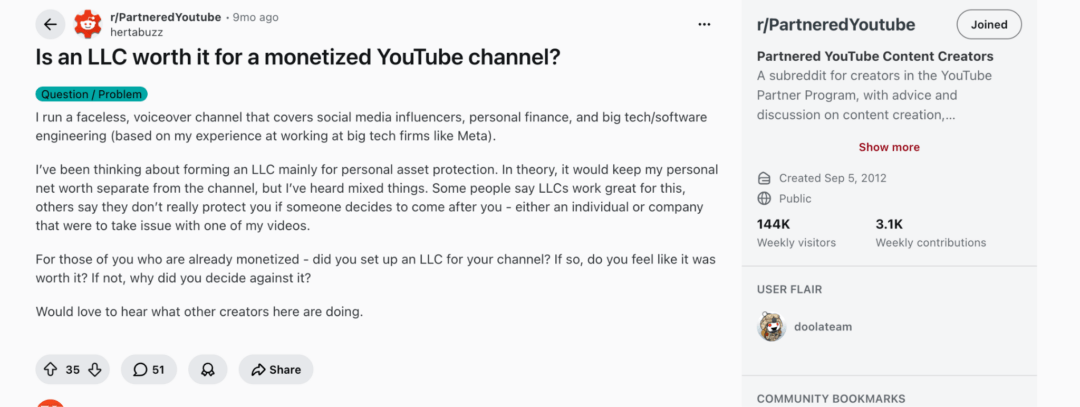
The question showing up most in creator communities right now is not “should I form an LLC.” It’s the tricky bits that come after that decision.
Like this one, posted recently:
To put things in perspective, YouTube has distributed well over $100 billion to creators and artists over the past four years via its Partner Program.
What that means for you is simple: if you are bringing in regular ad revenue, signing brand deals, investing in equipment, or cutting checks for editors, you aren’t playing your passion game anymore, you are running a business.
The IRS knows it, the brands you work with know it, and anyone who has ever asked you to fill out a W-9 knows it too.
🔖 Related Read: W-9 vs 1099: Contractor Tax Forms Demystified
When you join the YouTube Partner Program, you enter a business-to-business relationship with YouTube. The IRS treats YPP earnings as self-employment income, which means you are responsible for self-employment taxes and will receive a 1099 once you cross the reporting threshold.
So, whether you are trying to scale a massive multi-channel media operation or just trying to protect a single, fast-growing channel, the main question you need to answer is this:
Does your legal setup actually match the business you are already running?
Even if you started your channel with just 500 subscribers, the moment your content is optimized to generate income, the IRS looks at it as a business endeavor, not a casual hobby.
Ready to make it official? doola handles LLC formation for YouTube creators in all 50 states and for international creators. Start your formation here.
Your YouTube Income Streams, and What Each One Can Put at Risk
Your channel probably earns from more than one source. Each source creates a different kind of exposure.
Here is what that looks like before and after an LLC:
| Income Stream | How It Is Paid | Who You Are Liable To | What an LLC Changes |
| AdSense / Google revenue | Direct deposit from Google | Google (contract compliance), IRS (tax reporting) | Business receives payment; personal accounts are shielded |
| Brand deals / sponsorships | Wire transfer or check from brand | Brand (contract deliverables, FTC compliance) | Contract is between the brand and your LLC, not you personally |
| Affiliate commissions | Network payment (PayPal, ACH, check) | Affiliate network (W-9 or W-8BEN compliance) | LLC provides the business entity networks require |
| Merchandise sales | Platform payout (Shopify, Printful, etc.) | Customers (product liability, refunds), platforms | LLC absorbs product complaints and disputes |
| Channel memberships / Super Thanks | YouTube payment | YouTube (platform terms) | Business entity receives; cleaner tax separation |
AdSense
Google issues a 1099-NEC when AdSense earnings hit the IRS reporting threshold.
Because this document is addressed to you as a business, operating without a formal business entity means this income flows directly onto your personal tax return, commingling your channel revenue with your personal finances.
Note on IRS Reporting Thresholds
AdSense and brand deal payments are reported on Form 1099-NEC, where the threshold increased to $2,000 for tax years beginning after 2025, with inflation adjustments starting in 2027.
Brand Deals and Sponsorships
When a brand sends a W-9 request, they are treating you as a business entity, whether you’ve formed one or not.
Signing that W-9 as an individual means the contract, the deliverables, and any dispute over missed deadlines or content approvals are tied directly to you personally.
| The Core Difference
When a brand gives you a W-9, they are treating you as a business vendor. 👉🏼 Without an LLC: You sign with your Name and SSN. If you miss a deadline or violate a contract, the brand can sue you personally, putting your personal savings at risk. 👉🏼 With an LLC: You sign with your LLC Name and EIN. The LLC acts as a shield, meaning only the business is liable, protecting your personal assets. Real-World Example The Setup: You sign a $10,000 brand deal for a holiday video. Your equipment breaks, you miss the strict deadline, and the brand sues for $30,000 in lost revenue. ✔️ If you signed as an Individual: They sue you. A judge can order your personal bank accounts or assets to be seized to pay the debt. ✔️ If you signed as an LLC: They sue the LLC. They can only claim what the business owns (like business funds or gear). Your personal savings are completely safe. |
Affiliate Commissions
Major affiliate networks (like Amazon Associates, ShareASale, or Impact) require a W-9 for US creators or a W-8BEN for non-US creators. These forms establish your tax status as a Youtube creator.
An LLC with an EIN (the federal tax ID assigned to your business) provides the professional business identity these networks are designed to work with.
Merchandise
If a customer gets injured by a defective product or sues over a major shipping/refund dispute, they are suing you personally. Your personal savings and assets are on the line.
But if you have an LLC, it absorbs the blow. Any product liability lawsuits or customer disputes stay trapped within the business, shielding your personal finances.
For example, let’s say you sell custom hoodies. A batch has a manufacturing defect that causes severe skin rashes. A group of customers sues for $15,000 in medical bills. With an LLC, they can only sue the merchandise business, not take your personal savings.
Channel Memberships and ‘Super Thanks’
These flow directly from YouTube under your channel’s tax identity. Routing them through an LLC keeps your business income consolidated and your personal finances clean.
What an LLC Actually Protects a YouTuber From (And What It Does Not)
Four scenarios play out regularly in the creator economy.
All four look very different depending on whether the creator involved has an LLC.
Scenario 1: A brand deal dispute
A sponsor says the video didn’t meet the brief. Maybe it went live late, the tracking link was wrong, or a required talking point was missed. Now they want their money back, or worse, they claim the campaign caused them a loss. If you signed that deal in your own name, the dispute is tied to you personally.
If the contract was with your LLC, the issue generally stays with the business, not your personal savings, car, or other assets, as long as you’ve kept the LLC properly separate.
Scenario 2: A DMCA federal lawsuit
A copyright strike on YouTube is a platform-level administrative action.
But if a rights holder escalates beyond the platform and files a federal civil lawsuit under the Digital Millennium Copyright Act, that is a different matter entirely. Federal civil litigation can result in significant financial liability.
An LLC limits which assets can be reached in that judgment to business assets, not personal ones.
Scenario 3: A right-of-publicity or defamation claim
You use someone in a video, maybe in a reaction clip, commentary piece, or documentary-style segment, and they say you used their image without permission or described them in a damaging way. That kind of claim can get serious quickly.
If everything is under your personal name, the claim can point directly at you. If the video was created and published through your LLC, the claim generally goes against the business instead, as long as the LLC is set up and managed properly.
Scenario 4: Contractor misclassification
You’ve been paying your video editor as a contractor for two years. They file a claim asserting they were actually an employee and are entitled to back wages, benefits, or both. Without a business entity, this claim reaches your personal finances directly.
What an LLC does NOT protect against:
- Personal guarantees: If you personally guarantee a business loan, the LLC structure does not protect those assets
- Fraud or intentional wrongdoing: Courts will not use an LLC to shield deliberate misconduct
- Commingling funds: This is the one creators get wrong most often. If you run personal expenses through your business account, or business revenue through your personal account, a court can pierce the corporate veil.
💡 “Piercing the corporate veil” is a legal term for when a judge disregards the LLC structure and holds you personally liable as if the LLC never existed. Commingling funds is the primary trigger for it among small business owners
An LLC reduces exposure; it does not eliminate all risk. For channel-specific legal questions, consult a licensed attorney.
Sole Proprietorship or LLC for YouTube: A Side-by-Side Comparison
Here is how the two structures compare across the factors that matter most to YouTube creators.
| Factor | Sole Proprietorship | LLC |
| Setup Cost | $0 (Automatic at first dollar earned). | $50 to $500 state filing fee, plus registered agent costs. |
| Personal Liability | Unlimited: Personal assets fully exposed to copyright lawsuits, defamation claims, or brand contract disputes. | Limited: Personal assets separated from business liabilities. The entity shields your home, savings, and personal property. |
| Tax Treatment | All income reported on Schedule C; self-employment tax applies (15.3%) to all net channel earnings.
Note: The 12.4% Social Security portion applies up to $176,100 in net earnings for 2025; the 2.9% Medicare portion applies to all net self-employment income. |
Pass-through taxation by default (business profits reported on your personal tax return, not taxed at the entity level); S-Corp election available at higher income to reduce self-employment tax. |
| Business Expense Deductions | Available but harder to substantiate without separate accounts, increasing IRS audit risk for write-offs like gear or studio space. | Cleaner substantiation with dedicated business accounts and entity records, making it easier to safely deduct gear, software, and travel. |
| Credibility with Sponsors | Some brands will work with sole proprietors; many prefer or require an LLC for higher-tier deals. | Strongly preferred by brands; required by some for W-9 and contract purposes to avoid treating the creator as an employee. |
| Business Bank Account | Can open one, but tied to personal SSN and identity, making true financial separation difficult. | Opens on EIN and business identity; fully separated from your personal identity and SSN. |
| Complexity to Maintain | None: No filing requirements beyond your standard personal tax return. | Annual report and renewal fee; operating agreement recommended; dedicated finances strictly required to preserve the liability shield. |
| Legal Identity & Contracts | You and the channel are the same legal entity. Contracts are signed in your personal name, tying deadlines and deliverables to you. | The LLC is a separate legal “person.” Contracts are signed in the business name, placing the entity between you and the brand. |
| Channel Assets & IP | The YouTube channel, copyrights, trademarks, and AdSense account are tied directly to your personal name. | Intellectual property, trademarks, and channel assets can be formally owned by the company, facilitating easier sale or transfer later. |
| Recommended For | Casual Hobbies: Channels with minimal income, zero team members, and low risk of contract or copyright disputes. | Growth & Full-Time Creators: Channels actively signing sponsorships, selling merchandise, hiring editors, or generating stable revenue. |
When Should a YouTuber Switch From Sole Proprietor to LLC?
Many creators mistakenly believe they only need an LLC when they go “full-time.” Legal protection is dictated by exposure, not your working hours.
| The exact moment to consider an LLC as a YouTuber is when you hit any of these thresholds:
✔️ Making $500+/month in channel revenue: At this point, your channel is no longer a casual pastime. It is generating consistent income that could draw financial scrutiny or audit attention. ✔️ Your first active sponsorship contract: Signing a contract means you are legally agreeing to strict deadlines, content approvals, and deliverables. If things go wrong, an LLC ensures the brand sues the company, not you personally. ✔️ Your first W-9 request from a brand: When a brand requests a W-9, they are officially designating you as an independent business vendor. Signing with your personal Social Security Number means you assume 100% of the personal liability behind that deal. |
Key Takeaway: If you’ve hit all three of these milestones and are still operating as a sole proprietor, you are running a real business operation while leaving your personal savings, property, and assets completely unprotected.
| The IRS hobby loss rules (IRC Section 183) are worth understanding before you decide to wait on formation.
If the IRS reclassifies your channel as a hobby rather than a business, you lose the ability to deduct losses and channel expenses against your other income entirely. Forming an LLC, opening a dedicated business account, and keeping clean income records are the strongest signals you can send the IRS that your channel is a legitimate operation, not a pastime. |
Which State Should You Form Your LLC In?
The right answer depends on where you live and whether you are a US-based or international creator.
US-based creators should generally form an LLC in their home state. This avoids the cost and complexity of “foreign qualification” (registering your LLC to do business in a state other than your state of formation), the extra step of registering your business in a second state.
A Wyoming or Delaware LLC makes sense for US-based creators only when there are multiple members, a need for outside investment, or a strong preference for privacy.
Wyoming does not require member names in public filings, which is a meaningful advantage for creators who want to keep their legal identity separate from their public channel identity.
If you are a non-US creator: Wyoming is the answer, and the reasons are quite specific:
- The Wyoming Secretary of State charges a $100 one-time filing fee for Articles of Organization
- Wyoming has no state income tax
- Wyoming does not require member names in public filings
- Non-US residents do not need a US address, a Social Security Number, or a visa to form a Wyoming LLC
You only need two baseline components to maintain legal compliance: a certified registered agent with a physical Wyoming street address to receive legal notices during business hours, and an EIN issued by the IRS for banking and contract clearance.
When deciding where to file, map your situation directly to this rule:
If you are a US resident creating content from your home state, file in your home state.
If you are an international creator living outside the United States, file your LLC in Wyoming.
Instead of letting state bureaucracy stall your momentum, use an all-in-one provider to secure your liability shield.
Explore doola’s formation options today to file your Articles of Organization, appoint a compliant registered agent, and secure your IRS business tax identity.
How to Start an LLC for a YouTube Channel: Step by Step
Whether you run a single growing channel or a multi-platform brand, the formation process is the same eight steps. Here is how to get it done.
Step 1: Choose Your State
Apply the two-track rule: if you are a US resident, file in your home state to keep taxes and local compliance simple.
If you are an international creator, file in Wyoming to take advantage of low fees and zero state income tax.
🔖 Related Read: How Much Does an LLC Cost in Every State
Step 2: Choose Your LLC Name
Your official legal business name does not have to match your YouTube channel name.
You can register a broad name like “Main Street Media LLC” and file a DBA (Doing Business As) to legally link it to your public handle, like “TechWithJamie.”
Note: Registering an LLC name only secures it with your state. Protecting your channel name nationally requires a separate trademark filing with the USPTO.
Step 3: File Articles Of Organization
This is the foundational document you submit to the Secretary of State to officially bring your LLC to life.
State filing fees vary wildly, ranging from roughly $50 in Kentucky to $500 in Massachusetts. If you follow the international track and file in Wyoming, the state fee is a flat $100.
Verify current fees at your state’s SOS website before filing.
Step 4: Appoint A Registered Agent
Every state legally requires your LLC to list a Registered Agent, a designated person or professional service with a physical, in-state street address. They must be available during business hours to receive official legal summons, tax notices, and government letters.
If you are an international creator without a US address, using a professional service is mandatory.
Step 5: Obtain An EIN From The IRS
An EIN (Employer Identification Number) is essentially a Social Security Number for your business. You will need this 9-digit ID to fill out brand W-9 forms, apply for business credit, and open a bank account.
US residents can grab one for free on IRS.gov, while non-US creators must submit Form SS-4 via fax or mail, a tedious process that doola completely automates.
Step 6: Draft An Operating Agreement
This internal document outlines exactly how your business operates: who calls the shots, how money flows, and what happens if you bring on an editor as a partner.
Even if you are a solo creator, having an Operating Agreement proves to courts and the IRS that your LLC is a legitimate, structured corporation, and not a flimsy legal shield.
Step 7: Open A Dedicated Business Bank Account
Like we mentioned earlier, co-mingling your money destroys your legal protection.
Open a dedicated business account the moment your LLC is approved. All creator income should go into your business account: AdSense payouts, merch sales, sponsorship payments, affiliate commissions, everything.
All business expenses should come out of that same account: camera gear, editing software, travel, contractors, subscriptions, and production costs.
Your personal money and business money should stay completely separate.
Step 8: Update Brand Deal Contracts And AdSense
An LLC only protects you if you actually use it. Go back to your active sponsorship contracts and update the language to reflect your new LLC name.
Finally, log into your YouTube Studio and update your Google AdSense tax identity to your LLC and EIN.
This final step officially completes your transition from an individual creator to a corporate business.
| Let doola Set Up the Business Side
doola handles steps 2 through 7 for YouTube creators in all 50 states; from registered agent service to EIN filing and ongoing compliance. Ready to set up your YouTube LLC? Start with doola today. |
International YouTube Creators: You Can Form a US LLC Without a US Address
Non-US residents can legally form and own a US LLC without a US address, a Social Security Number, or a US bank account at formation.
If you’ve been searching for a straight answer to this question and every article you found either ignored you or buried a vague footnote at the bottom, this section is written for you.
Here is why a US LLC changes everything for an international creator specifically.
Reason 1: AdSense and Google payments become simpler
Google’s payment infrastructure is built around business entities.
A US LLC with an EIN (Employer Identification Number, the federal tax ID the IRS assigns to your business) replaces the complicated W-8BEN paperwork and foreign tax treaty questions with a clean entity classification. You get paid without the friction.
Note that foreign-owned single-member LLCs with US-source income may be required to file Form 5472 annually.
Reason 2: US brands want to contract with US entities
Most US brands require a W-9 from every partner they work with, and a W-9 requires either a US Social Security Number or a business EIN.
For any non-US youtuber llc situation, a Wyoming LLC solves this in one step: it gives you the EIN that makes the W-9 possible, which means you stop losing sponsorship deals to US-based creators simply because of your paperwork.
For a fuller picture of how this plays out across your creator business, doola’s creator economy hub covers the full financial and legal setup for creators at every stage.
Reason 3: US payment processors become accessible
Mercury, Relay, and Stripe all require a US business entity and EIN to open an account. Without an LLC, international creators are locked out of this infrastructure entirely.
With a Wyoming LLC and an EIN in hand, these tools become available to you immediately.
doola’s banking support helps you get your US business account set up as soon as your LLC is active.
How to Get Your EIN as a Non-US Creator
Here is a distinction worth understanding clearly.
An ITIN (Individual Taxpayer Identification Number) is a tax ID issued to individuals who need to comply with US tax law but are not eligible for a Social Security Number.
An EIN belongs to the business entity itself, not to you personally. You do not need an ITIN to obtain an EIN for your LLC. They are entirely separate.
International creators obtain an EIN by filing IRS Form SS-4, available at IRS.gov, by mail or fax directly to the IRS, or through a registered agent service that handles the submission on your behalf.
doola’s formation service includes EIN filing as part of the package, so you do not have to navigate the IRS fax route.
If you are unsure whether you also need an ITIN for personal US tax compliance, the IRS ITIN guidance page explains eligibility clearly.
What This Looks Like for a Creator
To put this into perspective, imagine a creator based in Nigeria, the Philippines, or Brazil who earns consistent AdSense income and wants to scale by pitching premium US brands.
Instead of being locked out of the US market, they can form a Wyoming LLC through doola, obtain an EIN via IRS Form SS-4, and open a US business bank account, all remotely, without ever traveling to the United States.
When it comes to selecting a legal home for an international channel, Wyoming is undeniably the right state for the job.
However, building this initial legal shield is only the first step in a long-term strategy to scale your brand and protect your growing revenue.
If you are ready to take your channel beyond your local market with a structured foundation, doola can help international creators like you form a US LLC and set up a business structure built for global earning.
Next? Handle Taxes, Deductions & Ongoing Requirements With doola

Here is what running a well maintained youtuber llc actually looks like across four areas, and what happens if you skip any of them.
1. IRS Quarterly Estimated Tax Due Dates
As a self-employed creator, no employer withholds taxes from your AdSense deposits or brand deal payments. That responsibility falls entirely on you.
The IRS requires quarterly estimated tax payments if you expect to owe $1,000 or more when you file.
- April 15: January 1 to March 31 income
- June 15: April 1 to May 31 income
- September 15: June 1 to August 31 income
- January 15: September 1 to December 31 income
The self-employment tax rate is 15.3% on net self-employment income: 12.4% for Social Security and 2.9% for Medicare as per the IRS.gov, Self-Employment Tax.
Missing a quarterly deadline triggers an underpayment penalty even if you pay the full annual balance by April 15.
2. Deductible Creator Expenses
One of the most practical advantages of a youtuber llc with a dedicated business account is cleaner deduction substantiation. Every business expense runs through one account, making documentation straightforward at tax time.
YouTube-specific deductible expenses include:
| Expense Category | Examples |
| Filming equipment | Camera bodies, lenses, gimbals, tripods |
| Audio and lighting | Microphones, audio interfaces, ring lights, LED panels |
| Editing and software | Adobe Premiere, Final Cut Pro, DaVinci Resolve |
| Storage and backup | External hard drives, cloud storage subscriptions |
| Studio and workspace | Home office deduction (exclusive-use space only) |
| Contractor invoices | Video editors, thumbnail designers, scriptwriters |
| Content travel | Travel to filming locations directly related to production |
For a detailed breakdown of what qualifies and how to document it correctly, doola’s guide to taxes for YouTubers covers creator-specific deductions in full.
3. Financial Separation and Bookkeeping
The single most common way a court pierces the corporate veil: holding you personally liable as if the LLC never existed is commingling funds.
Three rules that protect your LLC structure:
- Open a dedicated business account at formation, before your first channel payment arrives
- Route every dollar of channel income into it: AdSense, brand deal wire transfers, affiliate payouts, merch revenue
- Never use it for personal transactions, not even once
Consistent bookkeeping also makes quarterly filing significantly less stressful.
doola Bookkeeping is designed for creator economy llc operators who need clean, organized records without hiring a full-time accountant.
For an independent breakdown of bookkeeping options built specifically for creators, doola Bookkeeping guide for YouTubers is worth reading before you decide.
4. Annual LLC Maintenance
Your LLC requires ongoing upkeep to stay in good standing.
Most states require an annual report filed with the Secretary of State, accompanied by a renewal fee. Typical range: $50 to $300 depending on state.
Wyoming’s annual report fee starts at $60. Verify at sos.wyo.gov.
Missing the filing deadline can result in administrative dissolution of your LLC, meaning the legal protection it provides lapses entirely until you reinstate it. Reinstatement often carries additional fees and paperwork on top of the missed filing.
Two habits that prevent this:
- Set a recurring calendar reminder for your LLC‘s anniversary month
- Treat the annual report fee as a fixed line item in your channel’s business budget
| doola’s full-stack service keeps your YouTube Channel LLC compliant, your books organized, and your taxes filed on time, so the business side of your channel runs without pulling you away from content.
See how doola’s full-stack service works for YouTube creators here. |
FAQs
Do I need an LLC to run a YouTube channel?
No law requires an LLC to run a YouTube channel. But once your channel clears $500/month, lands its first sponsorship, or receives a W-9 request from a brand, you’ve real legal and tax exposure.
Your structure should match your reality. Those three triggers are your signal to form.
Does an LLC protect YouTubers from copyright claims?
Partially, yes, an LLC protects YouTubers from copyright claims.
YouTube’s copyright strike system is a platform-level administrative process. An LLC has no effect on strikes or Content ID claims.
However, if a rights holder escalates to a federal civil lawsuit under the DMCA, an LLC limits which assets a judgment can reach to business assets, not your personal savings or accounts.
Should the LLC name match my YouTube channel name?
No. Your legal entity and your public channel brand can carry different names.
A DBA (doing business as) filing lets your LLC operate publicly under your channel name while the registered entity uses a separate legal name.
Protecting the channel name itself requires USPTO trademark registration, which is a separate process entirely.
What are the tax benefits of an LLC for YouTubers?
Cleaner deduction substantiation when every expense runs through one account, more organized quarterly filing, and the option to elect S-Corp tax treatment at higher income levels.
S-Corp election is generally discussed around $40,000 to $60,000 in net self-employment income, though the right threshold depends on your full tax picture.
This is general educational information, not tax advice. Consult a licensed CPA before making any S-Corp election decision.
Can I have multiple YouTube channels under one LLC?
Yes. A single LLC can own and operate as many YouTube channels as you run.
All income routes through one business entity, which consolidates bookkeeping, simplifies tax filing, and extends personal liability protection across every channel without requiring a separate legal structure for each one.