

CorpNet has been filing business documents since 2009, and its founders were pioneers in this industry a decade before that. If experience alone decided the outcome, CorpNet’s credentials would be difficult to argue with.
But if you’re on this page, you are probably choosing more than just a filing vendor. You’re choosing infrastructure your product will depend on: an API your engineers integrate, events your app reacts to, and a service layer your users experience as your brand.
Based on those terms, doola and CorpNet represent two different generations of the same idea.
CorpNet is a filing service business with an API attached. doola is an API-first platform with a full financial stack behind it. Both are legitimate businesses solving real problems for different buyers.
And because we’re comparing ourselves, a disclaimer is warranted. Yes, we are doola. We have tried to earn your trust the only way that works in a comparison post: every claim below is verifiable against public documentation, and we link to CorpNet’s own docs where they demonstrate it well enough.
doola vs CorpNet: Comparison At A Glance
| Capability | doola | CorpNet |
|---|---|---|
| LLC and C-Corp formation, all 50 states | Yes | Yes, plus nonprofits |
| Registered agent and annual reports | Yes | Yes |
| Employer and payroll tax registration (SUI / SIT)SUI: State Unemployment Insurance. SIT: State Income Tax withholding. | No | Yes, a genuine strength |
| Business license research and fulfilment | No | Yes |
| Non-US entrepreneurs with no SSN and no ITIN | Yes(Entrepreneurs from 175+ countries, SS-4 flow documented in the API) | Not a documented capability |
| ITIN support | Yes(Coming soon in 2026) | No |
| IRS tax filings (Form 5472, pro forma 1120) | Yes, via OAuth | No |
| Bookkeeping (white-label) | Yes, via OAuth | No |
| Business banking access for entrepreneurs | Yes, via banking partners | No |
| API authentication | Environment-scoped keys (dk_test_ / dk_live_) | Single static bearer token issued at onboarding |
| Test environment | Sandbox, plus sandbox-only endpoints that complete formation and EIN milestones on demand | Staging environment with environment-scoped keys |
| Status updates | Signature-verified webhooks; docs say “do not poll” | Polling required. Webhooks are on the roadmap |
| Idempotency keys | Idempotency-Key header is required on all create endpoints | Not documented |
| Error handling | Machine-readable code on every error, lets you branch on it without parsing | Docs advise branching on HTTP status; error body shape varies by endpoint |
| Agent and AI surfaces | Live formation MCP in Claude, ChatGPT, Perplexity, Replit, Lovable, and Vercel | None published |
| Partner models | Affiliate, embedded iFrame, full white-label API | Referral (20% of net revenue, rising to 30% by volume), Pass on the Savings, reseller and white label (wholesale 20% to 30% by volume), enterprise, strategic alliance via API or co-brand |
| Built for | Platforms, fintechs, AI products, global user bases | Accountants, CPAs, payroll firms, legal and tax professionals |
| Security posture | Encryption in transit and at rest, layered access controls | SOC 2 Type II covering Security, Availability (offers 99.99% uptime SLA), and Confidentiality, attested by Insight Assurance, TLS 1.2+ |
Where CorpNet Earns Its Reputation
CorpNet’s reputation is the result of building a filing business that has spent years solving operational problems its customers actually face.
Its partner program is free to join and the economics are simple:
- Resellers get wholesale pricing starting at 20% off retail and rising toward 30% with volume, then set their own retail prices on top.
- Referral partners earn from 20% of net revenue with the same upward ladder, and there is a separate enterprise tier for high-volume filers.
- Enterprise and strategic alliance tiers cover high-volume filers and partners who want to deliver CorpNet’s catalogue from their own site or application through an API or co-branded interface.
Their commercial model is transparent from the outset, without opaque partner tiers or pricing hidden behind introductory sales calls.
CorpNet’s product portfolio is equally mature. Their Employer Payroll Tax Registration across all 50 states is a real product with a real API behind it, which is exactly why payroll platforms partner with them.
Their business license research, nonprofit formation, and DBA filings extend the catalogue well beyond standard LLC and corporation work. On document fulfilment alone, CorpNet covers broader ground than doola, and if those workflows are central to your business it deserves serious consideration.
The company holds SOC 2 Type II attestation covering security, availability, and confidentiality, independently audited by Insight Assurance, and will share the report under NDA.
Availability is more than an audit category for them: CorpNet backs the API with a 99.99% uptime SLA commitment, and for its largest API partners drafts a custom service level agreement tailored to that partner’s requirements rather than offering a single published tier.
CorpNet’s own partner materials describe the program as built for “business professionals representing clients.” Humans in the loop, placing orders on behalf of other humans, with a scalable in-house fulfilment team and live phone support as the headline feature.
That’s a coherent, well-executed business model which shows up everywhere in the product, including the API.
Divergence One: Who Your Users Are Allowed To Be
CorpNet’s stack was built for US clients of US professionals, and the public API documentation reflects that.
There is no documented path for a global entrepreneur without a Social Security Number (SSN). CorpNet’s own integration guidance recommends sending responsibleParty.responsiblePartyStatus: “No” and then collecting the SSN through CorpNet’s portal after submission, on the reasonable grounds that gathering SSNs in a third-party UI is rarely worth the compliance burden. Sensible advice.
But it presumes there is an SSN to collect. The documentation doesn’t describe an SS-4 workflow for entrepreneurs without one, doesn’t publish an ITIN path, and doesn’t document an equivalent onboarding flow for international entrepreneurs.
doola started at exactly that constraint, because it was the only constraint that mattered to our first customers. More than 22,000+ founders across 175+ countries have formed US companies through doola.
The infrastructure that makes that possible is exposed in the partner API rather than hidden behind a support ticket:
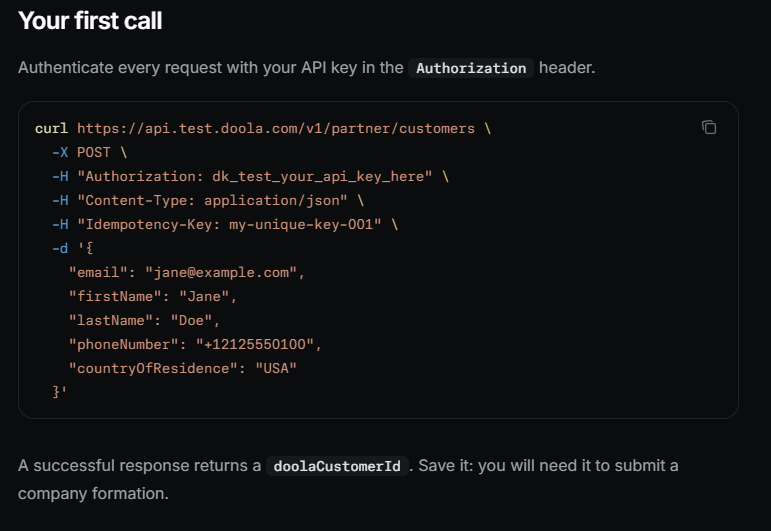
- A documented non-US resident flow where the entrepreneur signs an SS-4 before the EIN is issued, with the company object telling your application when that applies
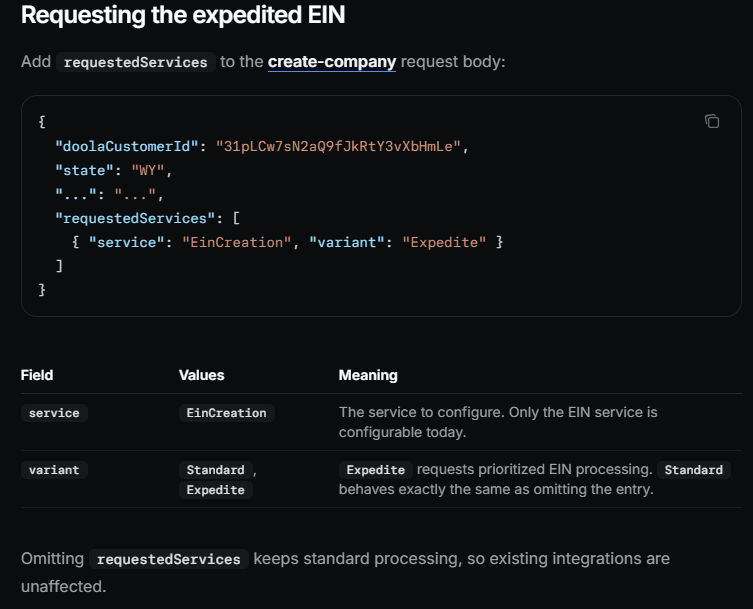
- Expedited EIN processing for partners whose agreement includes it, using Form 8821
- countryOfResidence as a first-class field on customer creation, not an edge case
- No US residency requirement and no SSN requirement anywhere in the path
If your platform has even one international user, this is the row that decides the evaluation. For consumer apps, fintechs, marketplaces, and AI products with global users, this isn’t an edge case. It’s their primary use case.
So, a formation API that stalls on ‘no SSN’ serves one country’s residents. That is a fine thing to be, and an expensive thing to discover in month three of an integration
Divergence Two: API Modernity
Both platforms expose REST APIs over HTTPS and return JSON. That’s where the similarities largely end. The differences aren’t the endpoints themselves, they’re the assumptions the platform makes about how modern software is built.
The key differentiator in our doola vs CorpNet comparison is: what happens after your first production deployment.
Authentication
CorpNet issues a single static bearer token during partner onboarding. There’s no OAuth flow, token exchange, or self-service rotation.
Important Note: Rotating credentials means contacting your account manager, and the old token is revoked as soon as the new one is issued, with no overlap window.
Staging and production credentials are separate, which is good, but there’s only ever one active key per environment.
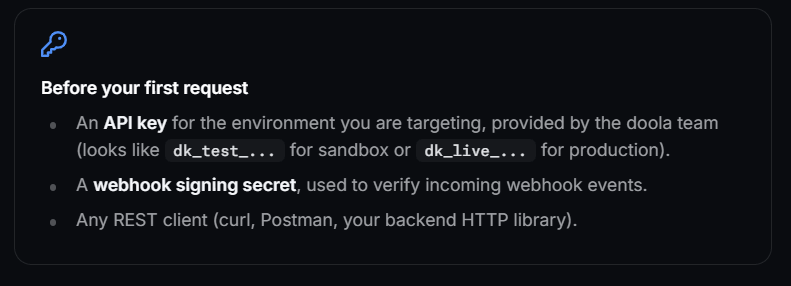
doola separates sandbox and production with environment-scoped API keys: dk_test_ for sandbox, dk_live_ for production, making credentials immediately identifiable and reducing the risk of accidental cross-environment usage.
Our model follows the same standard convention used by Stripe and adopted across modern developer platforms. So your engineers don’t need to learn a new credential model; they can use the same patterns they already rely on for storage, scoping, rotation, and environment management.
Testing
Both providers have a non-production environment. CorpNet documents a staging environment with its own distinct keys, separate from production at api.staging24.corpnet.com.
The difference is what you can do inside it. doola’s sandbox at api.test.doola.com includes two sandbox-only endpoints that complete the formation and EIN milestones on demand and fire the real webhooks while doing it.
That means your CI can exercise the entire entity lifecycle, including the asynchronous parts, in minutes.
CorpNet doesn’t document an equivalent capability. As a result, validating the latter half of an integration typically depends on waiting for real-world filing events.
Event Flow
This is the sharpest technical gap, and CorpNet states it plainly in their own FAQ: webhooks are not currently supported, order status requires polling Get Full Order Details, and webhook support is on the roadmap.
Now, formation is an inherently asynchronous workflow. State filing offices operate on their own timelines. The IRS operates on another.
So, building on polling means writing and maintaining a scheduler, deciding on backoff, and accepting that your users learn about their own company’s status on your cron interval.
doola pushes signature-verified webhooks on every status change, verified against your signing secret, covering formation filed, formation completed, registered agent assigned, and EIN issuance.
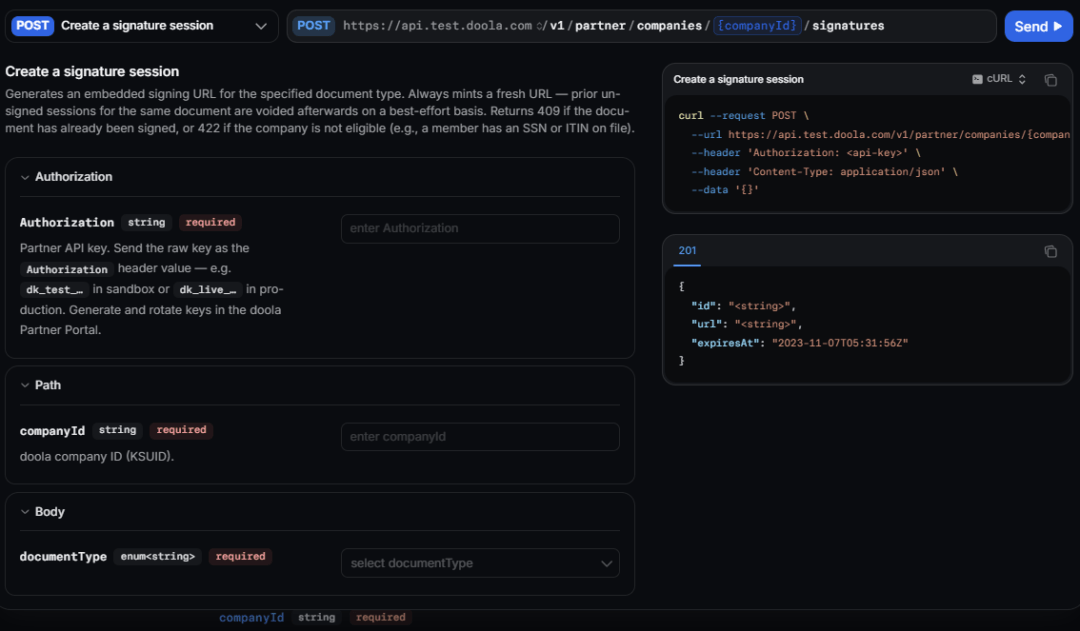
Important Note: Our documentation explicitly states “do not poll,” which is the whole design philosophy that captures the architecture.
Safety and Predictability
doola requires an Idempotency-Key header on every create endpoint. Retrying the request with the same key and body safely produces the same outcome and nothing double-files.
Reusing a successful key with a different payload returns a predictable and clean 409 E_IDEMPOTENCY_KEY_REUSED instead of accidentally creating duplicate entities.
Every error also includes a machine-readable code, allowing integrations to branch on structured responses rather than parsing free-form messages.
CorpNet’s documentation does not describe idempotency keys, and its authorization guide advises partners not to rely on error strings but to branch on HTTP status codes instead, noting that the error body shape varies by endpoint family.
To its credit, CorpNet’s FAQ is candid about a handful of integration realities worth budgeting engineering time for:
- Responses arrive as JSON-encoded strings that clients must double-decode, sometimes with a text/plain content type
- A GET on a non-existent order returns 400 rather than 404, with a body that says success and a null payload
Because the backend runs on Salesforce with async triggers, a GET immediately after a create can return null for fields the spec marks required, with a suggested retry after about 30 seconds.
CorpNet’s FAQ is also forthcoming about the realities of integrating with the platform: the edge cases, implementation quirks, and operational realities partners should expect. It’s also a practical estimate of where your engineering team is likely to spend its first integration sprint.
doola’s architecture reflects a different priority and starts from a different premise.
Environment-scoped keys, a production-grade sandbox, signed webhooks, idempotent requests, and machine-readable errors are built into the platform from the outset because they’re the patterns modern engineering teams expect from infrastructure they depend on.
That’s the architectural difference this comparison has been building toward.
One of these APIs was designed on the assumption that software would be the customer. The other was designed to let software place orders with a service bureau.
CorpNet treats APIs as an extension of its filing business. doola built its filing business around APIs.
Divergence Three: Day-two Compliance, Documents vs. Dollars
CorpNet defines compliance as document fulfilment: annual reports, licenses, registrations, BOI filings, all filed correctly and on time, with alerts and subscription management exposed through a Compliance API. That is valuable work and CorpNet is good at it.
doola’s definition of compliance includes the financial layer that keeps a company alive after the certificate arrives:
- IRS tax filings, including Form 5472 with a pro forma 1120 for foreign-owned single-member LLCs. This is the single most expensive trap for international entrepreneurs.
The penalty starts at $25,000 per form per year (applies even to an LLC with no revenue and no activity).
- Bookkeeping through O Auth, so those filings rest on books that were maintained all year.
- Banking access through doola’s partners, so the entity can actually receive revenue.
- Registered agent and state annual filings, matching CorpNet on the fundamentals.
For a platform, this changes the economics: it’s the difference between reselling documents and reselling a complete financial operating system.
Document filings offered by CorpNet generate one-time revenue, which is definitely great.
doola’s bookkeeping, tax, and compliance subscriptions, on the other hand, are recurring revenue attached to every entity you form, under your brand, with churn tied to the life of the business rather than the length of a filing queue.
Divergence Four: Where Formation Gets Bought Next
The biggest difference between doola vs. CorpNet didn’t exist until 18 months ago. And this final contrast reflects where this market is heading rather than where it has been.
doola runs a formation MCP live in Claude, ChatGPT, Replit, Lovable and Vercel. An entrepreneur describing their idea to an assistant can form the company inside that same conversation, without leaving to complete it somewhere else.
Formation stops being something an agent recommends and becomes something an agent executes.
The same infrastructure is available as a direct API integration.
- Ramp for Agents uses doola’s Formation API to run the incorporation step inside its single-prompt flow, so an entrepreneur can incorporate, apply for Ramp, and stand up a finance stack in one instruction.
- Whop uses doola’s Formation API to handle state incorporation filings, registered agent assignment, and EIN acquisition asynchronously without leaving Whop interface.
- Naïve uses doola so that autonomous agents can form entities on behalf of the operators building on top of them.
CorpNet has not published an equivalent offering as a part of their official documentation. If your product surface is a chat interface, an agent, or a builder tool, this is a key integration rather than another differentiator in your stack
The Verdict
Choose CorpNet if you’re an accounting, legal, or payroll firm serving primarily US clients; you need employer or payroll tax registration, business license fulfilment, or nonprofit filings; and you’re looking for a reseller program backed by an experienced human operations team.
On those requirements, CorpNet is the natural fit.
For a broader look at how doola compares to other formation services, see doola vs. alternatives →
If your users include entrepreneurs outside the US, your engineers expect modern API conventions, your business depends on recurring bookkeeping and tax revenue, or your product lives inside AI agents and developer tools, doola is the platform those requirements were built around.
FAQs

Can CorpNet form a company for a founder without an SSN?
Not through a documented API path. CorpNet’s integration guidance assumes an SSN will be collected from the responsible party through CorpNet’s own portal after order submission.
If you need a published no-SSN flow, doola documents one, including the SS-4 signature step and expedited EIN handling.
Does CorpNet support webhooks?
Not currently. CorpNet’s API FAQ states that order status updates require polling and that webhook support is on the roadmap. doola delivers signature-verified webhooks on every status change today.
Is doola or CorpNet cheaper?
Neither publishes partner pricing. CorpNet publishes its discount structure (wholesale from 20% off retail, referral from 20% of net revenue, both scaling toward 30% and beyond with volume) but not the underlying rates.
doola quotes wholesale rates against your projected volume, and white-label partners set their own retail pricing with no cap on markup.
Compare landed cost per entity alongside the recurring compliance revenue each model lets you keep. Headline discount percentages will mislead you on both counts.
Which one is more secure: doola or CorpNet?
CorpNet holds SOC 2 Type II attestation covering security, availability, and confidentiality, independently audited by Insight Assurance, and enforces TLS 1.2 or higher.
doola encrypts data in transit and at rest with layered access controls, and white-label partners get a dedicated agreement covering data handling before production keys are issued.
If SOC 2 documentation is a hard procurement gate for you, ask both teams for current documentation, including ours.
How long does integration take?
doola partners typically go live within 48 hours of the integration being built, and the sandbox milestone-simulation endpoints mean you can validate the full lifecycle before that.
CorpNet does not publish an integration timeline; ask your account manager, and budget time for the polling layer and the response-parsing details in their FAQ documents.
Can I use both?
Yes, and some platforms should. If you need Employer Payroll Tax Registration for US employers alongside global formation with day-two tax compliance, running doola for formation and compliance and CorpNet for payroll registration is a defensible architecture.
Talk to both teams and be candid with each about the split.